Real rides. Real notes. No hype.

Suspension fork vs no suspension e-bike—this guide explains when suspension improves comfort and control, when it wastes energy, and who should skip it.
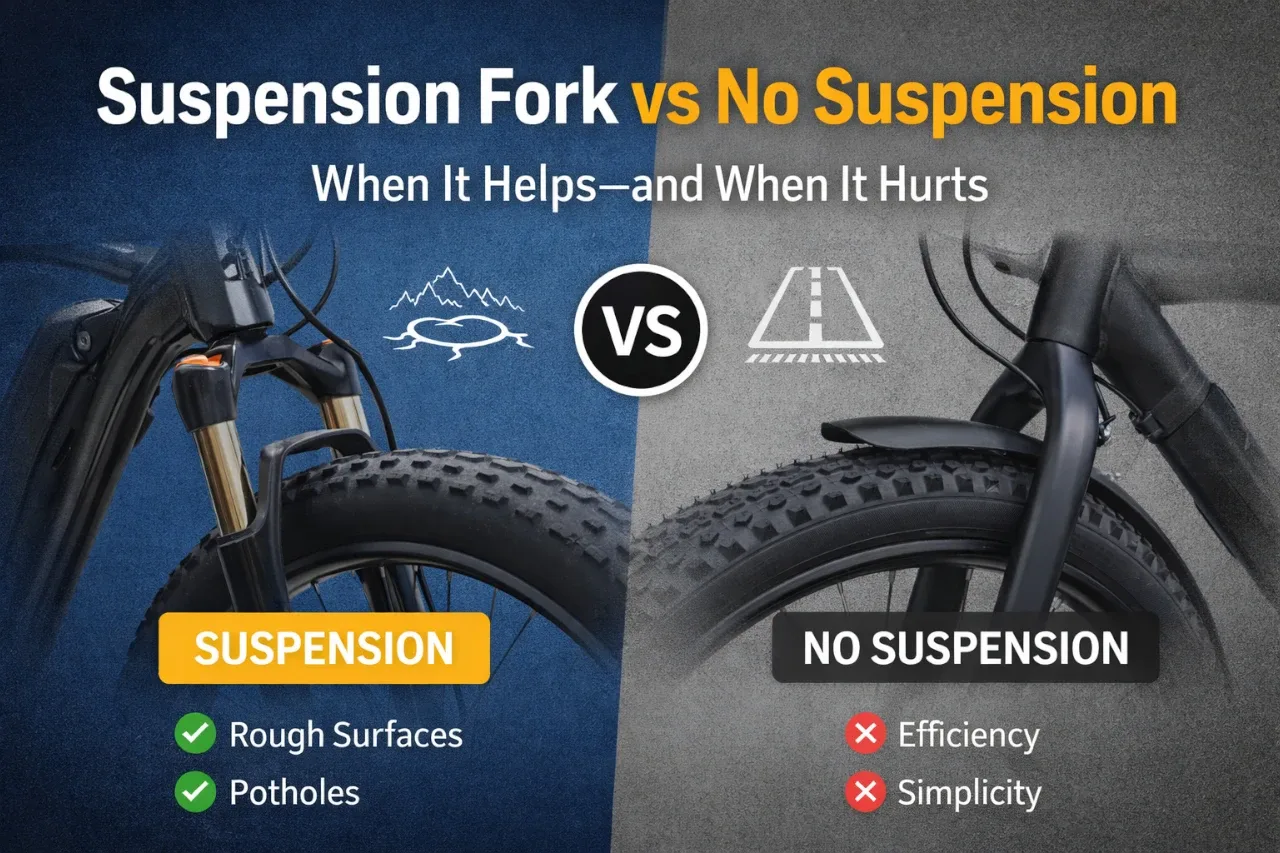
If you’re shopping for an e-bike, front suspension is one of those features that sounds like an automatic upgrade—until you live with it. I’ve ridden plenty of e-bikes with budget coil forks, decent air forks, and rigid forks paired with bigger tires. The truth is simple:
A suspension fork can make a bike safer and more comfortable in the right conditions.
But on many commuter-style e-bikes (especially value models), it can also add weight, maintenance, wobble, and “fake comfort” that doesn’t actually fix the real problem.
Choose a suspension fork if you ride rough pavement, potholes, broken sidewalks, hardpack/gravel, or you want better control at speed—and the fork is at least decent quality or properly tuned.
Choose no suspension (rigid fork) if you ride mostly smooth roads, care about low maintenance, want sharper steering, or you’re buying a value e-bike where the “suspension” is likely the cheapest part of the build.
My rule of thumb:
| Category | Suspension Fork | No Suspension (Rigid Fork) |
|---|---|---|
| Comfort on rough pavement | ✅ Big improvement (if tuned) | ⚠️ Depends on tires/pressure |
| Control over potholes/gravel | ✅ Better traction & stability | ⚠️ More arm fatigue, more deflection |
| Steering feel | ⚠️ Can feel vague/“floaty” | ✅ Direct, predictable |
| Weight | ❌ Heavier | ✅ Lighter |
| Maintenance | ❌ Seals, bushings, stanchions, play | ✅ Minimal |
| Long-term reliability | ⚠️ Quality-dependent | ✅ Very high |
| Value on budget e-bikes | ⚠️ Often low (cheap forks) | ✅ Usually higher |
| Best for | Rough roads, mixed surfaces, higher speeds | Smooth commuting, simplicity, low upkeep |
A front suspension fork is designed to absorb sharp impacts so the front wheel stays in contact with the ground longer, instead of bouncing and skittering. That can mean:
But suspension does not automatically fix:
Also, on many e-bikes, “front suspension” often means a basic coil fork with minimal damping. That’s where the “hurts” part begins.
If your commute includes cratered asphalt, broken concrete seams, or constant curb cuts, a decent fork reduces repeated impacts that beat up your wrists and hands.
Real-world effect: you stay relaxed longer, you’re less likely to tense up, and your line through rough spots is steadier.
This matters more than people think. On rough pavement, rigid forks can cause the front tire to “chatter” during braking. Suspension can keep the tire planted longer, which helps you slow down in a straighter line.
Translation: better stability during “oh crap” stops on bad roads.
If you use your e-bike like a do-everything machine—commute weekdays, trail path weekends—front suspension is a comfort and control upgrade.
It won’t turn an e-bike into a mountain bike, but it can make light off-road riding feel calmer and more predictable.
Heavier e-bikes (especially fat tire models) carry more momentum. When the front end hits an edge at speed, suspension can reduce that harsh “kick” that unsettles the bike.
This is where suspension can feel like a safety feature, not just comfort.
If you already know your hands go numb or your wrists complain, a properly tuned fork is one of the few upgrades that can genuinely reduce impact stress—especially combined with correct tire pressure.
Budget forks often have:
Result: the front end can feel mushy in turns, less stable at speed, and less confident under braking.
If you’ve ever felt a bike’s front end “float” or “wander,” a low-quality fork is a common culprit.
A suspension fork adds weight exactly where you feel it most—at the front end. This matters when:
On a commuter e-bike, that extra weight often delivers less benefit than people expect.
If you like to pedal with effort, some forks compress slightly under load—especially when standing or accelerating. That movement can make the bike feel less efficient and less “snappy.”
Some forks have lockouts, but on many e-bikes the lockout is either missing or not very effective.
Rigid forks stay the same for years. Suspension forks slowly change:
Even if you’re not “servicing” it, you’re still paying the maintenance cost—just later, in handling and noise.
I see this constantly: riders buy suspension because the ride is harsh, but the real fix is:
If the bike is harsh because the tires are rock hard, suspension won’t feel like the miracle you want.
Important nuance:
A bad suspension fork can be less safe than rigid because it can introduce wobble, unpredictable dive, and looseness over time.
So the “safe” choice depends on fork quality + your riding environment.
Before you spend money or prioritize suspension, do these first:
For many commuters, a rigid fork + correct tire setup beats a cheap suspension fork every day.
You don’t have to be a bike mechanic, but you do need to:
If you hate maintenance: rigid is the smarter long-term choice.
Choose Suspension Fork if you check 3 or more:
Choose No Suspension (Rigid) if you check 3 or more:
Tie-breaker:
If you’re 50/50, I’d rather see you buy rigid and invest in tires + pressure + contact points, because the benefits are more guaranteed.
Is suspension necessary on an e-bike?
No. It’s beneficial for rough surfaces and higher-speed stability, but many commuters are better served by rigid forks with correct tire setup.
Are suspension forks on budget e-bikes worth it?
Sometimes, but often they’re the weakest part of the build. If the fork has poor damping and develops play, rigid may be the better long-term value.
What’s better for comfort: suspension fork or fat tires?
For pure comfort at typical city speeds, fat tires at the right pressure can do a lot. Suspension helps more with sharp impacts and control.
Does suspension reduce flats?
Not directly. Tire choice, pressure, and puncture protection matter far more.
Does suspension make handling worse?
A good fork won’t. A cheap fork can—especially if it’s underdamped or gets loose over time.
Should I get suspension for hills?
Suspension doesn’t help climbing power. If anything, bobbing can slightly reduce efficiency. Hills are mostly about motor tuning, gearing, and weight.
What if I only want a smoother ride?
Start with tire pressure, then consider a suspension seatpost. Those usually give a bigger comfort win per dollar for commuters.
What’s the simplest “safe” choice?
If you don’t know fork quality and you ride mostly pavement: rigid is the safe bet.
Suspension forks shine when your real life includes sharp impacts, imperfect braking surfaces, mixed terrain, and higher-speed stability needs. In those cases, the comfort is real—and the control is a genuine upgrade.
But if your riding is mostly smooth commuting and you’re buying a value e-bike, a rigid fork often rides cleaner, steers more predictably, weighs less, and stays reliable for years—especially once tire pressure and tires are dialed in.