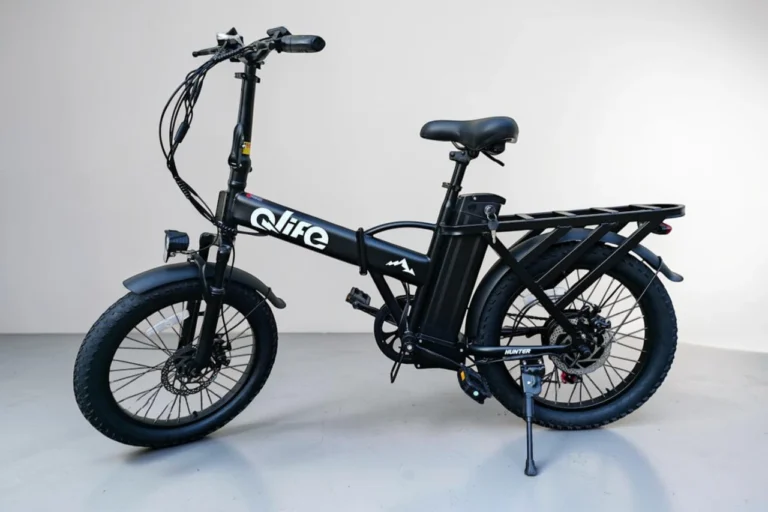
Ridstar Q20 Electric Bike — 1500W Fat-Tire Mini Moto
Our take: a brutally strong 1500W motor, big 48V 20Ah battery and fat tires make the Q20 a budget-friendly rocket for streets, trails and sand.
- 1500W rear hub motor and 48V 20Ah battery deliver 30+ mph bursts and strong hill-climbing.
- Dual suspension and 20×4" fat tires smooth out potholes, dirt tracks, sand and snow.
- Hydraulic disc brakes, bright moto headlight and 330 lb load rating inspire confidence.
- Motor
- 1500W rear hub
- Battery
- 48V 20Ah (960Wh)
- Top Speed
- ≈30 mph (unlocked)
- Real Range
- ≈30–50 mi mixed
The Ridstar Q20 is one of those bikes you notice immediately.
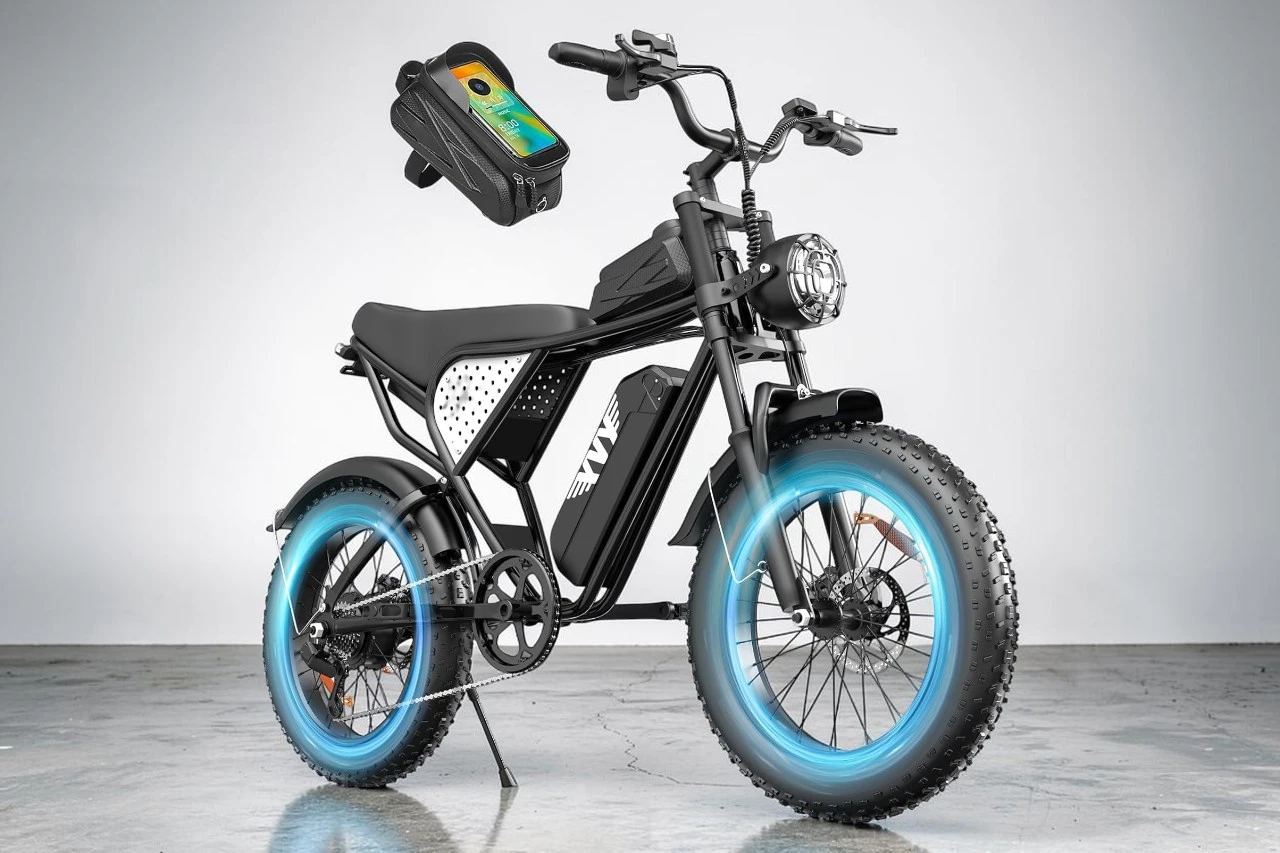
Between the moto-style frame, oversized 20" x 4" fat tires, and that huge battery sitting in the middle of the frame, it looks more like a compact electric motorcycle than a traditional bicycle.
On paper it promises a lot: a 1500W rear hub motor, a big 48V 20Ah battery, claimed speeds around 30–33 mph, dual suspension, and hydraulic disc brakes – often selling around the mid-$600 range on Amazon when on promotion. That spec sheet would have been reserved for premium e-bikes not long ago.
This review walks through what the Q20 is really good at, where it cuts corners to hit that price, and which riders will genuinely enjoy living with it.
Quick Verdict
The Ridstar Q20 is a powerful, budget-friendly fat-tire e-bike that behaves more like a small electric dirt bike than a polite city commuter. If you want serious punch for steep hills, soft terrain, or just fast blasts on back roads, it offers huge motor power and a big battery for the money.
In return, you accept some trade-offs: it’s heavy, only comes in one frame size, and out of the box it can easily exceed the legal e-bike limits in many areas, so you’ll likely need to limit the speed in the settings if you want to stay street-legal.
At a Glance
- Category: Moped-style / fat-tire all-terrain e-bike (effectively “off-road / unclassified” until you limit top speed)
- Motor: 1500W rear hub, approx. 80–85 Nm torque
- Battery & Range: 48V 20Ah (960Wh) removable pack; up to ~50 miles throttle / 75 miles PAS claimed, realistic 30–50 miles for most riders
- Top Speed: Claimed up to ~30–33 mph in unlocked mode
- Weight & Payload: ~66 lb bike, 330 lb max load (bike + rider + cargo)
- Tires: 20" x 4.0" puncture-resistant fat tires for sand, snow, gravel, and city streets
- Suspension: Dual suspension – front fork + rear shock
- Brakes: Dual hydraulic disc brakes, 180 mm rotors
- Best For: Riders who value raw power, off-road fun, and hill-climbing more than light weight or stealthy “bicycle” looks
| Preview | Product | Price | |
|---|---|---|---|
|
|
Ridstar Electric Bike for Adults, 1000/2000W, 25/30/37MPH,48V-52V, 20AH,40AH Battery, Max 50-180... | $649.00 $569.00 | View on Amazon |
What Is the Ridstar Q20?
The Ridstar Q20 sits in the rapidly growing “moto-style” fat-tire e-bike category – bikes that look and feel like mini electric motorcycles but still have pedals and a bicycle drivetrain.
Instead of a step-through or traditional diamond bicycle frame, the Q20 uses a long saddle and straight top bar reminiscent of small dirt bikes. Combined with 20" x 4" fat tires and full suspension, it’s clearly aimed at riders who want something fun and rugged rather than a delicate city commuter.
Ridstar as a brand focuses heavily on high-power, value-oriented e-bikes. Their range includes the Q20 Lite (1000W) and Q20 Pro (dual-motor 2000W) above and below this model in power and price. The Q20 1500W version is positioned as the sweet spot: more punch and range than the Lite, but simpler and cheaper than the dual-motor Pro.
In short, the Q20 is designed for riders who want motorcycle-like acceleration and off-road capability without paying motorcycle money.
Key Specs
| Spec | Detail |
|---|---|
| Motor | 1500W brushless rear-hub motor, ~80–85 Nm torque |
| Battery | 48V 20Ah (960Wh) removable lithium pack, UL-focused marketing, BMS protection |
| Claimed Range | Up to 50 miles pure electric, 75 miles pedal assist under ideal conditions |
| Realistic Range (most riders) | Roughly 30–50 miles depending on speed, rider weight, terrain, and PAS level |
| Top Speed | Claimed ~30–33 mph when fully unlocked and fully charged |
| Bike Class | Effectively “unclassified / moped-style”; can be speed-limited in settings to behave more like Class 2/3 in some regions |
| Weight / Payload | Approx. 66 lb bike; 330 lb maximum load (rider + cargo) |
| Frame & Size | High-step, moto-style frame, high-tensile steel construction |
| Rider Height Range | Recommended ~5'4"–6'2" (5'4"–6'4" on some official spec sheets) |
| Brakes | Front & rear hydraulic disc brakes, advertised shorter stopping distance vs mechanical systems |
| Drivetrain | Shimano 7-speed derailleur |
| Suspension | Front suspension fork + rear shock (dual suspension) |
| Tires | 20" x 4.0" fat tires with puncture-resistant casing |
| Display & Controls | Backlit LCD, PAS levels, battery indicator, odometer, and speed readout |
| Lights & Accessories | Integrated motorcycle-style headlight, rear light, phone holder, USB charging port, storage box |
Who Is the Ridstar Q20 Best For?
Ideal For
- Riders who want power first. If your priority is hill-climbing and quick acceleration rather than gentle exercise, the 1500W hub motor will make you smile.
- Mixed-terrain commuters and weekend explorers. Fat tires, dual suspension, and a fairly long range mean you can commute on weekdays and hit gravel, dirt, or beach paths on weekends.
- Heavier riders. With a 330 lb load rating and a strong frame, the Q20 is more forgiving for bigger riders than many skinny-tire city e-bikes.
- People who like moto-style aesthetics. Some buyers want their e-bike to look like a motorcycle. If you want something that stands out and feels substantial, the Q20 fits that vibe.
Not Ideal For
- Riders under about 5'4". The standover height and saddle position can feel tall and stretched for shorter riders, especially since the frame is one-size-fits-most.
- Those who need a lightweight bike. At ~66 lb, lifting it up stairs or onto a car rack is a workout.
- Strictly regulated Class 1 / Class 2 trail use. Many shared trails limit bikes to 20 mph and lower wattage. You can limit the speed, but some rangers may still frown at a 1500W fat-tire “moto” frame.
- Riders who dislike motorcycle ergonomics. The long seat and straight top tube put you in a slightly more moto-like posture. If you want a traditional upright bicycle feel, a step-through city e-bike will be more natural.
Budget & Value Positioning
The Q20 is very much a high-power budget bike. Official brand sites often list it around US$1,100–1,300, but big-box and marketplace promotions frequently drop it closer to the mid-hundreds – which is where it becomes extremely compelling.
To hit that aggressive price while still offering a big motor and battery, Ridstar trims costs in areas like weight, refinement, branding, and some components. The frame is sturdy rather than light; the display and controls are functional but basic; and customer support isn’t on the same level as premium brands. If you go in expecting a fun, hot-rod value machine rather than a polished “lifestyle” e-bike, you’ll be much happier.
Design, Frame & Build Quality
Visually, the Ridstar Q20 is bold. The black frame, long bench seat, angular battery enclosure, and oversized headlight immediately give off electric-motorcycle energy. If you want to be anonymous on the bike path, this is not the bike for you.
Frame & Geometry
The high-tensile steel frame (on the Amazon-marketed variant) uses a long, flat seat and compact wheelbase. It’s more like a small dirt bike than a traditional hardtail MTB. There’s no step-through, so you swing a leg over the saddle or mount from the side.
The upside of this layout is:
- Stiffness and stability. The frame feels solid and planted when you’re riding fast or over rough ground.
- Room to slide. The bench seat lets you shift forward for more aggressive cornering or slide back for comfort on straight sections.
The downside is:
- Tall standover. Shorter riders may struggle to straddle the bike comfortably.
- Single size. You can adjust seat height somewhat, but there’s no separate frame sizing or adjustable stem, so very tall riders may still feel a bit compact.
Finish & Details
Paint and welds are typical of value-priced e-bikes: not boutique-level smooth, but generally tidy. Cable routing is semi-internal; you’ll see some external wiring around the head tube, but it’s reasonably managed and zip-tied out of the way.
The large motorcycle-style headlight and perforated side panels help the bike stand out. They’re a bit “showy,” but that’s the point. If you want understated, this isn’t it.
The included phone mount and storage box are surprisingly useful. The phone holder fits most modern smartphones, and the box is just right for a charger, small lock, or a few tools and snacks.
Motor Performance & Speed
This is where the Ridstar Q20 earns its reputation.
Acceleration & Throttle Feel
With a nominal 1500W brushless hub motor and roughly 80–85 Nm of torque, the Q20 launches with authority.
- Throttle mode: Twist the throttle and the bike surges forward quickly, especially from 0–20 mph. For riders not used to powerful e-bikes, it can feel a bit abrupt, so it’s worth familiarizing yourself in an open area first.
- PAS (Pedal Assist): Pedal assist layers motor power on top of your pedaling. Lower PAS levels keep things mellow, while higher levels feel almost like a small electric motorcycle with pedals mostly there for legal reasons.
If you’re commuting in busy areas, you’ll probably want to stay in lower PAS levels or configure the controller to soften initial throttle response where possible.
Cruising & Top Speed
Ridstar advertises speeds of around 30–33 mph when the Q20 is fully unlocked and the battery is freshly charged. In practice, speed will depend heavily on rider weight, incline, and wind, but it’s safe to say the bike is far faster than a typical Class 2 20-mph e-bike.
For many riders, a comfortable cruising speed will be in the 20–26 mph range. At those speeds the bike feels stable, and you’re not draining the battery as violently as you would at full tilt.
Legal note: In many areas, anything that goes over 20 mph on throttle or 28 mph on assist is no longer considered a standard e-bike. It’s up to you to ensure your settings and riding locations comply with local rules.
Hill-Climbing
The Q20’s torque and gearing make short work of moderate hills. On ~8–10% grades, riders can usually maintain mid-teens mph just using throttle, and steeper pitches become manageable with pedal assist.
It’s not a dedicated mid-drive mountain goat, but for urban hills, rolling countryside, and off-road climbs up to the 25–30° range suggested in the marketing, it’s far more capable than lower-powered commuter bikes.
Motor noise is present but not obnoxious – that typical faint electric whir rather than a loud mechanical grind.
Turn Every Ride Into an Adventure
From city streets to sand and snow, the Ridstar Q20 gives you 30+ mph thrills, long-range comfort, and serious stopping power.
Battery, Range & Charging
The heart of the Q20 is its large 48V 20Ah battery – roughly 960Wh of capacity. That’s significantly bigger than the 48V 12–15Ah packs common on many mid-priced e-bikes.
Claimed vs Realistic Range
Ridstar and major retailers tout:
- Up to 50 miles in pure electric (throttle) mode
- Up to 75 miles in pedal-assist mode under ideal conditions
Those numbers assume a relatively light rider, steady moderate speeds, and low PAS levels on mostly flat ground.
In the real world, with mixed terrain, stop-and-go riding, and higher PAS levels, most riders should expect something more like:
- 30–40 miles of spirited riding with a lot of throttle
- 40–50+ miles if you consciously ride in lower PAS levels around 15–18 mph and contribute decent pedaling effort
The big takeaway: even when ridden hard, the Q20’s battery is generous enough for most daily commutes and extended weekend rides without range anxiety.
Battery Design & Charging
- Removable pack: The battery slides out of the frame, allowing you to charge it indoors. It locks in place with a key to deter casual theft.
- Charging time: Marketing materials list around 4–8 hours depending on charger and remaining capacity.
- Safety: Some listings highlight UL2849 compliance and BMS (battery management system) protections for over-charge, over-discharge, and short circuits.
There have been occasional owner reports online of batteries or power systems cutting out unexpectedly, as with many budget e-bikes; this seems more like quality control variability than a fundamental design flaw, but it’s worth checking your unit thoroughly within the return window.
Ride Comfort & Handling
Comfort
Despite its aggressive look, the Q20 is surprisingly comfortable once you’re on board.
- Riding position: The long bench seat and mid-height handlebars give a semi-upright stance – not as bolt-upright as a Dutch city bike, but far from a racing crouch.
- Seat: The saddle is thicker and wider than typical MTB saddles, matching the moped styling. It’s firm enough not to feel mushy but has enough padding for longer rides.
- Suspension:
- The front fork absorbs potholes, roots, and curbs reasonably well.
- The rear shock helps smooth out chatter from rough trails and gravel roads. It’s not a high-end MTB suspension system, but for a budget fat-tire bike it does a good job of protecting your back and wrists.
- Fat tires: Running 20" x 4.0" tires at moderate pressures (e.g., 12–18 psi off-road, 20–25 psi on pavement) adds a big layer of plushness.
On long rides, most riders will find the combination of suspension and fat tires significantly more forgiving than a rigid city bike or narrow-tire hybrid.
Handling & Stability
The Q20’s handling is dominated by three things: short wheelbase, fat tires, and weight.
- At low speeds it’s fairly nimble; the small wheels and short wheelbase make tight turns and U-turns straightforward once you’re used to the weight.
- At higher speeds (20–30 mph) it feels planted as long as tire pressures are appropriate. The long seat lets you shift your weight slightly to keep the front end stable.
- Off-road: On gravel, dirt, and even light sand or snow, the fat tires and traction make the bike feel secure. You can float over loose material that would unsettle a skinny-tire commuter.
The main handling caution is simply remembering the weight. Aggressive last-second swerves or emergency maneuvers require more commitment than on a 40-lb city e-bike.
Brakes & Safety Features
A fast, heavy bike absolutely needs good brakes, and this is an area where the Ridstar Q20 stands out relative to many similarly priced competitors.
Hydraulic Disc Brakes
The bike comes with dual hydraulic disc brakes front and rear. Compared with mechanical discs, hydraulics provide:
- Lighter lever feel
- Stronger clamping force for the same finger effort
- More consistent performance in wet conditions
Ridstar and major retailers highlight shorter stopping distances versus mechanical brakes, and owner feedback generally supports that claim – provided the brakes are bedded in correctly and kept in good condition.
For such a powerful bike, hydraulics are not a luxury; they’re close to essential.
Tires & Traction
The 20" x 4.0" fat tires give abundant grip on:
- Wet pavement
- Gravel and dirt
- Hard-packed sand and snow
Because you can run them at low pressure, they deform and grab the terrain instead of skipping across it.
Lighting & Visibility
- Front: A large motorcycle-style LED headlight mounted on the fork crown. It’s bright enough for urban night riding and makes you highly visible to oncoming traffic.
- Rear: Integrated tail light with brake-light functionality on many Q20 packages.
- Reflectors: Wheel and pedal reflectors add passive visibility.
Add in the sheer visual presence of the bike and you’re unlikely to go unnoticed in traffic – a safety benefit in its own right.
Controls, Display & Riding Modes
Display & Controls
The Q20 uses a backlit LCD mounted near the center of the handlebar. It typically shows:
- Current speed
- PAS level
- Battery bar and voltage
- Trip and total mileage
- Basic error codes if something goes wrong
On the left bar you’ll find the control pad for power and PAS level changes; on the right grip is the twist throttle. The layout is fairly standard and easy to learn within a ride or two.
Riding Modes
Ridstar advertises three riding modes:
- Pure Electric (Throttle-Only) – Twist the throttle and ride without pedaling. This is where you feel the full strength of the 1500W motor, but it drains the battery fastest.
- Pedal Assist (PAS) – The controller adds power when you turn the cranks. With multiple PAS levels, you can choose anything from mild assistance to near-moto behavior.
- Pedal-Only (No Assist) – You can ride with the power off, but given the bike’s weight and fat tires, this really is an emergency-only mode.
PAS tuning on budget e-bikes can sometimes be a bit “jumpy.” On the Q20, lower PAS levels are reasonably smooth; higher levels deliver very strong assistance, which is thrilling but may require a light touch in close traffic.
Extra Features
- USB charging port: Handy for topping up a phone or GPS on the go.
- Phone holder: Simple but functional; great if you like running navigation or fitness apps.
- Walk assist / cruise: Depending on the controller firmware, you may have walk-assist or basic cruise control – helpful for pushing the heavy bike up ramps or keeping a steady speed on long stretches.
Fit, Sizing & Adjustability
Ridstar recommends the Q20 for riders roughly between 5'4" and 6'2"–6'4".
Key points:
- Seat height: Adjustable, but the long bench design means you adjust more for reach and comfort than perfect leg extension. Many riders compromise slightly on textbook saddle height for overall comfort and easier foot-down stops.
- Reach: The handlebar position suits medium to slightly tall riders best. Very tall riders may feel a touch cramped unless they install a higher or longer stem.
- Standover: At around 33" standover, shorter riders may need to lean the bike slightly when stopped.
If you’re near the lower end of the height range or have limited mobility, a step-through frame from another model may feel much more friendly. But for average-to-tall riders who like the moto style, the fit is generally comfortable after a few small adjustments.
Assembly & Out-of-the-Box Experience
Like most direct-to-consumer e-bikes, the Ridstar Q20 ships partially assembled.
Expect:
- The frame, rear wheel, and drivetrain pre-assembled
- You install the front wheel, handlebar, pedals, headlight, and front fender, and attach accessories like the phone holder and storage box
- Basic alignment of brakes and gears may be required
For someone reasonably handy with basic tools, assembly usually takes around 45–90 minutes. Ridstar includes the necessary hex keys and wrenches along with a manual; there are also various third-party YouTube videos walking through assembly of similar bikes.
If you’re new to bike wrenching, it’s worth having a local shop do a quick safety check – especially on the brakes and axle nuts – after you’ve finished.
What’s Included in the Box?
In a typical Ridstar Q20 package you’ll find:
- Ridstar Q20 e-bike (about 90% pre-assembled)
- 48V 20Ah removable battery
- 48V charger (usually 2A–3A)
- Phone holder (about 7.2" diagonal)
- Storage box mounted within the frame
- Front and rear fenders
- Integrated front headlight and rear light
- Pedals
- Basic toolkit and user manual
Our Take on the Package
For a budget-oriented fat-tire bike, the accessory bundle is quite generous. You don’t need to immediately buy a headlight, tail light, or phone mount; even the storage box is more useful than it first appears. A rear rack isn’t standard, though, so if you plan to carry panniers or heavy cargo you may need to add an aftermarket rack that’s compatible with the frame.
Pros & Cons
| Pros | Cons |
|---|---|
| Very powerful 1500W motor with strong hill-climbing ability | Heavy (~66 lb) – not fun to carry upstairs or pedal unassisted |
| Large 48V 20Ah battery offers genuinely long range for the price | Only one frame size; not ideal for shorter riders under ~5'4" |
| Dual hydraulic disc brakes appropriate for the bike’s speed | Out-of-box top speed may exceed local e-bike laws unless limited |
| 20" x 4" fat tires and dual suspension handle varied terrain comfortably | Fit and finish are “good budget” rather than premium |
| Moto-style design with bright lighting and useful included accessories | |
| High 330 lb load rating suits heavier riders and gear |
How the Ridstar Q20 Compares to Alternatives
Ridstar Q20 Lite (1000W, 48V 15Ah)
The Q20 Lite is the lower-powered sibling:
- 1000W motor vs 1500W
- 48V 15Ah battery vs 20Ah
- Mechanical disc brakes vs hydraulic on many Q20 packages
- Often a bit cheaper
Choose the Q20 Lite if you like the styling but don’t need maximum power or range and want to save some money. Choose the 1500W Q20 if you’re heavier, live in hilly areas, or simply value performance.
Ridstar Q20 Pro (2000W dual motor, 52V 40Ah)
The Q20 Pro turns everything up:
- Dual 1000W motors (front + rear)
- Massive 52V 40Ah battery
- Even higher speeds and torque
It’s more expensive and heavier again, bordering on small e-moto territory. If you regularly ride very steep off-road trails or deep sand and snow, the extra traction and power can be worth it. For most riders, though, the single-motor Q20 offers plenty of performance while remaining a bit more manageable.
Other Fat-Tire Alternatives
In the broader market, bikes like the Heybike Mars / Mars 2.0, Engwe M20, or Aventon Aventure compete in overlapping price and spec zones. Many of them:
- Use 750–1000W motors instead of 1500W
- Offer more polished branding, dealer support, or app integration
- Sometimes come with smaller batteries at similar price points
You’d pick the Ridstar Q20 when raw power and value per watt-hour matter most, and you’re comfortable with a more direct-to-consumer ownership experience.
Common Questions About the Ridstar Q20
Is the Ridstar Q20 legal to ride in my city?
It depends on your local regulations. In many US states, standard e-bikes are limited to:
- Class 2: 20 mph with throttle and/or assist
- Class 3: 28 mph with pedal assist only
Because the Q20 can exceed those speeds and uses a 1500W motor, it may not strictly fit within the usual e-bike classes unless you limit the top speed through the controller settings. Always check local rules and adjust your bike accordingly.
How far can it really go on a single charge?
The official claim is up to 50 miles on throttle and 75 miles on PAS under ideal conditions. In everyday mixed riding with some hills and higher speeds, most riders should realistically plan on 30–50 miles per charge. If you cruise gently in low PAS and pedal a lot, you can push beyond that.
Can I ride it in the rain?
The Q20 is marketed as suitable for wet conditions, with sealed electrical components and waterproof lights. Light rain and wet roads are usually fine, but – as with any e-bike – it’s best to avoid deep puddles and high-pressure hose sprays, and dry the bike off after particularly wet rides.
Is it suitable for heavier riders?
Yes. With a 330 lb maximum load rating and a sturdy frame, the Q20 is well-suited to heavier riders or those carrying a backpack and gear. Just remember that higher weight will reduce both range and climbing speed somewhat.
How hard is it to maintain?
Basic ownership tasks – keeping the chain lubricated, checking tire pressure, and occasionally adjusting the derailleur and brakes – are similar to other e-bikes. Because the Q20 uses fairly standard components (Shimano drivetrain, common hydraulic brakes), most local bike shops can service it, though some may be cautious about working on high-speed e-bikes, so it’s worth calling ahead.
What about reliability?
Most owners report solid performance once the bike is set up correctly, but as with many budget brands, there are occasional reports of issues such as battery cut-outs or minor electrical faults. Buying from a retailer with a clear return window and registering your warranty with Ridstar is strongly recommended.
Final Verdict – Should You Buy the Ridstar Q20?
Score: 8.3 / 10 (for power-hungry value shoppers)
The Ridstar Q20 is not a delicate commuter bike, and it doesn’t pretend to be. It’s a high-powered, fat-tire machine built for riders who want serious acceleration, generous range, and the ability to shrug off bad roads, gravel tracks, and steep hills – all without spending premium-brand money.
You trade away low weight, ultra-refined fit and finish, and the dealer network that comes with big mainstream brands. You also need to be proactive about staying within legal limits by setting a reasonable top speed and riding responsibly.
If you’re looking for:
- A powerful fat-tire e-bike that can haul a heavier rider up steep hills
- A fun, moto-styled machine for mixed on-road and off-road use
- A bike with big-battery range at a relatively modest price
…then the Ridstar Q20 deserves a place very near the top of your shortlist.
If, on the other hand, you prioritize ultra-light weight, discreet styling, or strictly Class 1/2 compliance, a lighter 750W commuter or step-through bike from a more conservative brand will suit you better.
If you’re drawn to the idea of a compact electric “mini-moto” that can tackle city streets, dirt paths, and weekend adventures with equal enthusiasm, the Ridstar Q20 is a very compelling option.


![The Ultimate PHILODO Electric Bike Review ([year]): Which Model is Right for You? PHILODO Electric Bike Reviews](https://goebikelife.com/wp-content/uploads/2024/09/PHILODO-Electric-Bike-Reviews-768x512.jpg)
![Conquer Steep Hills: The 5 Best Electric Bicycles Tested & Ranked ([year]) Best Electric Bicycle for Hills](https://goebikelife.com/wp-content/uploads/2025/09/Best-Electric-Bicycle-for-Hills-768x512.jpg)