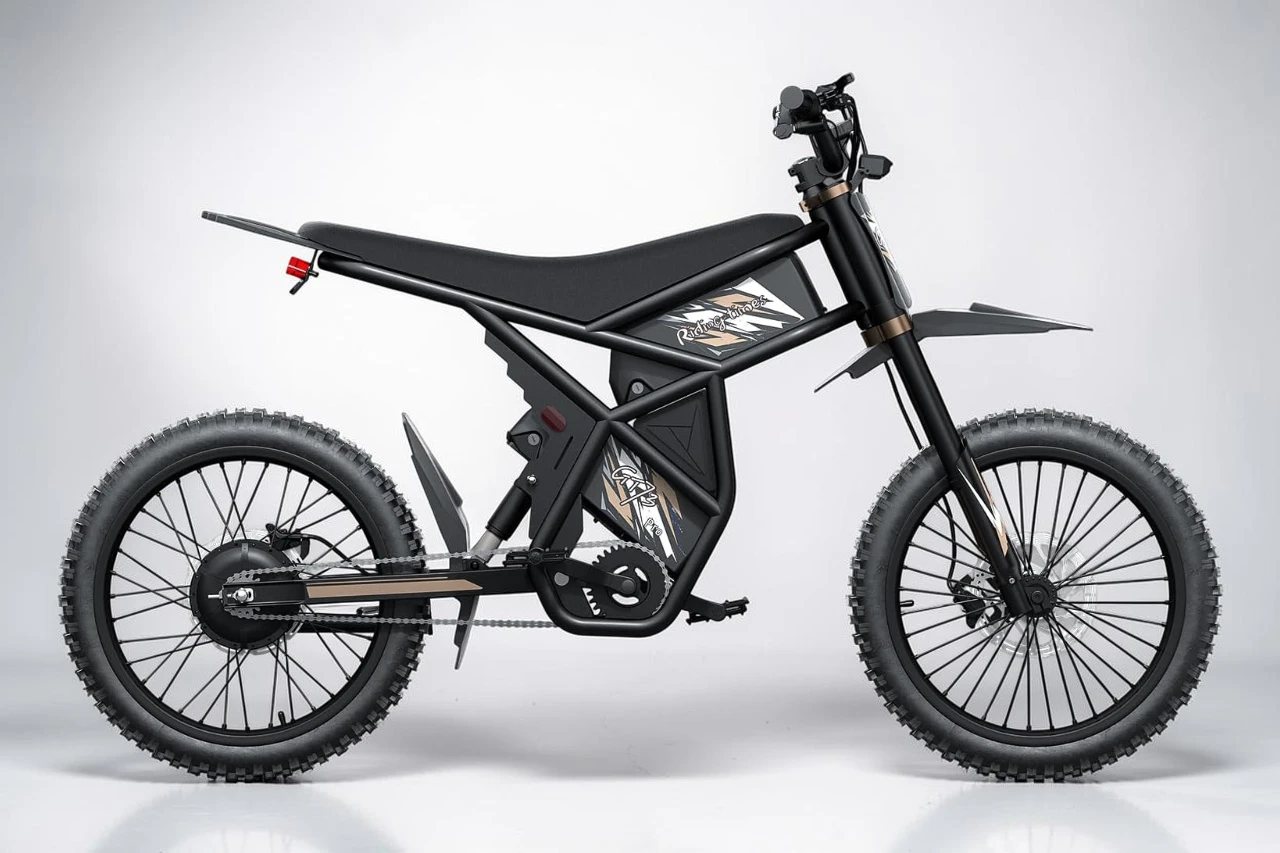
The Riding’times GT73 Pro makes a strong first impression on paper: a motor advertised at 3000W, two 60V batteries, full suspension, hydraulic brakes, and a dirt-bike silhouette. The headline that attracts the most attention is its claimed 50 mph top speed.
During our testing, the GT73 Pro’s most convincing qualities were its comfortable seat, smooth suspension, precise throttle response, and composed handling on light trails. We reached approximately 31 mph on GPS. Our battery checks also gave us an initial sense of range, although we did not complete a full battery rundown.
That leaves us with a clear recommendation: consider this version of the GT73 Pro for comfortable recreational riding in places where it is permitted, particularly if you value control more than aggressive acceleration. We would not choose it on the expectation of verified 50 mph performance.
Testing scope: This review covers our initial testing of the GT73 Pro configuration advertised at 3000W, including comfort, handling, acceleration, climbing, braking, and pedal assist. Our range estimate is preliminary, and we have not completed long-term durability testing.
Our Quick Verdict
The Riding’times GT73 Pro looks most appealing as a comfortable, throttle-focused recreational electric dirt bike. During our rides, its long padded seat, responsive suspension, and reassuring braking stood out most.
With approximately 200 lb onboard, we reached about 31 mph on GPS and climbed a hill we estimated at roughly a 15% grade at around 17 mph without pedaling. Acceleration was progressive, with a noticeable difference between Eco, Standard, and Turbo.
The trade-offs are substantial weight, limited usefulness as a pedal bicycle, and uncertainty around several advertised specifications. We would also confirm the exact version, equipment, and warranty with the seller before ordering.
For the right buyer, the comfort and control are persuasive. For someone seeking a lightweight commuter, efficient pedaling, or proven high-speed performance, we would look elsewhere.
What We Found in Our Tests
Here are the key results from our initial tests, along with the conditions and limits that matter when interpreting them.
| Area | Our test result | How we interpret it |
|---|---|---|
| Top speed with a rider | Approximately 31 mph on GPS; the bike’s display showed about 33 mph | The speed we achieved with this configuration; results may vary by rider and conditions |
| Unloaded wheel speed | Approximately 49 mph on the bike’s display | A wheel spinning without a rider does not establish riding speed |
| Sustained hill | Around 17 mph on a climb we estimated at roughly 15%, following a run-up | Capable climbing in this test; the grade was not independently surveyed |
| Acceleration over the same short section | About 13 mph in Eco, 20 mph in Standard, and roughly 21–23 mph in Turbo | Shows differences between modes; these were not timed 0–20 mph runs |
| Braking | A stop from approximately 28 mph finished before the chosen marker | Strong braking in our test; we did not measure the stopping distance in feet or meters |
| Pedal assist | Approximately 14–15 mph during the pedal-assist check | Pedaling delivered substantially less performance than the throttle |
| Battery observation | About 19–20 miles ridden, with three display bars dropping to two under throttle | A partial-charge observation, insufficient to establish total range |
What We Like—and What Gives Us Pause
What we like
- A long, cushioned seat that kept us comfortable after more than an hour of riding.
- Smooth suspension on gravel and mild dirt trails after the included replacement rear shock was installed.
- Precise throttle control at low speed and prompt response when more power was requested.
- Strong braking when we stopped from approximately 28 mph.
- Two removable batteries with a combined nominal capacity of 2160Wh.
- Little rattling or chain slap during our rides, plus useful lights and integrated storage.
What we would weigh carefully
- Our GPS top speed fell well below the advertised 50 mph figure.
- A complete range test was not finished, so neither the advertised range nor the roughly 40-mile projection was verified.
- Its listed weight makes stairs, lifting, and transport significant considerations.
- Short cranks and a single-speed drivetrain limit its appeal for active pedaling.
- The advertised brake rotor size differs from what we identified on our test bike; the exact diameter needs confirmation.
- The initial rear shock setup required attention before it provided suitable support.
Riding’times GT73 Pro Specifications
The table below combines the manufacturer’s specifications with our findings for the configuration we tested. Advertised figures are labeled separately from our test results.
| Specification | Details and qualification |
|---|---|
| Motor | Rear geared hub motor advertised at 3000W; continuous output was not independently established |
| Claimed torque | Up to 338 Nm; not independently measured during our tests |
| Batteries | Two removable 60V 18Ah packs |
| Combined capacity | 60V 36Ah, or approximately 2160Wh nominal |
| Advertised top speed | Up to 50 mph |
| Our GPS top speed | Approximately 31 mph with roughly 200 lb onboard |
| Advertised range | Up to 85 miles using the motor alone; up to 155 miles with pedal assist |
| Charging | Two 3A chargers listed; approximately six hours claimed when charging both packs together |
| Front suspension | Adjustable inverted hydraulic fork on our test bike |
| Rear suspension | We tested the included replacement rear shock, listed with a 1200-lb designation; see the setup discussion below |
| Brakes | Front and rear hydraulic discs with four-piston calipers on our test bike |
| Brake rotors | 230 mm advertised; the rotors on our test bike appeared to be 203 mm, but we did not independently measure their diameter |
| Tires and wheels | 70/100-19 tires on our test bike; marketed as approximately 25-inch motorcycle-style tires |
| Riding modes | Eco, Standard, and Turbo |
| Throttle and pedal sensor | Full-twist throttle; cadence-based pedal assist |
| Display | Large central display, listed as five inches |
| Lighting | Three front LED elements, rear light, brake light, and turn signals |
| Listed weight | 116.8 lb according to the manufacturer; we did not independently weigh the bike |
| Claimed payload | 330 lb |
| Suggested rider height | 5 ft 5 in to 6 ft 3 in, according to the manufacturer |
Comfort and Fit: The Strongest Part of the Package
The seat is one of the GT73 Pro’s most appealing features. We appreciated its generous padding, textured surface, and enough length to adjust our seating position. It remained comfortable after more than an hour of riding.
We see that as a practical advantage for recreational use. If the goal is to explore a permitted riding area at a relaxed pace, a supportive seat can matter more than an impressive motor number.
The wide riser handlebar and short stem also suit the bike’s character. We found the cockpit compact and comfortable, with useful steering control. Soft grips and an accessible twist throttle complete a setup oriented toward seated, motor-powered riding.
However, a long seat does not provide the same fit adjustment as a conventional bicycle saddle and seatpost. The advertised height range is only a starting point. We would pay particular attention to reach, inseam, and the ability to steady the bike at a stop.
The listed 116.8 lb weight deserves equal attention. Even if that feels manageable once moving, lifting the bike into a vehicle or maneuvering it up steps is a different task. We would plan storage and transport before buying it.
We would also treat the long seat as space for positioning a single rider unless the seller explicitly confirms passenger capability, suitable equipment, and the applicable load limits.
Assembly and Rear Suspension: An Important Setup Detail
We found most of the assembly straightforward, including fitting the front wheel, handlebars, brakes, and fenders. The rear shock required more attention.
Our bike arrived with a small coil shock installed. With roughly 200 lb onboard, we noticed that it compressed excessively when we sat down. We found a different rear shock with the accessories and installed it before evaluating the bike’s ride comfort.
We felt a meaningful improvement in support and comfort after making that change.
This was one of the most important setup lessons from our testing. Our positive suspension impressions apply to the bike after the shock change, so we recommend confirming which shock is installed and which parts are included with your shipment.
In our testing, the replacement rear shock provided smoother movement and better support. The manufacturer describes a hydraulic rear shock with a 1200-lb designation. We did not independently verify its internal construction or spring specification, so owners should follow the instructions for the component fitted to their bike.
Likewise, the 1200-lb component designation should not be confused with the bike’s rider capacity. The manufacturer’s maximum payload figure is 330 lb.
Once set up, the suspension’s main strength was absorbing small bumps and smoothing mild trails. We would not extend that initial impression into a claim that it is suitable for large jumps or demanding motocross use.
Motor Performance: Smooth Delivery, Moderate Acceleration
The GT73 Pro’s advertised 3000W output and 338 Nm torque create high expectations. During our testing, we experienced progressive acceleration, useful climbing ability, and a throttle that was easy to control.
We particularly liked the low-speed throttle response. Even in Turbo, small inputs allowed us to creep along at around walking pace. When we asked for more power, the motor responded promptly without a noticeable delay.
That combination is valuable. A throttle can respond quickly while still delivering power gradually enough to manage on uneven ground.
The three modes provided distinct levels of acceleration. Eco was very subdued. Standard added a useful step in response. Turbo was the most lively, although the bike still took time to build speed rather than delivering an abrupt launch.
Over the same short acceleration section, we reached approximately 13 mph in Eco, 20 mph in Standard, and 21–23 mph in Turbo. GPS lag made the last figure approximate. These numbers describe how quickly speed built over that section; they are not each mode’s verified speed limit.
We would avoid comparing the advertised torque directly with another brand’s number without a common measurement method. For us, the bike’s response during acceleration and climbing is more useful evidence than an unverified torque figure alone.
Does It Actually Reach 50 MPH?
We did not reach 50 mph during our testing.
With approximately 200 lb onboard, we reached about 31 mph on GPS while the bike’s display showed around 33 mph. We used Turbo mode with the higher-performance setting enabled for this run.
A separate unloaded wheel check produced approximately 49 mph on the display. That is a different measurement: the motor was spinning a wheel without carrying a rider down the road.
Our GPS test result was approximately 31 mph, while 50 mph remains the advertised claim. Rider weight, battery condition, settings, terrain, and weather may change the outcome. We did not test with a lighter rider, so we cannot say what speed they would achieve.
If verified 40–50 mph performance is essential to your purchase, this evidence does not support that expectation.
How Well Does It Climb?
For our first hill test, we used a sustained climb that we estimated at roughly a 15% grade. After an uphill run-up, our speed settled around 17 mph. We made it up without adding any pedal assistance.
Later, with fewer battery bars showing under load, a different climb still produced speeds in the mid-to-high teens without pedal input. Power felt reduced, but the bike remained capable of completing that section.
We take those observations as encouraging for ordinary recreational hills. They do not establish performance on a prolonged technical ascent, especially because the second hill’s grade was not measured and the battery state was estimated from display bars.
Handling and Tires: Well Suited to Mild Trails
Gravel and mild dirt trails brought out the GT73 Pro’s strengths. We found the ride settled and comfortable, with useful tire grip and suspension that smoothed out small surface irregularities.
Mechanical quietness also stood out. We heard little rattling or chain slap, leaving mainly motor noise and wind. We like the simple single-speed pedal drivetrain here: it avoids a rear derailleur and reduces the number of exposed drivetrain parts.
Our test bike had 70/100-19 tires mounted on 19-inch rims. The manufacturer’s approximately 25-inch description refers to the tire’s overall size, while the “19” in the tire designation identifies rim fitment. For replacement tires or tubes, we would use the actual sidewall marking.
On pavement, we found the handling more responsive than the aggressive tread suggested, and tire noise was less noticeable than we expected. Those are useful initial impressions, although they do not establish wet-road grip or long-term tire wear.
Our preferred use case is modest terrain: gravel access roads, mild dirt routes, and recreational riding areas that permit this vehicle. We did not test the bike in deep sand, snow, over large obstacles, or on demanding downhill routes.
Braking: A Convincing Result, with a Specification Conflict
Braking was one of the strongest parts of our testing. From approximately 28 mph, we stopped before our chosen endpoint with a noticeable margin remaining.
We see that as a positive initial result, particularly given the bike’s weight. Our test bike had hydraulic brakes with four-piston calipers, and we appreciated the adjustable lever feel.
We did not measure the stopping distance in feet or meters, calculate an average across repeated stops, or conduct a wet-weather comparison.
We also noticed a specification discrepancy: the manufacturer lists 230 mm rotors, while the rotors on our test bike appeared to be 203 mm. We did not independently measure their diameter, so we recommend confirming the fitted size with the seller. We could not establish whether the difference came from a specification error or equipment variation.
The manufacturer also lists EABS. We have no independent assessment of that function and would not interpret the label as proof of motorcycle-style anti-lock braking.
Our conclusion is straightforward: braking performed well in our stopping test; the exact hardware and wider braking capabilities need more verification.
Battery and Range: Big Capacity, Incomplete Range Evidence
The dual-battery system is a major part of the GT73 Pro’s appeal. Two 60V 18Ah packs provide a combined nominal capacity of 36Ah at 60V:
60V × 36Ah = 2160Wh.
That is rated energy capacity, not a measured amount of usable energy delivered during a ride. The removable packs also make it possible to charge without bringing the entire bike to an outlet, subject to the manufacturer’s handling instructions.
The manufacturer claims up to 85 miles using the motor alone and up to 155 miles with pedal assist. We did not verify either figure during our testing.
What We Can Say About Real-World Range
After riding approximately 19–20 miles, we saw three battery bars on the display, dropping to two when we applied the throttle. That led us to an initial range estimate of roughly 40 miles.
We regard that as a preliminary estimate only. Battery bars are not a precise remaining-energy measurement, and voltage sag under acceleration can temporarily lower the reading. We did not continue riding until the batteries reached their low-charge cutoff.
Consequently, we would not promise 40 miles, quote it as a completed range result, or treat it as a worst-case minimum. What we established was that we could ride roughly 20 miles with charge still showing on the display.
Speed, hills, temperature, surface resistance, rider load, and battery condition will all influence the eventual distance. For a route that depends on a specific range, we would establish the bike’s behavior over progressively longer rides while keeping a reserve.
Charging Practicality
The manufacturer lists two included 3A chargers and approximately six hours to charge both packs simultaneously. Charging sequentially with one charger is listed at approximately 12 hours.
Those are manufacturer estimates; we did not time a complete charging cycle. Still, including two chargers is a useful practical feature because it allows both batteries to be charged together. We would confirm that both are included with the selected seller’s package.
Pedal Assist: Useful at Lower Speeds, Limited for Cycling
Although the GT73 Pro has working pedals, we would evaluate it primarily as a throttle-focused machine.
During our pedal-assist test, we reached approximately 14–15 mph. Assistance built more slowly and felt much less powerful than throttle operation, even with Turbo selected. Our test bike used a cadence sensor, short cranks, and a single-speed drivetrain.
That setup allows some pedal contribution at modest speed, but it does not offer the gearing range or fit of a conventional commuter bicycle. Above that pace, we felt the pedals spinning without contributing much useful drive.
We did not complete a true power-off pedaling test. We therefore cannot say how manageable the bike would be after fully exhausting both batteries.
For us, this is a significant buying distinction. If you want exercise, sustained pedaling, or a practical bicycle fallback when the battery runs low, we would choose a more conventional e-bike. If you expect to use the throttle for most of the ride, the GT73 Pro’s arrangement makes more sense.
Display, Lights, and Everyday Details
The controls are reasonably straightforward: a key ignition, a full-twist throttle, hydraulic brake levers, mode buttons, and a separate lighting control cluster. Eco, Standard, and Turbo keep the basic power choices simple.
When we switched the bike on, it entered a park state that required a brake input before riding. We like having a deliberate startup process, although owners should follow the instructions for their specific version.
The large central display provides speed, battery bars, and trip information. We found it bright during our initial inspection, although we did not evaluate it in every lighting condition or verify the accuracy of all its readings.
The front light uses three LED elements, and the rear lighting demonstrated brake-light and turn-signal functions. We liked the light output during our stationary check, although we did not complete a nighttime riding assessment.
The small frame-mounted storage bag is another useful detail for keys, tools, or a few essentials. The ignition key adds operating security, but we would still use a suitable physical lock when leaving the bike unattended.
Ownership Questions We Would Settle Before Buying
First, we would confirm that the seller’s configuration matches the one reviewed here. Motor ratings, controller settings, brake hardware, rear shock equipment, and included chargers should be checked against the actual listing and manufacturer’s documentation.
Second, we would clarify support. The advertised two-year coverage should be checked against the terms that apply to your particular Amazon purchase. We would ask who handles claims, whether the battery has separate conditions, and how replacement parts are supplied. We have not evaluated the warranty claim process.
Third, we would request model-specific certification documentation before describing the GT73 Pro as independently certified. We have not independently verified a listing number or the exact scope of certification.
Finally, we would confirm where this configuration may be used. Pedals, lights, or a lower speed setting should not be treated as a guarantee of access to bicycle lanes, public roads, or nonmotorized trails. Classification and access need to be checked for the particular vehicle and location.
We would also distinguish the battery enclosure’s advertised IP65 rating from the protection of the complete bike. We did not conduct a water-resistance test.
Is the GT73 Pro Good Value?
We see the strongest value in the combination of battery capacity, seat comfort, suspension, and braking. Those features worked well together during our relaxed recreational rides.
We would compare the current seller price against that package, rather than assign value to the unverified 50 mph claim or maximum advertised range. Check the seller’s current price and any applicable promotion when comparing options.
The most suitable buyer is an adult who has an appropriate place to ride, can manage the bike’s size and weight, and prefers smooth throttle control to forceful acceleration. A garage or accessible ground-level storage space would make ownership more practical.
The least suitable buyer is someone who needs to carry a bike upstairs, pedal efficiently over long distances, use ordinary bicycle infrastructure without resolving classification, or rely on proven 40–50 mph performance.
Manageable power delivery is a benefit, but we would not let it obscure the demands of a heavy vehicle capable of the approximately 31 mph we achieved during testing.
Frequently Asked Questions
How fast did the Riding’times GT73 Pro actually go?
We reached approximately 31 mph on GPS with roughly 200 lb onboard. The bike’s display showed around 33 mph. We did not achieve the advertised 50 mph figure in our test.
What range should I expect?
We do not have a completed range test. We rode approximately 19–20 miles with charge still showing on the display. The roughly 40-mile projection is an estimate; the advertised 85-mile motor-only and 155-mile pedal-assist figures remain unverified here.
Is it comfortable on trails?
Comfort was a clear strength on gravel and mild dirt trails after the rear shock was changed to the included replacement. Our positive impression applies to the mild terrain we tested; we did not evaluate demanding off-road use.
Can I use it like a normal pedal bicycle?
We would not choose it for that purpose. We reached roughly 14–15 mph using pedal assist, and the short cranks, single-speed drivetrain, and substantial weight favor throttle use. Power-off pedaling was not fully evaluated.
Are the brake rotors 203 mm or 230 mm?
The rotors on our test bike appeared to be 203 mm, while the manufacturer lists 230 mm. We did not independently measure their diameter, so we recommend verifying the fitted size before purchasing the bike or ordering replacement parts.
Our Final Verdict
After our initial testing, we see the Riding’times GT73 Pro’s main appeal in its comfort and control. Its cushioned seat, smooth suspension, precise throttle, and strong initial braking result form a convincing package for comfortable recreational use.
The limits are equally clear. We reached approximately 31 mph on GPS, completed only a partial range assessment, and found that pedaling was a secondary function. There are also equipment details worth confirming, particularly the rear shock and brake rotors.
We would shortlist this configuration for comfort, control, and mild-trail enjoyment in suitable permitted areas. We would pass if the purchase depends on verified 50 mph speed, a guaranteed long-distance range, or the practicality of a conventional commuter bicycle.
If that matches your priorities, compare the seller’s current specification and included equipment before deciding.
| Preview | Product | Price | |
|---|---|---|---|

| Riding’times Upgraded GT73PRO Electric Dirt Bike for Adults Teens 60V, Max 50MPH & 36AH… | View on Amazon |
GoEBikeLife publishes independent e-bike reviews, comparisons, and practical buying guides. Some links on this page are affiliate links. If you make a purchase through an eligible link, we may earn a commission at no additional cost to you.