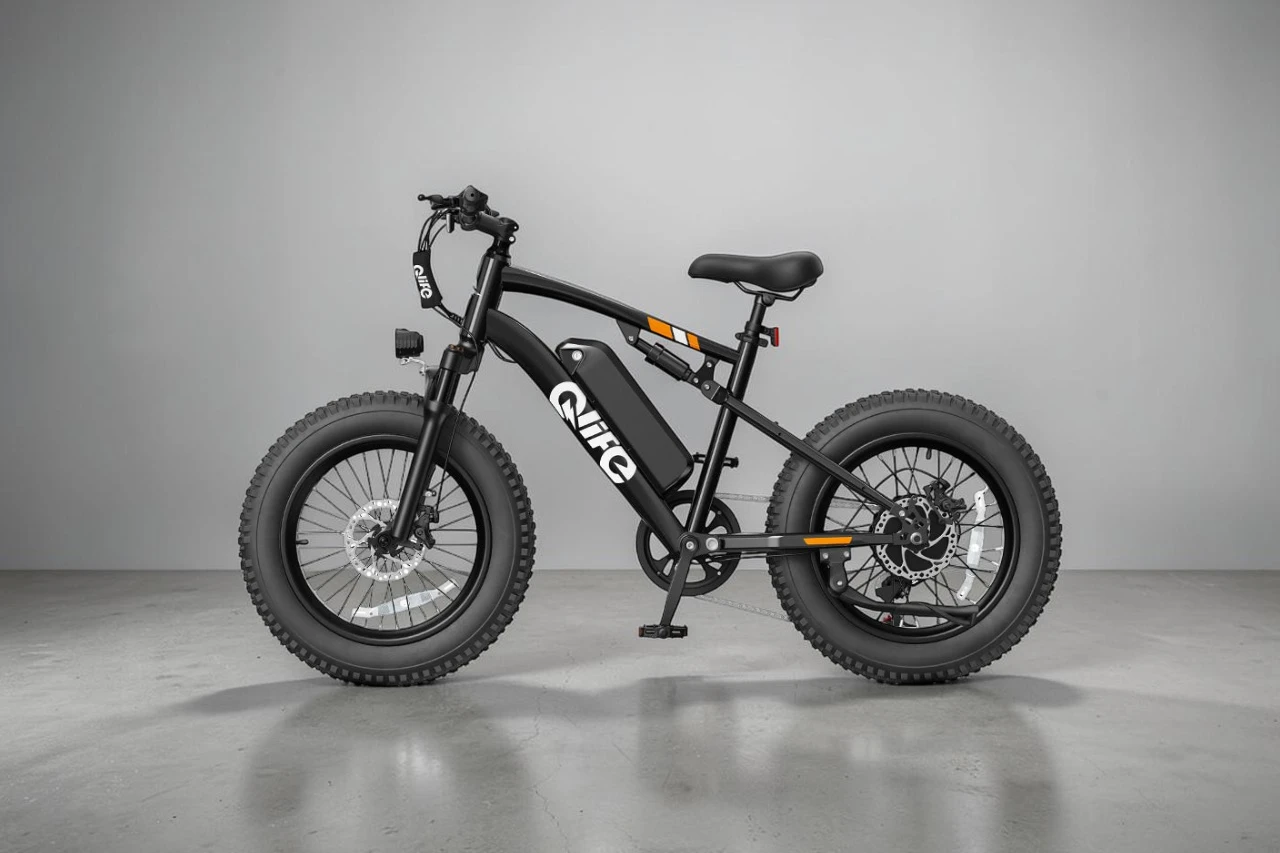
The Qlife Racer Fat Tire 2.0 caught my attention because it combines several features that normally make an electric bike much larger and heavier: a 750W rated motor with 1,800W peak output, 20×4.0-inch fat tires, full suspension, and a 748.8Wh removable battery.
After spending time riding the Racer, what surprised me most was how much performance Qlife managed to package into such a compact bike.
It is quick, torquey, comfortable over rough surfaces, and much more capable off pavement than its relatively small 20-inch wheel size might suggest. At the same time, its compact geometry will not be ideal for every rider, especially taller adults who prefer an upright cockpit.
So, is the Qlife Racer Fat Tire 2.0 worth buying?
For riders looking for an affordable, compact fat-tire e-bike that can handle commuting, gravel roads, trails, and recreational riding, I think it offers a lot for the money. But there are a few things I would consider before buying one.
Qlife Racer Fat Tire 2.0 at a Glance
The Racer Fat Tire 2.0 is essentially a compact all-terrain e-bike built around a powerful rear hub motor and a full-suspension frame.
Its current specifications include:
| Specification | Qlife Racer Fat Tire 2.0 |
|---|---|
| Motor | 750W rated / 1,800W peak brushless motor |
| Battery | 48V 15.6Ah removable battery |
| Battery Capacity | 748.8Wh |
| Claimed Range | Up to 65 miles |
| Tires | 20×4.0-inch fat tires |
| Suspension | Lockable front suspension + rear suspension |
| Drivetrain | 7-speed |
| Display | LCD |
| Brakes | Dual disc brakes |
| Headlight | Integrated headlight |
| Maximum Speed | Around 28 mph during my ride |
| Riding Style | Commuting, recreational riding, gravel, trails, mixed terrain |
The combination of 20-inch wheels and fat tires gives the Racer an interesting personality. It feels more compact and maneuverable than a typical 26-inch fat-tire e-bike, while still providing the traction and cushioning that make fat tires useful.
What I Like

Strong acceleration from the 750W motor
The motor feels considerably stronger than I expected from a compact 20-inch bike. Acceleration is responsive, and there is plenty of assistance available for hills and loose terrain.
Very capable full-suspension setup
The front and rear suspension make a noticeable difference once the pavement becomes rough. Gravel, grass, uneven trails, and small bumps are handled surprisingly well.
20×4.0-inch fat tires
The wide tires improve traction and stability while also contributing additional cushioning.
Large 748.8Wh removable battery
A 48V 15.6Ah battery is generous for this type of e-bike and makes the Racer more practical for longer recreational rides.
Compact and maneuverable
Compared with many full-size fat-tire bikes, the Racer is easier to maneuver and feels more playful.
What Could Be Better
The cockpit feels compact for taller riders
This is the biggest issue I noticed. Taller riders may find the handlebars low and the overall riding position cramped.
Motor noise is noticeable
The rear hub motor produces a noticeable electric whine under heavier acceleration.
It is more practical than premium
The Racer focuses on performance and value rather than premium refinement. Riders expecting high-end components or an ultra-polished riding experience should keep their expectations realistic.
Motor Performance: Much Stronger Than Its Size Suggests
The current Racer Fat Tire 2.0 uses a 750W rated brushless motor capable of reaching 1,800W peak output.
That specification sounds impressive, but what matters more is how the bike actually feels.
And this is one area where the Racer impressed me.
The motor provides strong acceleration as soon as the pedal assistance starts working. Because the bike uses smaller 20-inch wheels, the motor feels particularly responsive when accelerating from lower speeds.
There is enough torque available that I never felt like the Racer was struggling during normal riding.
When I moved onto rougher terrain and started climbing, the motor continued to pull confidently.
It feels much stronger than I initially expected from such a compact e-bike.
This makes the Racer particularly enjoyable for riders dealing with:
- Moderate hills
- Gravel roads
- Grass
- Dirt paths
- Urban streets
- Recreational trails
The motor does make itself heard. Under heavier loads, there is a noticeable hub-motor whine. It is not something that ruined the experience for me, but it is less refined than some quieter modern hub motors.
Performance, however, is difficult to complain about.
Top Speed
During my ride, the bike reached approximately 27–28 mph, and I found the bike’s LCD speed reading to be surprisingly accurate.
That puts the Racer firmly into fast e-bike territory.
At the lower pedal-assist settings, power delivery was much easier to manage. Increasing the assist level progressively raised the available speed until the bike approached its maximum.
For everyday riding, I would rarely need the highest level.
The lower and middle settings provide enough assistance for commuting while giving me better control and helping conserve battery capacity.
Local e-bike speed and class regulations vary, so riders should configure and use the bike according to the laws where they live.
Hill Climbing
One of the things that stood out during my ride was the Racer’s climbing ability.
The combination of the 750W rated motor, high peak output, smaller wheels, and wide tires gives it good low-speed pulling power.
I rode it toward steeper sections expecting the motor to begin struggling, but it continued climbing better than I expected.
This is not an electric dirt bike, and I would not buy it specifically for extreme technical climbs.
For normal recreational riding, rolling terrain, and moderate hills, however, there is plenty of power available.
If your commute includes hills, the Racer Fat Tire 2.0 should be considerably more capable than a basic 350W or 500W commuter e-bike.

Ride Quality and Full Suspension
The suspension ended up being one of my favorite parts of the Racer.
Qlife combines a lockable suspension fork with rear suspension, creating a genuine full-suspension setup.
On smooth pavement, that mostly translates into additional comfort.
Off pavement is where I appreciated it much more.
I took the Racer across rougher trails, gravel, uneven sections, and repeated bumps, and the bike remained surprisingly composed.
The suspension absorbed considerably more vibration than I initially expected.
Instead of constantly feeling every impact through the handlebars and saddle, the bike stayed relatively comfortable.
Combined with the large-volume fat tires, the suspension gives the Racer a much softer ride than a typical rigid commuter e-bike.
For riders who regularly travel over cracked pavement, poorly maintained roads, gravel paths, or recreational trails, this is an important advantage.
Is It Really an Off-Road E-Bike?
I would call the Racer a capable recreational all-terrain e-bike rather than a hardcore mountain bike.
It performs well on:
- Gravel
- Hard-packed dirt
- Grass
- Mild trails
- Uneven paths
- Rough pavement
The short wheelbase also makes it feel agile.
However, riders planning aggressive downhill riding, large jumps, or highly technical mountain-bike trails should look toward a purpose-built electric mountain bike with higher-end suspension and components.
For the type of mixed riding most owners are likely to do, I found the Racer surprisingly capable.
20×4.0-Inch Fat Tires
The 20×4.0-inch tires are a major part of the Racer’s character.
They provide significantly more contact with the ground than conventional bicycle tires, giving the bike extra traction on loose and uneven terrain.
I noticed the difference most clearly when riding over gravel.
Instead of feeling nervous or twitchy, the Racer remained relatively planted.
The tires also contribute additional cushioning because the larger air volume can absorb smaller bumps before the suspension even needs to work.
That makes the bike useful for riders who regularly encounter a mixture of pavement and recreational terrain.
The trade-off is rolling resistance.
Fat tires naturally require more effort to pedal without electrical assistance than narrow commuter tires.
Fortunately, the powerful motor largely eliminates that disadvantage whenever assistance is active.
Battery and Range
The current Racer Fat Tire 2.0 is equipped with a 48V 15.6Ah removable lithium-ion battery, giving it a total capacity of:
748.8Wh
That is a substantial battery for a compact 20-inch electric bike.
Qlife advertises a maximum riding range of up to 65 miles per charge.
As with virtually every e-bike range claim, I would treat that number as a best-case figure rather than something every rider should expect.
Real-world range changes dramatically depending on:
- Rider weight
- Average speed
- Pedal-assist level
- Throttle usage
- Hills
- Tire pressure
- Wind
- Temperature
- Terrain
Riding primarily in lower pedal-assist settings on flatter roads should get much closer to the advertised maximum than riding at high speeds or repeatedly using maximum assistance.
The good news is that a 748.8Wh battery gives the Racer a meaningful amount of energy to work with.
For normal recreational riding or commuting, I would be much more comfortable starting a longer trip on this bike than on an inexpensive e-bike equipped with a small 360Wh or 480Wh battery.
Removable Battery
The battery can be removed from the bike for charging.
I consider that an important feature, particularly for apartment owners or anyone who stores their bike away from an electrical outlet.
Instead of bringing the entire bike inside, I can remove the battery and charge it separately.
It also gives owners more flexibility when storing the battery during extreme temperatures.

Pedal Assist and Throttle Performance
The Racer offers multiple levels of electrical assistance.
The power difference between the lower and upper settings is very noticeable.
At lower levels, the bike behaves more like a conventional bicycle with electrical support.
Increase the assistance, and the character changes quickly.
The stronger settings provide considerably more acceleration and allow the bike to reach higher speeds without much effort.
I preferred the middle assist levels for normal riding.
They provide enough power to keep the bike moving quickly without making every acceleration unnecessarily aggressive.
Maximum assistance is better reserved for situations where I actually need the additional power.
7-Speed Drivetrain
The Racer uses a 7-speed mechanical drivetrain.
Seven gears are adequate for the intended purpose of this bike.
The lower gears help when starting or climbing, while the higher gears allow me to continue pedaling comfortably as speed increases.
With a motor this powerful, I am not relying heavily on the drivetrain for propulsion, but having multiple gears remains useful.
It also makes the Racer much more usable if the battery becomes low or if I simply want to ride with minimal assistance.
LCD Display
The LCD display provides the basic information I want while riding, including:
- Current speed
- Battery level
- Pedal-assist setting
- Basic ride information
One thing I specifically appreciated was its speed accuracy.
When I compared the displayed speed while riding, it tracked the bike’s actual speed closely.
That might sound like a small detail, but inaccurate speedometers are surprisingly common on inexpensive electric bikes.
The display itself is straightforward rather than sophisticated, but it does its job.
Braking Performance
Qlife lists the Racer Fat Tire 2.0 with dual disc brakes.
The braking system provides the stopping power I would expect from a bike in this category.
That is especially important because this is not a slow 15 or 20 mph commuter.
Once speeds begin approaching the upper 20-mph range, predictable braking becomes increasingly important.
As with any new e-bike, I recommend checking brake adjustment before the first longer ride and periodically inspecting pad wear afterward.
The extra mass, speed, and tire grip of a fat-tire electric bike can put considerably more stress on brake components than a conventional bicycle.
Integrated Headlight
The Racer also includes a built-in front headlight.
I like having a light integrated into the electrical system because I do not need to remember to recharge a separate bicycle light.
It improves visibility during early morning, evening, and low-light rides.
I would still recommend adding a strong rear light and reflective equipment if you frequently ride after dark.
Frame Size and Rider Fit
This is the area I would think about most carefully before buying the Racer Fat Tire 2.0.
The bike has a noticeably compact cockpit.
The 20-inch wheels and relatively short frame make it agile, but taller riders may feel that the handlebars sit too low.
I found myself wanting more handlebar height.
A stem or handlebar riser could improve the riding position for taller adults, but riders significantly above the ideal size range may simply prefer a larger-frame e-bike.
On the other hand, shorter riders may really appreciate the Racer’s dimensions.
Many powerful fat-tire electric bikes are extremely large and intimidating. The Racer feels significantly more manageable.
That compactness is one of its strengths—as long as the geometry fits you.
I strongly recommend checking Qlife’s current rider-height recommendations before ordering.

How It Rides Without Motor Assistance
I also spent some time riding the Racer with the electrical system turned off.
For a fat-tire e-bike, it is reasonably manageable.
You can pedal it like a normal bicycle, particularly on flatter terrain.
Once hills become involved, however, the combination of wide tires, battery, motor, and full-suspension hardware becomes much more noticeable.
This is still an electric bike first.
I would consider unassisted riding useful for short distances or emergencies rather than the primary way I would use the Racer.
Handling
One advantage of the smaller wheel platform is maneuverability.
The Racer changes direction quickly and feels more compact underneath me than a full-size 26×4-inch fat-tire bike.
That can be useful around:
- Bike paths
- Neighborhood streets
- Tight corners
- Parking areas
- Narrow trails
At higher speeds, larger wheels can sometimes feel more stable, but I never found the Racer difficult to control during normal riding.
Keeping both hands firmly on the handlebars and slowing down appropriately for terrain remains important, particularly when riding loose surfaces.
Assembly
The Racer requires some assembly after removing it from the box.
The package includes the components needed to get the bike together, including pedals and basic accessories.
Anyone comfortable assembling bicycles should find the process relatively straightforward.
However, brake alignment, wheel installation, handlebar positioning, fastener torque, and tire pressure all affect safety.
If you are not confident setting those up correctly, having a bicycle shop perform a final inspection is worth considering.
I would especially inspect:
- Front wheel installation
- Brake alignment
- Handlebar and stem bolts
- Pedal installation
- Tire pressure
- Suspension hardware
before taking the bike on its first high-speed ride.
Qlife Racer Fat Tire 2.0 Pros and Cons
Pros:
- Powerful motor
The 750W rated motor has plenty of punch, while the claimed 1,800W peak output gives the bike strong acceleration. - Good off-road comfort
Full suspension and 4-inch fat tires work together extremely well on rougher surfaces. - Large battery
748.8Wh is a respectable capacity for this category. - Compact dimensions
The smaller frame is easier to maneuver than many full-size fat-tire e-bikes. - Around 28 mph performance
There is enough speed available for riders who want something considerably quicker than a basic commuter. - Removable battery
Charging and storage are more convenient. - Useful 7-speed drivetrain
The gears make pedaling easier across different terrain.
Cons:
- Can feel small for taller riders
The low cockpit is the biggest drawback I noticed. - Motor is not especially quiet
There is noticeable hub-motor noise when accelerating hard. - Basic component package
This is a value-oriented e-bike rather than a premium enthusiast model. - Fat tires increase rolling resistance
Pedaling without assistance takes more effort than on a conventional commuter bike.
Who Should Buy the Qlife Racer Fat Tire 2.0?
I think the Racer makes the most sense for someone who wants one relatively affordable e-bike that can handle several types of riding.
It is particularly suitable for riders who want to combine:
- Neighborhood riding
- Daily commuting
- Bike paths
- Gravel roads
- Recreational trails
- Light off-road riding
It also makes sense for someone who wants fat-tire capability without moving all the way up to an enormous 26-inch fat-tire bike.
Shorter riders may especially appreciate its compact size.
Who Should Skip It?
I would look elsewhere if you:
- Are very tall and want a spacious upright cockpit
- Want a lightweight traditional commuter
- Need premium mountain-bike suspension
- Regularly ride highly technical trails
- Prefer an exceptionally quiet motor
- Primarily want a bicycle that is easy to pedal without electrical assistance
A larger 26-inch e-bike may also make more sense for tall riders who prioritize high-speed stability and more cockpit space.
Qlife Racer Fat Tire 2.0 vs. a Regular Commuter E-Bike
Compared with a conventional commuter e-bike, the Racer trades some efficiency for capability.
A normal commuter with 1.95- or 2.4-inch tires will usually roll more efficiently on pavement.
The Racer’s advantage appears when the road quality deteriorates.
Its fat tires and suspension make potholes, gravel, grass, broken pavement, and dirt far easier to deal with.
That makes the Racer more versatile if your riding is not limited to smooth city streets.
Is the Qlife Racer Fat Tire 2.0 Worth It?
I think it can be, especially when it is competitively priced.
The Racer does not reinvent the electric bike.
Instead, it combines the features many buyers are already looking for:
a powerful motor, a large battery, fat tires, full suspension, useful speed, and a compact frame.
And it delivers that combination surprisingly well.
The riding experience was better off pavement than I initially expected. The suspension and wide tires kept the bike comfortable through gravel and uneven sections, while the motor had enough torque to make hills and loose terrain much easier.
Its main limitation is rider fit.
If the compact geometry works for your height, the Racer becomes much easier to recommend.
If you are tall, I would pay close attention to Qlife’s sizing information and consider whether a handlebar riser—or a larger e-bike altogether—would provide a more natural position.
Final Verdict
The Qlife Racer Fat Tire 2.0 is a powerful little all-terrain e-bike that punches above what its compact dimensions initially suggest.
The 750W rated / 1,800W peak motor provides strong acceleration, while the 48V 15.6Ah battery gives it substantially more long-distance capability than many entry-level electric bikes.
But what impressed me most was the ride quality.
The combination of 20×4.0-inch fat tires and full suspension makes rough roads, gravel, and recreational trails surprisingly comfortable.
It does not have the sophistication of a premium electric mountain bike, nor does it need to.
For someone who wants an affordable fat-tire e-bike for commuting during the week and exploring rougher paths on the weekend, the Racer Fat Tire 2.0 offers a very appealing balance of performance, versatility, and value.
Just make sure the compact frame matches your height before ordering.
| Preview | Product | Price | |
|---|---|---|---|

| Qlife Racer Fat Tire 2.0 Electric Bike for Adults-Peak 1800W Motor | 20″X4.0″ Fat Tire… | $649.00 | View on Amazon |
Qlife Racer Fat Tire 2.0 FAQ
How fast is the Qlife Racer Fat Tire 2.0?
During my ride, I was able to reach approximately 27–28 mph. Actual top speed can vary depending on rider weight, terrain, battery charge, tire pressure, and bike configuration.
How far can the Qlife Racer Fat Tire 2.0 travel?
Qlife advertises a maximum range of up to 65 miles. Real-world range will usually be lower when riding quickly, climbing hills, using high pedal-assist settings, or relying heavily on motor power.
What battery does the Racer Fat Tire 2.0 use?
The current model is listed with a 48V 15.6Ah removable battery, equivalent to 748.8Wh.
What motor does it have?
It uses a 750W rated brushless motor with up to 1,800W peak output.
Does the Qlife Racer Fat Tire 2.0 have full suspension?
Yes. It combines a lockable front suspension fork with rear suspension.
What size tires does it use?
The Racer Fat Tire 2.0 uses 20×4.0-inch all-terrain fat tires.
Is the Qlife Racer Fat Tire 2.0 good off road?
For gravel, grass, dirt paths, mild trails, and other recreational terrain, I found it surprisingly capable. The fat tires and full suspension provide considerably more traction and comfort than a standard commuter e-bike.
I would not treat it as a replacement for a premium electric mountain bike on highly technical terrain.
Is the Qlife Racer Fat Tire 2.0 good for tall riders?
This is one area where I would be cautious. The Racer has a compact frame and relatively low cockpit, so taller adults may find the riding position cramped.
Check Qlife’s latest rider-height recommendations before purchasing.
Is it a good commuter e-bike?
Yes, particularly if your commute includes poor pavement, gravel sections, hills, or rough roads.
If your commute is entirely smooth pavement and maximum efficiency is your priority, a conventional commuter e-bike with narrower tires may be a better choice.
Should I buy the Qlife Racer Fat Tire 2.0?
I would consider it if you want a compact but powerful fat-tire e-bike with full suspension, a large removable battery, and genuine mixed-terrain capability.
Its combination of power, comfort, and versatility makes it especially attractive for riders who do not want to choose between a commuter and a recreational all-terrain e-bike.
GoEBikeLife publishes independent e-bike reviews, comparisons, and practical buying guides. Some links on this page are affiliate links. If you make a purchase through an eligible link, we may earn a commission at no additional cost to you.