Real rides. Real notes. No hype.

The PUJH PU1 is a full-size commuter e-bike with a large battery, 29-inch wheels, and strong value on paper, but buyers should watch the spec clarity.
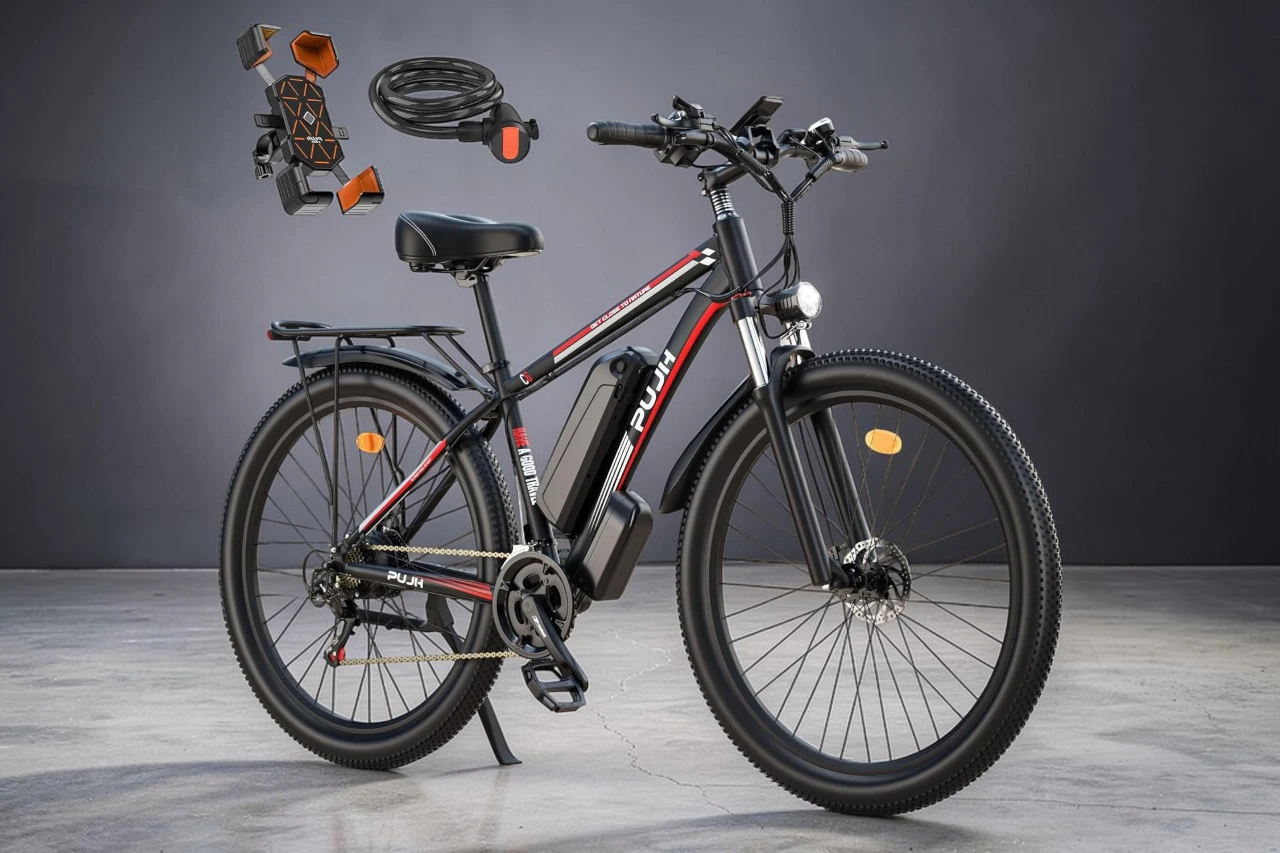
The PUJH PU1 looks like a strong value pick for riders who want a fast, full-size commuter with a big battery and lots of included extras, but it is not the smartest choice for buyers who need polished spec clarity, lighter weight, or a more proven brake-and-sensor package.
Best for
Not ideal for
Biggest strength: On paper, the PU1 gives you a lot of bike for the money: a large 48V 17.5Ah battery, 29-inch wheels, front suspension, commuter accessories, and strong claimed performance.
Biggest trade-off: The bike’s published specs are not fully consistent across PUJH and Amazon-adjacent listings, which makes it harder than it should be to know exactly what performance and weight you are buying.
| Item | PUJH PU1 |
|---|---|
| Category | Full-size commuter / all-road e-bike |
| Motor | 2000W peak claimed on current PUJH page |
| Torque | 60 Nm claimed |
| Battery | 48V 17.5Ah removable battery |
| Claimed range | Up to 80 miles |
| Claimed top speed | 28–32 mph on current PUJH page; some listings still show up to 34 mph |
| Drivetrain | 21-speed |
| Suspension | Front suspension |
| Brakes | Disc brakes |
| Tires | 29 x 2.1 in |
| Rider fit | Official page says 5.4 ft to 6.5 ft |
| Weight | Official page says 63.7 lb including battery |
Assembly time: I’d budget around 45–60 minutes. PUJH says the bike ships 80% pre-assembled, which matches what I would expect from a big-wheel commuter e-bike in this class.
First ride setup issue: The cockpit is the area I would re-check first. Based on the notes you supplied, handlebar-area tightness is the thing I would pay attention to after the first couple of rides.
Power feel: I’d expect the PU1 to feel strong for a commuter. This is not the kind of spec sheet that suggests a sleepy entry-level city bike.
Hill performance: For regular urban hills and rolling suburban climbs, I’d expect it to outperform the typical 500W commuter, especially when I lean on higher PAS levels or throttle.
Range reality: I would plan around about 30–40 miles if I ride throttle-heavy and much closer to the higher end only if I pedal consistently and keep speed realistic. PUJH itself frames the battery as a 48V 17.5Ah pack with up to 80 miles of range depending on terrain and mode.
Handling: I’d expect it to feel planted rather than playful. The 29-inch wheels should smooth rough pavement, but they also make the bike feel more substantial.
Noise / rattles: I would watch for assembly-related hardware looseness more than motor noise.
Biggest surprise: The amount of equipment bundled into the package is better than I expect at this end of the market.
Biggest disappointment: The spec story is messy. Current PUJH pages, Amazon snippets, and older PU1/PU149 references do not read like one perfectly aligned product sheet.
The PUJH PU1 is basically a full-size commuter/all-road e-bike dressed more like a hardtail-style mountain bike than a relaxed city cruiser. The 29-inch wheels, front suspension, 21-speed drivetrain, rear rack, fenders, and removable 48V 17.5Ah battery tell me this bike is trying to cover daily commuting, rough pavement, bike paths, and light unpaved use in one package.
Price-wise, it sits in the value lane. That matters, because the PU1 is not selling refinement first. It is selling output, battery size, accessory value, and size-for-the-money. That can work well for the right buyer, but it also means I expect compromise in areas like braking sophistication, sensor feel, and spec transparency.
I think the PU1 makes the most sense for a rider who wants one e-bike to do almost everything: commute during the week, cruise mixed pavement on weekends, and carry a little cargo without immediately shopping for extra accessories. The included rack, fenders, lights, lock, pump, spare tube, and spare pads give it a practical, ready-to-ride feel.
At 5’10” and 180 lb, I would likely sit in the PU1’s sweet spot. The official fit range is 5.4 ft to 6.5 ft, and the 29-inch wheel setup usually favors average-to-taller riders who like a more stable ride at speed.
Terrain-wise, I’d treat this as an all-road commuter, not a true mountain bike and not a real sand or snow specialist. The listing mentions mountain road, sand, and snow, but the actual tire size here is 29 x 2.1 inches, which is much more road-and-hardpack friendly than deep-sand or deep-snow friendly.
I would skip the PU1 if I were under about 5’5″ and especially cautious about stand-over height, reach, or low-speed confidence. The official fit range starts at 5.4 ft, but your supplied size graphics and the full-size 29-inch layout still make me think shorter riders should be extra careful here. A smaller-wheel commuter or step-through would be safer.
I would also skip it if I needed to carry the bike upstairs often. The official page says 63.7 lb including battery, which is not outrageous for a value commuter, but it is still a lot compared with lighter city models. Even your supplied spec image showing 50.7 lb does not fully solve the issue, because either number tells me this is not a one-hand apartment bike.
And I would pass if I wanted the most polished commuter feel at this budget stretch. Bikes like the Aventon Soltera 2.5 give you a lighter chassis, hydraulic brakes, and a torque sensor, while the Lectric XPress 750 adds a torque sensor, hydraulic brakes, 330 lb payload, and clearer UL 2849/2271 language. The PU1 fights back with bigger battery claims and more raw speed on paper, but not with the same clarity or refinement.
Who it affects: Careful buyers comparing bikes side by side, and anyone worried about legal class, top speed, true weight, or warranty.
When it shows up: Before purchase, and later when you are trying to understand what the bike should actually do.
Why it matters: The current PUJH product page says 2000W peak, 28–32 mph, 63.7 lb including battery, and a 2-year frame / 1-year electronics warranty. Amazon-related snippets for PU1 listings still show up to 34 mph and 1-year manufacturer language, while older PU1/PU149 references mention 1500W peak. That is more confusion than I want around a commuter e-bike.
Workaround: Before ordering, I would get the seller to confirm the exact shipped version, locked/unlocked speed behavior, real bike weight, and written warranty coverage.
Who it affects: Shorter riders, apartment dwellers, and anyone wanting a very nimble city bike.
When it shows up: Mounting, walking the bike indoors, carrying it upstairs, and tight storage situations.
Why it matters: The 29-inch wheels and official 63.7 lb weight push the PU1 toward “full-size commuter” behavior, not “easy urban throw-around” behavior. That can feel great on rough pavement, but it is less friendly in cramped real-world ownership.
Workaround: Remove the battery before lifting, confirm stand-over carefully, and skip it entirely if portability is one of your top two priorities.
Who it affects: Fast riders, heavier riders, and anyone descending longer hills.
When it shows up: High-speed stops, repeated braking, wet conditions, or emergency braking situations.
Why it matters: PUJH lists disc brakes, but the product page does not position them as hydraulic brakes, while some comparably priced commuter competitors now do. On a bike marketed around 28–34 mph behavior, that matters.
Workaround: I would bed in the pads properly, keep the system adjusted, and be realistic about sustained high-speed use. If I bought the bike and rode it fast often, upgraded pads would be high on my list.
Who it affects: Commuters planning charge intervals and buyers who expect the headline number.
When it shows up: Throttle-heavy riding, hills, headwinds, cold mornings, and high average speed.
Why it matters: “Up to 80 miles” sounds great, but the same bike can feel like a 30–40 mile machine if I ride it hard. That is normal e-bike reality, but buyers still need to hear it plainly. PUJH’s own brand content frames throttle-only use at roughly 30–40 miles and pedal assist at roughly 60–80 miles.
Workaround: I would buy this bike only if my real commute fits inside the lower half of the range story, not the best-case number.
Using your rider profile and supplied notes, I would expect the PU1 to feel lively in normal traffic. The 60 Nm torque claim, big battery, and full-size wheelbase suggest a bike that should get moving with less hesitation than a basic budget commuter. That matters most at stoplights and on rolling urban terrain, where a weak hub motor can feel lazy.
For hills, I think the PU1’s strongest case is not “mountain goat,” but “stronger than average value commuter.” I would expect it to handle standard city grades and moderate suburban climbs without much drama if I use the upper PAS levels or throttle to keep momentum. I would not buy it as a true off-road climber, but I also would not lump it in with low-power budget bikes that bog down as soon as the road tilts.
This is where the PU1 becomes a little tricky. The current PUJH page says 28–32 mph, some Amazon-connected snippets still say 34 mph, and PUJH also says the top speed can be adjusted in the display menu and reduced where Class 3 speeds are not allowed. So yes, this is clearly meant to feel quick, but I would go into it expecting some setup variance rather than a single perfectly documented performance target.
In normal use, I think PAS 3 would likely be the daily sweet spot. PAS 1 and 2 should be easy cruising modes, while PAS 4 and 5 are where the bike starts behaving like a fast commuter rather than a casual bike-path cruiser.
I would not buy the PU1 expecting the headline max range. I would buy it expecting strong battery capacity for the class and a useful real-world spread depending on how I ride. The 48V 17.5Ah battery is roughly 840Wh, which is a healthy size for a sub-$900 commuter-style bike. That is the good news. The reality is that speed eats range, hills eat range, wind eats range, and 29-inch wheels with a bigger rider do not help either.
So my practical read is simple: if I rode this mostly on PAS with sensible cruising speeds, I would feel good about the bike as a weekly commuter. If I rode it like a mini-moped and chased the upper speed claim all the time, I would plan around something much closer to the low end.
I would describe the PU1 as “stable and reasonably comfortable,” not plush. The front suspension, shock-absorbing saddle language, and large wheels should help knock down the sharpness of cracked pavement and rougher urban surfaces. But this still looks like a bike tuned for speed and utility more than soft, cruiser-style comfort.
For my 5’10” frame, I expect the PU1 would feel fairly natural once dialed in. The adjustable stem is a useful touch, because it gives me some room to fine-tune reach and bar height without immediately replacing parts. Based on the feature bundle, this seems like a bike that can be made pretty comfortable with basic fit adjustments.
On the road, I’d expect the PU1 to feel planted. That is one of the normal benefits of a 29-inch setup: it rolls over rough pavement more calmly and usually feels less twitchy than smaller-wheel commuters. The flip side is that it probably will not feel as quick or nimble in tight urban maneuvers as a lighter, smaller bike.
That is why I like it more for longer commutes, mixed-surface cruising, and rougher roads than for dense urban stop-start riding in cramped spaces.
I see the safety story here as decent, but not fully buttoned-up. The good part is that the bike includes lights, brake/turn-signal language on the product materials, disc brakes, and a full-size stable chassis. The part I like less is the lack of sharper model-level detail around braking hardware and certification language. The PU1 page says “UL Certified,” but it does not call out UL 2849 or UL 2271 by number on that product page.
That does not automatically mean the bike is unsafe. It means I would prefer more precision. On a commuter sold partly on speed, I want that clarity. Competing bikes from better-established commuter brands often make those details easier to verify.
The PU1’s feature list is generous for the price. PUJH lists a color display, speed and battery info, front suspension, adjustable comfort seat, LED headlights, brake and turn-signal lights, and bonus accessories. The supplied images also show a USB charging port and adjustable stem, which are genuinely useful real-world touches, not fluff.
I especially like that the bike ships with commuter-minded extras rather than making you build the bike up from scratch after purchase. That has real value for a first-time buyer.
At 5’10”, I would feel comfortable considering this bike. Official PUJH sizing says 5.4 ft to 6.5 ft, which puts average and taller riders in the safe zone.
For shorter riders, I would be cautious. The 29-inch wheels alone make this less approachable than a 26-inch or step-through commuter. Even if the saddle can drop enough, stand-over and low-speed confidence still matter.
For taller or heavier riders, the PU1 is more convincing. Your supplied materials show a 330 lb capacity, and the long, big-wheel chassis should feel better under bigger riders than many compact commuters do. Still, because published specs vary across sources, I would confirm the final shipped version if weight capacity is critical.
Assembly should be manageable for most buyers. PUJH says the bike ships 80% pre-assembled, and the included accessory set suggests the company expects first-time owners, not just enthusiasts, to buy this model.
After the first 10–20 miles, I would re-check the cockpit bolts, front wheel fastening, brake alignment, and rack/fender hardware. That is standard good practice on a mail-order e-bike, but it matters even more on a heavier, faster commuter.
One encouraging sign is that PUJH appears to sell replacement PU1 batteries and displays directly on its site, which is better than buying from a brand with no visible parts path at all. The official policy language also points to a 2-year frame warranty, 1-year coverage for motor/battery/display, and lifetime technical support.
If I were choosing between these two, I would call it a head-versus-heart decision.
The PUJH PU1 wins the paper-value argument. It brings the bigger battery claim, more aggressive speed story, 29-inch wheels, front suspension, and a much fatter included-accessory bundle. If I wanted a budget commuter that feels more like a full-size all-road machine, the PU1 is the more ambitious package.
The Aventon Soltera 2.5 wins the polish argument. It is much lighter at around 46 lb, uses hydraulic disc brakes, has a torque sensor, and comes with clearer model-level certification language and stronger mainstream commuter-bike credibility. Its trade-off is less battery, less raw speed, and less “big bike” presence.
So my simple take is this: I would choose the PU1 if budget, battery size, and included gear mattered most. I would choose the Soltera 2.5 if I cared more about ride refinement, lower weight, and cleaner product clarity.
Is the PUJH PU1 good for hills?
For normal city hills and moderate climbs, yes, it should be better than many cheap commuters. I would not buy it as a true technical hill specialist.
Is it comfortable for longer rides?
It looks reasonably comfortable for longer commutes thanks to the large wheels, front suspension, and upright-friendly adjustments, but not plush like a comfort cruiser.
Can shorter riders fit it?
Maybe, but this is not the bike I would recommend blindly to shorter riders. The official fit range starts at 5.4 ft, and the 29-inch layout is the real caution point.
Is the battery removable?
Yes. Both PUJH’s product page and supplied materials show a removable 48V 17.5Ah battery.
What maintenance should I expect?
The normal mail-order e-bike checklist: bolt re-checks, brake adjustment, drivetrain tuning, tire-pressure checks, and early rack/fender hardware inspections.
Buy it if you want a fast-feeling, full-size commuter with a big battery, stable 29-inch wheels, and a lot of included commuter gear for the money.
Skip it if you want the lightest urban bike, the clearest certification/spec story, or the most refined commuter ride in this price neighborhood.
My personal money test is this: I would consider spending my own money on the PU1 only if I wanted maximum battery-and-feature value under a tight budget, and only after confirming the exact shipped specs in writing. The bike has a lot going for it on paper, and I think the overall concept makes sense for a taller rider who wants one bike for commuting and light mixed-surface use. But I would still go in with eyes open, because the product-page inconsistency is the one thing that keeps this from being an easy yes.
| Preview | Product | Price | |
|---|---|---|---|

|
PUJH 2000W Electric Bike for Adults 48V 17.5Ah Battery, 29” Fast Ebike, up to 80 Miles, Front… | $849 | View on Amazon |