Real rides. Real notes. No hype.

The FREESKY Warrior Pro delivers aggressive dual-motor hill power and a large 1440Wh battery, but its ~97 lb weight hurts transport and daily use.
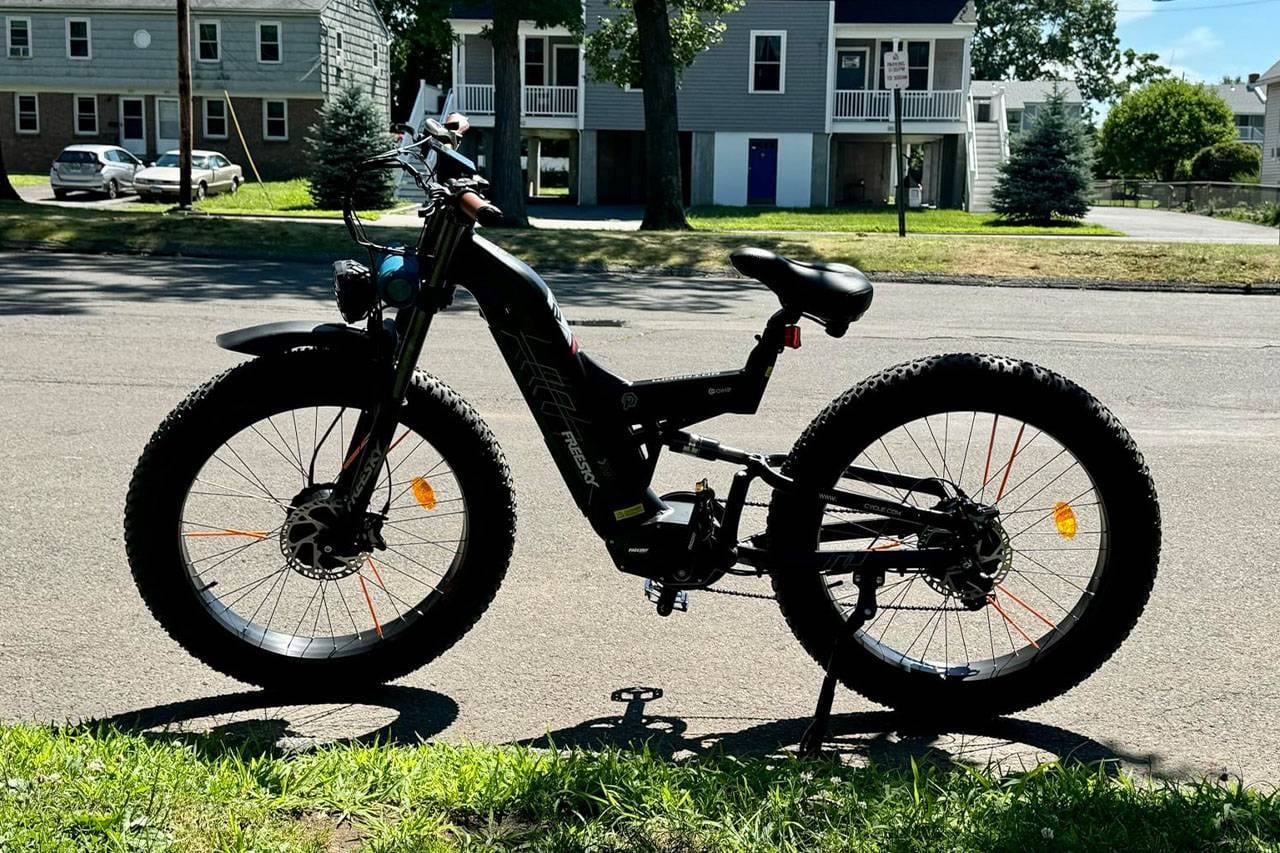
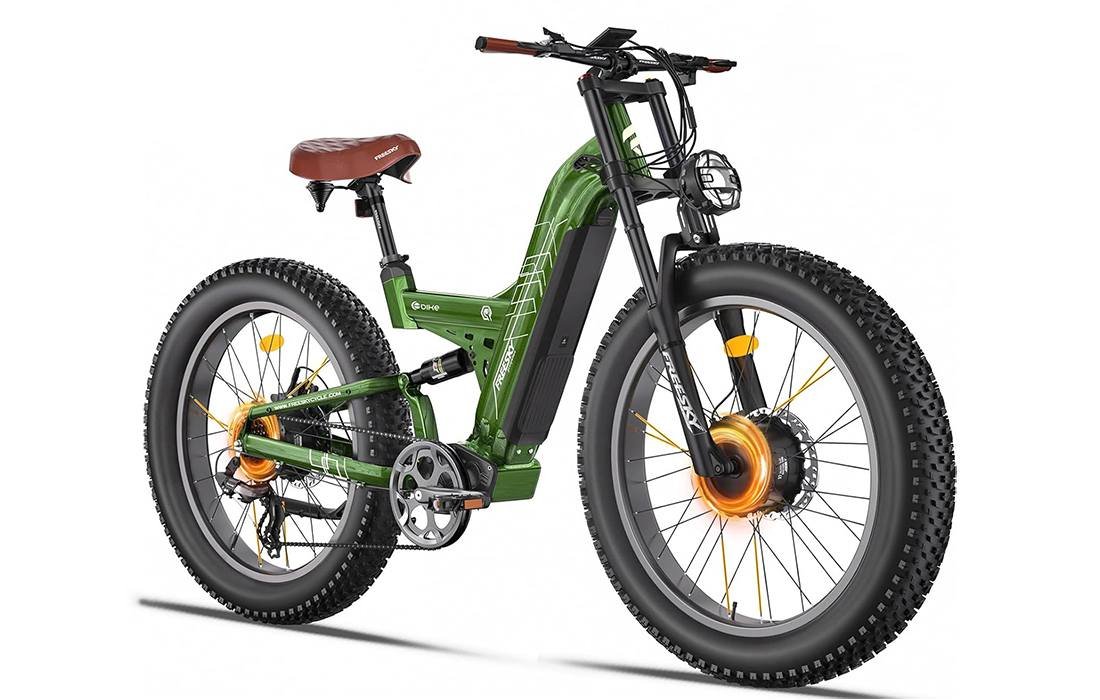
Dual-motor acceleration and traction feel incredible on steep grades, but the ~97 lb weight makes daily transport and storage the main compromise.
Bottom line: The FREESKY Warrior Pro is worth considering if you want serious dual-motor acceleration and traction for mixed terrain, but it’s too heavy and too fast for “normal e-bike life” (stairs, racks, and bike-path legality).
Best for: Riders who want an AWD-style fat-tire e-bike for rough roads, dirt, and steep grades—and who can store it on the ground level.
3-line decision summary:
This bike is built around two priorities: power and battery capacity—and you “pay” with weight and some component-consistency risk.
| Field | Value / Notes |
|---|---|
| Motor | Dual hub motors, peak 2000W + 2000W, 120 N·m each |
| Battery | 48V 30Ah (1440Wh) Samsung cells, removable, BMS |
| Claimed range | 50–120 miles; brand also frames it as single motor longer / dual motor shorter |
| Realistic range (my expectation) | 35–55 mi riding fast + frequent dual motor; 60–90 mi slower PAS + mostly single motor |
| Top speed behavior | Up to 40 mph with unlock logic; treat as off-road/private property unless local laws allow |
| Bike weight | ~97 lb (real-world reality: heavy) |
| Payload capacity | Up to 400 lb |
| Brakes | 4-piston hydraulic with 180mm rotors |
| Tires | 26″ x 4.0″ fat tires |
| Suspension | Full suspension: adjustable hydraulic front fork + rear shock |
| Safety certifications | System UL 2849 (TÜV), battery UL 2271 (TÜV) |
| Warranty | Listing mentions strong coverage + lifetime tech support, but verify exact terms in your paperwork |
| Typical price | About $1,649 (prices change) |
Score breakdown:
It climbs with authority because dual hubs can keep traction and speed up on steeper grades, but sustained hard climbing can expose maintenance needs (brakes, drivetrain, fasteners).
Fat tires + full suspension make dirt roads, rough pavement, and light trail riding feel controlled, but the knobby tires are louder and less efficient on pavement.
The chassis feels sturdy and confidence-inspiring for larger riders, but the bike’s mass demands more planning for stopping distance and storage.
The rear rack makes it easy to strap on essentials and ride for hours, but the total system weight becomes a problem if you ever need to lift or transport it.
Dual-motor acceleration is the standout experience, but that same punch can feel abrupt for beginners until you deliberately start slow.
Below are the deal-impacting downsides, written the way buyers actually feel them.
I’m 5’10” and ~180 lb, and I approached the Warrior Pro like a powerful dual-motor platform—not a casual commuter.
This bike feels aggressive and instant in dual-motor mode, and I’d call it “start slow” power. The first time you roll into throttle or higher PAS, it can feel more like a light electric moto than a typical commuter e-bike. I strongly recommend easing in—low gear, low PAS—until your hands and balance calibrate to the response.
The Warrior Pro is designed to reach higher speeds than normal e-bikes, and it has mode/unlock behavior that can change how much speed the throttle gives you. In practical terms, that means the bike can feel calm in one setting and surprisingly fast in another—so you want to be intentional with your settings and where you ride.
Hill performance is the headline. On steep grades, the dual motors help keep momentum and reduce that “bog down” feeling common on heavier single-motor fat bikes. The sensation is a steady shove uphill with strong traction—especially helpful when surfaces are loose or broken.
The ride is stable and planted—more “truck-like confidence” than nimble bicycle handling. That’s a compliment for rough roads and loose surfaces, but it also means tight maneuvers, quick direction changes, and slow-speed weaving require more attention because you’re managing real mass.
The 48V 30Ah (1440Wh) battery is legitimately large, and that’s the main reason the Warrior Pro can make sense as a long-roam machine.
Here’s the expectation I’d give a 180 lb rider:
If you chase top speed often, range drops quickly. If you ride it like an efficient e-bike—moderate speeds, smoother throttle, more pedal input—you get rewarded.
The battery is hidden and removable, uses Samsung cells, and is paired with a BMS. Charging is supported by a 3A charger, and the provided estimate is roughly 8–10 hours for a full charge. The size is a real advantage, but also remember: big battery + big power equals a system you’ll want to charge and store with care (avoid extreme heat, keep contacts clean, don’t ignore physical damage).
This bike can deliver long rides, but the moment you treat it like a 40 mph machine, you should expect range closer to the lower bands.
The listed recommendation is roughly 5’5″ to 6’3″, and at 5’10” it fits naturally. Bigger riders generally benefit from the sturdy frame feel, fat tires, and suspension—this bike doesn’t feel fragile underneath you.
The ride is comfortable in a “go all day” sense because the platform feels stable, and the bike’s posture works well for mixed riding. The ergonomic feel is reinforced by the “big bike” cockpit and fat tires smoothing smaller chatter.
The full suspension is a real quality-of-life upgrade on dirt, rough roads, and trail-style surfaces. It takes the edge off impacts and helps the bike stay composed. The trade-off is that if you ride hard, you may find the rear shock performance becomes a limit compared to what the motors can encourage you to do.
The Warrior Pro’s brake setup is strong on paper—4-piston hydraulic brakes with 180mm rotors—and the general stopping feel is confident. The practical reality is that the bike’s weight and speed potential still demand rider discipline: at higher speeds, you should plan longer stopping distances than you would on a lighter commuter.
On the safety side, the integrated lighting package is a real win for visibility: headlight, tail/brake light, and turn signals make the bike feel more “vehicle-like” in traffic. I treat that as helpful, but not something that replaces defensive riding.
The overall chassis feels sturdy and sharp-looking, and the double-triangle aluminum frame design is clearly meant to handle dual-motor loads. Where I stay cautious is the “high power meets real-world parts” problem: when a bike is this strong and this heavy, small issues (bolt settling, brake adjustment, cable routing rub, drivetrain tuning) matter more over time.
My ownership mindset for this bike is: assume you’ll do early re-checks (bolts, rotor alignment, derailleur tuning) after the first few rides, then keep a regular inspection routine—especially if you ride fast or off-road.
Assembly is very doable for most riders with basic tools and patience. My build took about 50 minutes, and the bike is mostly pre-assembled, so you’re completing final steps rather than building from scratch.
Daily ownership is where you should decide if this bike fits your life:
Better for: Riders who want strong performance with a different powertrain feel (Bafang motor focus) and similar long-range intent.
Why it wins: If you prefer a non-dual-hub approach and want a performance-oriented fat bike with a big battery.
Why you might still pick the Warrior Pro: You specifically want dual-motor traction and that AWD shove on steep or loose terrain.
Better for: Riders who want a lower-cost entry to fast fat-tire riding and don’t need the same battery size.
Why it wins: Value—much cheaper while still offering strong performance for the money.
Why you might still pick the Warrior Pro: You want the bigger battery, higher-end safety certification story, and the dual-motor platform.
At around $1,649, the Warrior Pro makes sense only if you will use its core advantages: dual-motor traction and high battery capacity.
Is the FREESKY Warrior Pro street legal?
It depends on local rules. Anything marketed up to 40 mph can fall outside typical Class 1–3 definitions. If you ride public paths, treat speed as a legal/ethical constraint and check local enforcement reality.
What range should a 180 lb rider expect?
If you ride fast and use dual motor often, plan around 35–55 miles. If you ride slower with more single-motor PAS, 60–90 miles is a realistic expectation.
Does it climb steep hills well?
Yes. Dual motors provide strong climbing push and traction. The bigger question is whether you’re prepared for the maintenance needs that come with hard hill use (brakes, fasteners, drivetrain tuning).
Is it comfortable for longer rides?
Comfort is strong for this category because suspension + fat tires reduce fatigue on rough surfaces. If you ride aggressively off-road, rear shock feel may become the limiting factor.
How hard is it to move around without riding?
This is a heavy bike. Rolling it is fine; lifting it is not. If you have stairs or you load bikes often, expect daily friction.
How long does it take to charge?
With the stated 3A charger, a full charge is roughly 8–10 hours.
Are the brakes “enough” for the bike’s speed?
They’re strong for an e-bike brake setup, but weight and speed mean your stopping distance is still longer than a lighter commuter. Keep brakes maintained and ride with extra margin.
What should I check after the first few rides?
Re-check key bolts, brake alignment, tire pressure, and drivetrain tuning. High power and heavy mass can “settle” components quickly early on.
My final take: The Warrior Pro is a high-power dual-motor fat bike that feels exciting and capable, but it demands a lifestyle that can handle its weight and speed.
Best for: Steep hills, loose terrain, and riders who want dual-motor traction with a truly large battery.
Biggest downside: It’s heavy and can be frustrating to transport, and long-term component consistency can vary under hard use.
Smart buy if price is: Around the mid-$1,600s and you’ll actually use the dual-motor + big-battery advantage.
| Preview | Product | Price | |
|---|---|---|---|

|
FREESKY 4000W Dual Motor Electric Bike for Adults, 48V 30AH Battery 120Miles Range, 40+MPH AWD Fast… | View on Amazon |
Read Also:
Freesky Swift Horse X-6E Electric Bike Review
Freesky Himalaya X-5E Electric Bike Review