Real rides. Real notes. No hype.

Looking for the best moped-styled e-bikes? Here are 7 ranked picks with honest pros/cons, comfort notes, range reality, and safety tips.
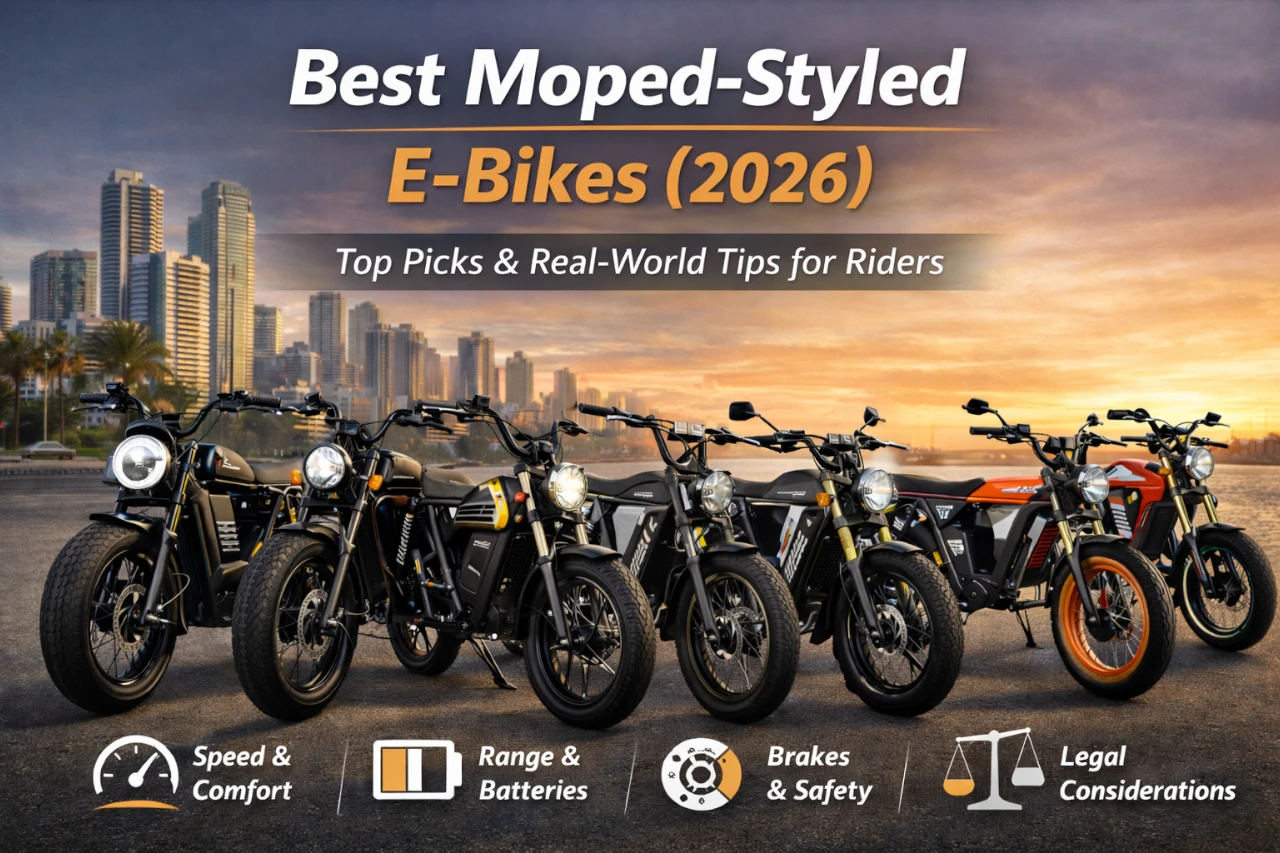
Moped-styled e-bikes are fun, comfy, and confidence-inspiring at speed—but they’re also heavier, harder to pedal unassisted, and often drift into “legal gray area” territory when listings claim 30+ mph.
In this guide, I’m ranking seven popular moped-style options based on the things that actually matter after the unboxing: stability, braking confidence, battery practicality, comfort, security features, and how livable they are day to day.
My rider baseline for “what to expect” is 5′10″ / ~180 lb, mixed city streets + rough pavement, with occasional hills.
Best overall pick: Windone E2 — the most balanced “moped e-bike” style choice for comfort, everyday rideability, and a more regulation-friendly speed setup (at least on paper).
Best value pick: Tamobyke T73 — the “Sup-er–73 inspired” experience for less money, as long as you’re realistic about weight and long-term parts/support.
Who should buy from this list:
Who may want to look elsewhere:
| Rank | Model | Best For | Key Strength | Main Drawback |
|---|---|---|---|---|
| 1 | Windone E2 | Comfort-focused daily cruising | Balanced speed + comfort package | Battery isn’t huge for high-speed riding |
| 2 | OUXI V8 Max | Long-range cruising | Dual-battery capacity is the headline | Big/heavy feel; range claims depend heavily on speed |
| 3 | Tamobyke T73 | Best bang-for-buck moped vibe | Strong “moped style” value proposition | Weight + long-term support uncertainty |
| 4 | YOLOWAY YR20 | Power seekers | High peak power + big battery | “Fast” often means “less legal” and more brake demand |
| 5 | Luckeep M5 MAX | Bigger/taller riders, high load | High payload + security features | Very high listed speed raises compliance/safety questions |
| 6 | Qlaway BK20 | Plush ride on rough surfaces | Full suspension emphasis + rear seat | Real-world range will drop fast at higher speeds |
| 7 | DTTZH F6 | Security-minded buyers | NFC/password unlock is genuinely useful | Smaller battery vs some rivals; speed claims complicate legality |
Instead of spec-dumping, I focus on what changes your ownership experience:
You’ll see a lot of “I’d expect…” language below because performance varies by rider weight, terrain, tune, and local speed limits—and listings often present best-case numbers.
If you want the moped look without instantly drifting into “this feels like it’s trying to be a motorcycle,” the Windone E2 is the most balanced package here. On paper, it leans into comfort, usable modes, and a speed setup that’s easier to live with day to day.
For a 5′10″ / 180 lb rider, I’d expect this to feel stable and confidence-building in the 15–24 mph range—exactly where most people cruise on these bikes. The “moped seat + fat tires” combo usually reduces wrist pressure and makes rough pavement less punishing. If your riding is mostly neighborhood roads, beach paths, or urban streets with potholes, this style can feel genuinely relaxing.
| Pros | Cons |
|---|---|
| Comfortable “sit-in” cruising posture | Likely heavy and awkward to carry |
| More livable speed structure than many 30+ mph listings | Range can drop fast if you ride aggressively |
| Fat tires + suspension help on broken pavement | Budget suspension can feel bouncy at speed |
| Removable battery for indoor charging | Pedaling efficiency is usually mediocre on this style |
Dual batteries change the ownership experience. Even if real-world range falls short of marketing claims, extra capacity gives you more “days per charge” and less anxiety.
If you’re a 180 lb rider doing mixed cruising, I’d expect this to be the best pick here for not charging constantly—especially if your rides are 8–15 miles at a time. Dual batteries also reduce the temptation to “ride it empty,” which is better for day-to-day convenience.
| Pros | Cons |
|---|---|
| Big capacity advantage (dual battery) | Weight and storage realities are real |
| Hydraulic brakes listed (good for confidence) | Range claims depend heavily on speed and throttle use |
| Great “cruise more, charge less” appeal | Heavier bikes feel less nimble in tight spaces |
| Removable batteries for indoor charging | Pedaling unassisted can feel sluggish |
This one is clearly aimed at delivering the moped-style experience for less money. If you want the vibe, the seating, and the “fun factor” without paying premium-brand pricing, it’s the most straightforward value play.
For casual cruising, I’d expect this to feel comfortable and stable, especially for riders who don’t want an aggressive cycling posture. The battery size is also a practical middle ground: enough for typical rides, not so massive that the bike becomes unmanageable solely due to capacity.
| Pros | Cons |
|---|---|
| Strong value for the moped-style format | Likely heavy; stairs/racks can be a pain |
| Practical battery size for most riders | Real-world “80 miles” expectations should be conservative |
| Hydraulic brakes listed | Setup/QA can vary; you may need to tweak things |
| Comfortable cruising posture | Not ideal if you want a bicycle-like pedaling experience |
A 48V 20Ah battery (about 960Wh) plus high peak power is attractive if you have hills, want fast acceleration, or simply want a stronger “push” from throttle.
If you routinely deal with hills or stop-and-go traffic, I’d expect this to feel strong off the line. In real riding, that matters more than top speed because it’s what makes merges and intersections feel easier.
| Pros | Cons |
|---|---|
| Strong “push” for hills and acceleration | Speed claims can complicate legality |
| Larger battery helps range potential | Bulk/weight likely high |
| Hydraulic brakes listed | High-speed riding demands more from brakes/suspension |
| Fenders are practical for commuting | Pedaling efficiency is usually not the strong point |
A high stated payload and security features like NFC unlocking are compelling for heavier riders or anyone who worries about theft.
For larger riders, the “moped frame + fat tires” format often feels more planted. I also like the idea of a lockable battery cover in crowded areas—battery theft is a real annoyance in many cities.
| Pros | Cons |
|---|---|
| High capacity battery + 52V feel can be strong | Very high listed speed raises compliance/safety concerns |
| Security features are a real daily-life benefit | Likely heavy and bulky |
| Full suspension + fat tires can be very comfortable | High-speed stability varies; quality matters |
| High load rating appeals to bigger riders | Not ideal for tight storage or frequent lifting |
This is positioned as a comfort-heavy “electric dirt bike” style: lots of suspension language, wide seats, and a rear seat for carrying flexibility.
If the suspension is tuned decently, I’d expect this to feel plush over broken pavement. The rear seat also increases practicality for small cargo (but passenger riding is another story—see safety notes below).
| Pros | Cons |
|---|---|
| Comfort-first positioning | High speed claims can complicate legality |
| Battery size is solid on paper | Range drops quickly if ridden fast |
| Rear seat adds utility for cargo | Passenger use may be unsafe if not rated |
| Cruise control can reduce fatigue | Apps can be buggy/annoying in this segment |
NFC/password unlock is genuinely useful, and a color display is nice, but the overall package looks less compelling versus bigger-battery rivals—especially if you’re tempted to ride fast.
If you park in public a lot, keyless-style access is convenient. I also like the idea of faster charging in this category—less downtime feels like “more bike.”
| Pros | Cons |
|---|---|
| NFC/password unlock is a real convenience | Smaller battery vs top range contenders |
| Fast charger concept reduces downtime | High speed claims complicate legality |
| Full suspension + fat tires should be comfortable | Range will shrink fast if ridden aggressively |
| Color display is nice for visibility | Support/parts clarity is important to verify |
Many moped-style e-bikes list 30–37+ mph, which may not fit typical Class 2 or Class 3 definitions in many places. Before buying, confirm:
If you’re unsure, choose a model that’s naturally closer to 20–28 mph rather than one advertising mid-30s.
At higher weights and speeds, brakes matter more than motor wattage.
Range claims often assume lighter riders, low speeds, and lots of pedaling.
This category is often heavy. Ask yourself:
Full suspension can be amazing—but it can also feel bouncy if it’s underdamped.
A rear seat doesn’t automatically mean it’s safe for a passenger.
Windone E2 is the best overall pick for most riders because it prioritizes the day-to-day things that keep you happy: comfort, predictable use, and a speed setup that (on paper) doesn’t immediately shove you into the highest-risk, least-clear legality zone.
The compromise you accept with the E2 is simple: if you ride fast and throttle-heavy all the time, you’ll want more battery capacity than a mid-size pack can consistently deliver.
| Preview | Product | Price | |
|---|---|---|---|

|
Windone E2 Electric Bike for Adults, Full Suspension, 48V13Ah Removable Battery, Up to 28MPH… |
$929 |
View on Amazon |
Are moped-styled e-bikes street legal?
Sometimes. Many are only clearly legal if limited to local Class 2/3 rules and labeled appropriately.
Why do these bikes feel comfortable compared to normal e-bikes?
The long seat, upright posture, fat tires, and suspension reduce road buzz and pressure on wrists/neck.
Do fat tires hurt range?
Yes. They add rolling resistance and weight, especially at higher speeds.
Is dual battery worth it?
If you ride often and hate charging, yes—dual battery mainly buys convenience and flexibility.
Can I pedal these bikes with the battery off?
You can, but most moped-style builds feel heavy and less efficient than traditional commuter e-bikes.
What’s the biggest safety upgrade to budget moped-style e-bikes?
Brakes and tires—because speed + weight demands real stopping confidence.
Should I buy a 30+ mph “e-bike”?
Only if you understand local rules, can limit it appropriately, and you’re comfortable managing higher-speed risks.