E-bikes are genuinely reliable machines for most riders, most of the time. But when something stops working, it can feel confusing fast, especially if you are new to electric bikes or not sure what each part does.
The good news is that most common e-bike problems have straightforward causes, and many of them can be checked or resolved at home with basic tools and a little patience. The ones that cannot be safely fixed at home are usually easy to identify, and knowing when to stop is just as useful as knowing what to check.
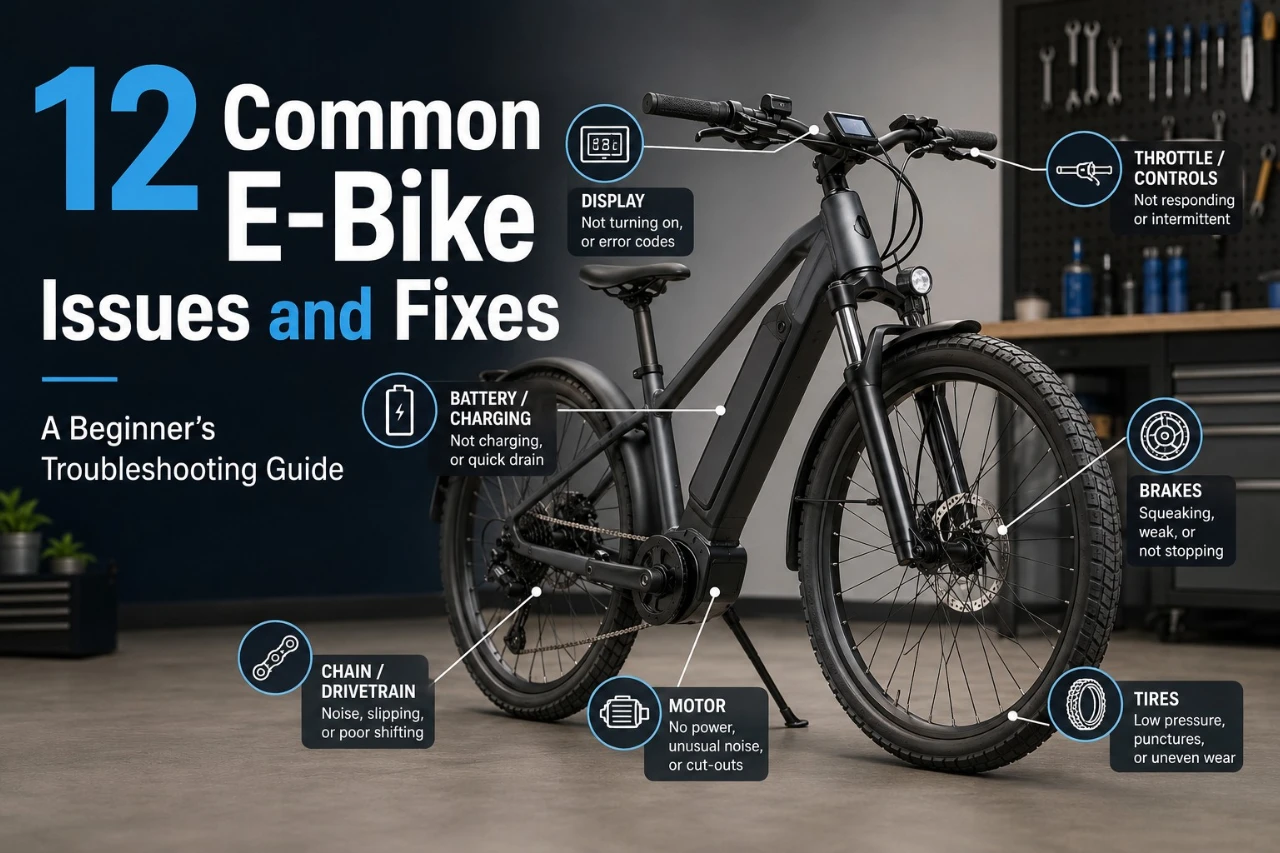
This guide walks you through 12 of the most common e-bike issues that everyday riders run into. For each one, you will find a plain explanation of what it looks like, what usually causes it, and what you can reasonably do yourself. You will also find clear guidance on when a problem needs professional attention rather than a DIY fix.
Key Takeaways
- Most e-bike problems trace back to battery connections, sensor alignment, or normal mechanical wear that you can check yourself before calling a shop.
- Simple steps like checking tire pressure, inspecting connectors, and reviewing your assist level settings can rule out many apparent faults quickly.
- Battery pack interiors, controller boards, and cracked frames are not safe for home repair; knowing where to stop protects both you and the bike.
Quick Troubleshooting Table
Most e-bike faults show up in a predictable pattern: a symptom you notice, a likely cause behind it, and a first check that either confirms the issue or rules it out. The table below covers the most common symptoms quickly. Deeper explanations for each follow in the numbered sections.
Symptom, Likely Cause, And First Check
| Symptom | Likely Cause | First Check |
|---|---|---|
| Battery will not charge | Faulty charger, dirty port, dead cell | Test with a different charger; inspect the port |
| Bike will not turn on | Dead battery, loose connection, display fault | Check battery charge level and connectors |
| Throttle not responding | Wiring fault, connector loose, worn throttle | Inspect throttle connector and wires |
| Pedal assist not engaging | Sensor misalignment, magnet gap, dirty sensor | Check PAS sensor alignment at the crank |
| Motor cuts out mid-ride | Overheating, voltage drop, loose connector | Let cool, check battery charge, inspect connectors |
| Error code on display | Sensor fault, wiring issue, calibration needed | Look up code in your manual; check connections |
| Range much lower than expected | Cold temps, tire pressure, high assist use | Check tire pressure, assist level, battery age |
| Brake sensor stops motor unexpectedly | Stuck or misaligned brake sensor | Inspect brake lever sensor position and connection |
| Blank or wrong display | Loose display cable, firmware glitch | Reseat display cable; try a power cycle |
| Flat tire | Debris, low pressure, worn tire | Inspect tire surface and check pressure |
| Squeaky or weak brakes | Dirty rotors, worn pads, misaligned calipers | Clean rotor; check pad thickness |
| Chain skip or poor shifting | Worn chain, cable stretch, dirty drivetrain | Check chain wear and cable tension |
Problems You Can Usually Handle At Home
Many of the issues in the table above are safe to address without special tools or professional training. These include checking tire pressure, cleaning brake rotors, reseating cable connectors, aligning the pedal assist sensor, lubricating the chain, and replacing a flat inner tube.
These are normal ownership tasks, and most e-bike manuals walk you through them directly.
Problems That Should Go Straight To A Shop
Some issues are not safe to diagnose or repair without proper training and tools. Do not attempt to open a lithium battery pack, modify the controller, bypass a brake sensor, or repair a cracked frame yourself. If you smell burning, see swelling on the battery, notice exposed wiring, or get an error code that your manual does not explain clearly, stop riding and get professional help.
Safety First Before You Start Checking Anything
Before you touch any part of your e-bike for diagnosis or repair, there are a few habits that protect both you and the bike. Electrical system issues and battery management system faults carry real risk if approached carelessly, and a calm, methodical approach prevents most accidental damage.
Power Down The Bike And Remove The Battery If The Manual Allows
Always turn the bike fully off before inspecting wires, connectors, sensors, or mechanical parts. If your battery is removable and your manual allows it, remove it before working near electrical components.
Do not work on a powered bike. Even low-voltage systems can cause shorts or damage sensitive components if a connector is accidentally disturbed while the system is live.
What Not To Open, Bypass, Or Modify
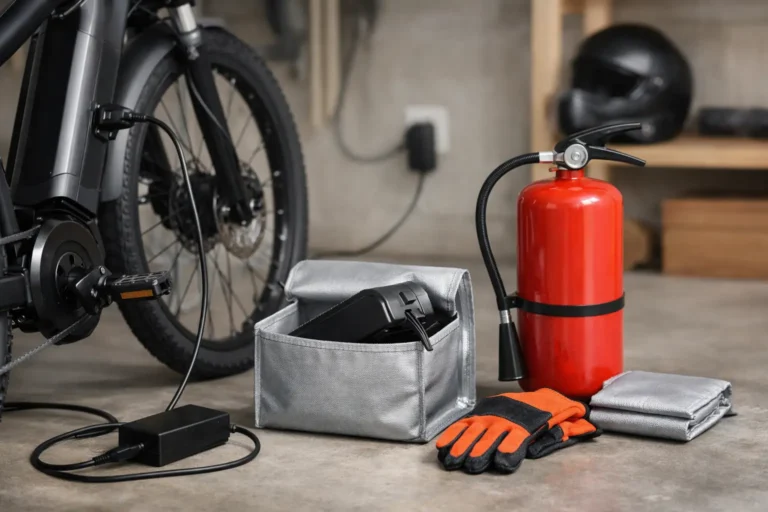
Do not open a lithium battery pack under any circumstances unless you are a trained technician. Damaged or improperly handled battery cells can cause fires or release harmful gases.
Do not bypass brake sensors, speed limiters, or safety cutoffs. These exist for real reasons. Do not modify the controller or cut wires to solve a fault you have not fully diagnosed. Loose connectors can sometimes look like a reason to rewire something, but most of the time a firm reseat of the connector is all that is needed.
Basic Tools That Are Safe And Useful For Home Diagnosis
You do not need a full workshop to check most e-bike issues at home. A set of hex keys (Allen wrenches), a Phillips screwdriver, and a clean cloth will handle the majority of mechanical checks.
Electrical contact cleaner in a spray can is useful for cleaning connector pins gently. A tire pressure gauge and a basic floor pump are essential. If you want to go further, a multimeter lets you check charger output voltage, but this is optional for most basic checks.
1. E-Bike Battery Not Charging
Battery charging problems are among the most common issues riders report, and they often have straightforward causes worth checking before assuming the battery itself has failed.
Battery Not Charging
The most common sign is that the charger light does not change color or does not light up at all when plugged in. The bike may also refuse to turn on after what should have been a full charge session.
Start by checking the charging port on the bike for debris, bent pins, or corrosion. Even a small amount of dirt can prevent a solid connection. Gently clean the port with a dry cloth or a very light spray of electrical contact cleaner.
Next, check the charger itself. If the indicator light never comes on, the charger may be the problem rather than the battery. Try a compatible replacement charger if you have access to one.
E-Bike Will Not Turn On
If the battery appears charged but the bike will not turn on, check that the battery is fully seated in its mount and that the connection points are clean and making contact. A battery that looks inserted can still have a loose contact.
Check that the main power button is being held long enough. Some e-bikes require a two-to-three second hold to start up rather than a quick tap.
Battery Drains Faster Than Expected
Fast drain is usually caused by riding in high assist levels for extended periods, cold temperatures reducing effective battery capacity, or a battery that is aging and losing its ability to hold a full charge.
If the range has dropped noticeably over a season and all other factors are the same, the battery may be nearing the end of its useful cycle life. Most lithium batteries on e-bikes last between 500 and 1,000 charge cycles before significant capacity loss.
Loose Battery Contacts And Charging Port Checks
Inspect the metal contact points between the battery and the frame dock. If they look corroded or discolored, a careful clean with electrical contact cleaner and a soft cloth can restore connection quality.
Do not force a battery that does not seat easily. If the dock feels misaligned or damaged, have it inspected rather than pressing harder.
2. E-Bike Will Not Turn On
When an e-bike will not power up at all, the cause is usually somewhere in the power chain between the battery and the display. Sensor-related issues, assist level misconfigurations, and torque sensor behavior can all look like a startup failure when they are actually something different.
Throttle Not Working
A throttle that does not respond during startup is sometimes mistaken for the bike not turning on. If the display is lit but the throttle produces no movement, the issue is likely in the throttle circuit or wiring rather than the main power system.
Check that the throttle connector is seated firmly at the controller. Throttle wires are prone to loosening near the handlebars from repeated movement.
Pedal Assist Sensor Not Engaging
Some bikes will appear to turn on but produce no motor assistance because the pedal assist sensor is not registering pedal movement. This can look like the bike is not fully working at startup.
Check that the cadence sensor magnet on the crank arm is correctly positioned and close enough to the sensor pickup. A gap of more than a few millimeters is often enough to prevent detection.
Assist Level Settings That Mimic A Fault
It sounds simple, but an assist level set to zero on the display will make the bike feel completely unpowered even when everything is working. Check your display settings before assuming a fault exists.
Some e-bikes also have a walk mode or a locked mode activated by a button combination. Check your manual for any mode that could explain the lack of response.
Torque Sensor Versus Cadence-Style Behavior
If your bike uses a torque sensor rather than a simple cadence sensor, it responds to how hard you pedal rather than just whether you are pedaling. Riding with very light pedal pressure may produce little or no assistance, which can feel like a fault when the system is actually working as designed.
Understanding which sensor type your bike uses helps you distinguish real problems from expected behavior.
3. Throttle Not Working
Throttle problems usually show up as no response when you twist or push the throttle, or as inconsistent power delivery. Motor problems, overheating, loose connectors, and battery voltage drop can all cause throttle faults that look similar at first.
Motor Cuts Out While Riding
If the motor cuts out only when you apply the throttle but the display stays on, the issue may be a voltage drop from a partially discharged battery. At very low charge levels, the battery management system may cut power to protect the cells.
Charge the battery fully and test again. If the cutout happens at higher charge levels, inspect the connector between the throttle and the controller.
Overheating Motor Warning Signs
Overheating can cause the motor to cut power temporarily during throttle use. This is most common after long climbs, extended high-assist riding in hot weather, or riding with a very heavy load.
Signs of overheating include a sudden loss of power followed by gradual recovery after a rest, and a motor housing that feels unusually hot to the touch. Let the motor cool for 15 to 20 minutes before riding again.
Motor Noise, Hesitation, Or Weak Assistance
A throttle that responds but produces weaker power than usual, along with unusual sounds from the motor, may indicate worn motor bearings or debris inside the motor casing. Grinding, clicking, or rattling from the motor area during throttle use warrants a professional inspection.
Hesitation on startup without noise can sometimes be a controller issue rather than a motor problem.
Loose Connectors And Controller-Side Checks
The throttle connects to the controller with a small multi-pin connector, usually located near the controller box on the frame. Check that this connector is fully seated and that no pins are bent or corroded.
Do not attempt to open or modify the controller. If reseating the connector does not resolve the throttle issue, a shop diagnosis is the appropriate next step.
4. Pedal Assist Not Working
Pedal assist failures are very common and usually have a mechanical rather than electrical cause. Electrical system issues, error codes, display faults, and contact problems can all look like pedal assist failures, so working through a short checklist usually narrows it down quickly.
Error Codes On The Display
If the display shows an error code when you try to use pedal assist, check your manual’s error code list before doing anything else. Many error codes point directly to the cause, such as a sensor disconnect or a communication fault between the display and the controller.
Do not ignore an error code and ride through it. Some codes indicate conditions that could cause unsafe behavior if the bike is ridden.
Faulty Display Or Blank Screen
If the display is blank or unresponsive, the bike may not enter assist mode at all even if the rest of the system is functioning. Check the display connector cable where it attaches to the handlebar mount and the main harness.
A power cycle (turning the bike fully off, waiting 10 seconds, and restarting) clears some temporary display faults.
Wrong Speed, Battery, Or Assist Readings
Inaccurate readings on the display can sometimes cause the system to behave unexpectedly. A speed sensor fault, for example, may cause the assist to cut out because the controller thinks the bike is moving faster than it actually is.
Check the speed sensor magnet on the wheel spoke and its alignment with the pickup on the fork. Reseating the sensor connector often resolves this.
Basic Electrical Connection Checks Before You Call For Service
Before calling a shop, work through a short connector check on the main wiring harness. Connectors between the battery, controller, display, and pedal assist sensor are the most likely places for a loose contact to develop. Use electrical contact cleaner on visible pin contacts if they look dirty or slightly corroded.
If everything looks connected and no error code appears but the assist still will not engage, a shop with diagnostic software can read controller-level faults that are not visible to the rider.
5. Motor Cuts Out While Riding
Motor cutouts mid-ride are frustrating but usually have a clear cause. Brake sensor behavior, overheating, loose connectors, and battery voltage drop account for the majority of cases, and most can be ruled out through a short process of elimination.
Brake Sensor Stops The Motor
E-bikes have brake sensors on the levers that cut motor power when you squeeze the brakes. If a brake sensor is stuck, misaligned, or has a loose connection, the motor may cut out even when you are not braking.
Squeeze both brake levers slowly and release them. If the motor only cuts when one lever is lightly touched rather than fully squeezed, that sensor may be triggering too early. Check the sensor magnet alignment on the lever.
Squeaky, Weak, Or Noisy Brakes
Brake noise or weakness noticed at the same time as a motor cutout is a sign that the brake sensor and brake mechanics need attention together. A brake caliper that is dragging may also add enough resistance to cause motor hesitation, which can feel like a cutout.
Check that pads are not rubbing the rotor when the lever is released.
Brake Pad Wear And Rotor Contamination
Worn brake pads and contaminated rotors are a common cause of brake sensor misbehavior. Oil, grease, or water on the rotor surface can cause the sensor to behave erratically in wet conditions.
Clean the rotor with a clean cloth and appropriate brake cleaner. Check pad thickness; if the pad material is worn close to the backing plate, replacement is overdue.
When Brake Problems Mean Stop Riding Immediately
If brakes feel spongy, fade badly on a descent, or produce a grinding metal-on-metal sound, stop riding immediately. These are safety conditions, not inconveniences.
Worn-through pads or a contaminated rotor can cause brake failure, especially on heavier e-bikes at speed.
6. Error Codes on the Display
Error codes are the bike’s way of pointing you toward a fault, and most of them are specific enough to be genuinely useful. Faulty display behavior, electrical system issues, and electrical contact problems often surface as error codes before any other visible symptom appears.
Error Codes On The Display
Look up the exact code in your bike’s user manual before doing anything else. Most manufacturers list their error codes with descriptions and recommended first steps. Common codes relate to motor communication faults, sensor disconnects, over-voltage, under-voltage, or temperature warnings.
If you no longer have the manual, many brands publish them online as PDFs. Search your brand name and model alongside the word “manual” or “error code list.”
Faulty Display Or Blank Screen
A display that shows a code intermittently, freezes, or goes blank may have a loose connector rather than a true electrical fault. Power the bike off, reseat the display cable connection, and restart.
If the code disappears after a reseat, check that connection again after your next ride to confirm it was the cause.
Wrong Speed, Battery, Or Assist Readings
Some error codes appear because a sensor is reporting an impossible value, such as a speed reading of zero while moving, or a battery level that jumps erratically. These often point to a sensor or connector issue rather than a failed component.
Check the speed sensor magnet and PAS magnet positions before assuming a component needs replacement.
Basic Electrical Connection Checks Before You Call For Service
If a code persists after connector checks and a power cycle, and your manual does not offer a clear resolution path, that code needs a qualified technician with a diagnostic tool. Do not attempt to clear persistent error codes by modifying wiring or bypassing sensors.
7. E-Bike Range Is Much Lower Than Expected
Range shortfall is one of the most common complaints among new e-bike owners, and it is rarely caused by a single dramatic fault. Routine maintenance gaps, cleaning habits, loose connections, tire pressure, and storage practices all affect how far your battery takes you.
Routine Maintenance Habits That Matter Most
A poorly maintained drivetrain adds resistance that forces the motor to work harder, which drains the battery faster. Keep the chain clean and lubricated, and make sure the brakes are not dragging when released.
These two checks alone can noticeably extend your real-world range.
Cleaning And Lubrication Without Harming Electronics
Avoid high-pressure water directly on connectors, the controller box, the display, or the battery dock. Use a damp cloth for the frame and components near electronics.
A dry or wax-based chain lubricant works better than wet lube in most commuting conditions because it picks up less dirt between cleaning sessions.
Connection Checks, Tire Pressure, And Brake Inspection
Low tire pressure increases rolling resistance significantly, especially on fat tire models. Check pressure before every ride and keep it within the range printed on the tire sidewall.
Loose connectors between the battery and controller can cause subtle power delivery inefficiency that shows up as reduced range before any obvious fault appears.
Storage Habits That Help Battery Health
Store your battery at a partial charge, between 40 and 80 percent, if you are not planning to ride for more than a few days. Storing at full charge or running the battery to zero repeatedly shortens its long-term capacity.
Keep the battery indoors at room temperature during cold months. Lithium batteries lose significant temporary capacity below 40 degrees Fahrenheit, which is one reason range drops sharply in winter.
8. Brake Sensor Stops the Motor
When the brake sensor stops the motor unexpectedly, it usually means the sensor is triggering when it should not be. A cracked frame, battery issues, electrical system problems, and motor faults can all present alongside brake sensor behavior, so ruling out the sensor first is the right starting point.
Signs Of Unsafe Battery Or Wiring Damage
A brake sensor that triggers erratically may in rare cases be a symptom of a broader electrical fault rather than just a misaligned sensor. If you notice any swelling of the battery case, a burning smell near the motor or controller, or visible wire damage near the sensor connections, stop riding immediately.
These are not brake sensor problems. They are safety concerns that require professional attention before the bike is ridden again.
Structural Damage Such As A Cracked Frame
A cracked frame near the motor mount or bottom bracket can cause sensor misalignment as the frame flexes under load. If you notice motor cutouts that happen specifically under hard pedaling or on rough surfaces, inspect the frame around the bottom bracket area carefully.
A cracked frame is not rideable. Have it assessed by a qualified mechanic before continuing to use the bike.
Problems That Need Diagnostic Tools Or Internal Repair
If reseating the brake sensor connector and adjusting the sensor magnet position does not stop the false triggering, the fault may be inside the controller’s sensor input circuit. This is not a home repair.
A qualified e-bike technician with a diagnostic interface can read the sensor signal directly and determine whether the sensor, the wiring, or the controller is at fault.
9. Display Not Working or Showing Wrong Information
A blank or inaccurate display can cause real confusion because it affects every other reading you depend on while riding. Start with the simplest checks before assuming the display unit itself has failed.
Check the cable connection between the display and the main wiring harness. This connector is one of the most common points of failure, especially on bikes that have been ridden in wet conditions or stored with the display attached and the bike left in varying temperatures.
Power the bike off completely, disconnect and reconnect the display cable firmly, and restart. This resolves a large percentage of blank-screen faults.
If the display powers on but shows wrong readings, such as a battery percentage that does not match actual charge level or a speed that reads zero while moving, the issue is likely a sensor rather than the display itself. Check the speed sensor magnet on the wheel and the battery connector contact points.
A display that powers on and off randomly during a ride usually has a loose connection that moves with vibration. Check the display mount and cable routing for points where the cable may be pinching or flexing excessively.
If the display is physically damaged, cracked, or water-ingressed, it will need replacement. Display units for most popular brands are available separately and are a straightforward swap for most models.
10. Flat Tire or Frequent Punctures
Flat tires are one of the most common mechanical issues on any bike, and e-bikes are no exception. The added weight of the motor and battery means e-bike tires carry more load, which increases the importance of maintaining proper pressure.
Check tire pressure before every ride. Under-inflated tires are more vulnerable to pinch flats, where the tube gets compressed against the rim when rolling over bumps. Most e-bike tires have a recommended pressure range printed on the sidewall.
Inspect the tire surface regularly for embedded glass, wire fragments, or sharp stones. Small debris works its way through the tread slowly over several rides before causing a flat, so catching it early matters.
If you are getting repeated flats in the same area of the tube, check the rim tape inside the wheel. A worn or shifted rim tape can expose spoke holes that cause slow punctures.
Puncture-resistant tires, such as models with reinforced belts under the tread, are a practical upgrade if you ride on roads with frequent debris. They add a small amount of rolling resistance but significantly reduce flat frequency for most urban and suburban riders.
Fixing a flat on an e-bike is the same process as on a standard bike for most models. Rear wheel removal is slightly more involved on hub-motor bikes due to the motor cable, but most manufacturers include instructions in the manual for exactly this situation.
11. Squeaky, Weak, or Noisy Brakes
Brake problems on an e-bike are more serious than on a standard bicycle because of the added weight and speed. Never ride through a brake issue and plan to fix it later.
Squeaking brakes are almost always caused by contaminated or glazed brake pads, a dirty rotor, or slight caliper misalignment. Clean the rotor with a clean cloth and appropriate brake cleaner. Avoid touching the rotor surface with bare hands, as skin oils contaminate the braking surface.
If cleaning does not stop the squeak, check that the caliper is centered over the rotor. A misaligned caliper causes one pad to contact the rotor unevenly, which produces noise and reduces braking power.
Weak braking that requires more lever travel than normal is often caused by worn brake pads. Check pad thickness visually. If the pad material is thin enough to see metal near the backing plate, replace both pads immediately.
Grinding sounds from the brakes usually mean the pads are worn completely through and metal is contacting the rotor. This is a stop-riding situation. Riding with metal-on-metal braking will damage the rotor and create a genuine safety risk, especially at e-bike speeds.
Hydraulic brakes that feel spongy may have air in the line. Bleeding the brake is a job most riders should leave to a shop unless they have specific experience with hydraulic brake systems.
12. Chain, Gear, or Drivetrain Problems
Drivetrain issues on an e-bike are mostly the same as on any bicycle, but the motor’s added torque can accelerate chain and cassette wear compared to a non-electric bike.
Chain skip under load, where the chain jumps over the cassette teeth when you pedal hard, is usually caused by a stretched chain. Check chain wear with a chain wear indicator tool. A chain that has stretched past the recommended limit should be replaced before it damages the cassette.
Poor shifting that feels slow, imprecise, or requires multiple clicks to find the correct gear is often caused by cable tension that has stretched slightly over time. A small adjustment at the derailleur barrel adjuster usually brings shifting back into alignment. This is one of the more accessible adjustments for beginners.
Drivetrain noise, specifically clicking, rattling, or a grinding sound that changes with pedaling cadence rather than speed, is almost always mechanical rather than motor-related. Cross-chaining, meaning using the largest chainring with the largest cog or smallest with smallest, causes chain noise and stress. Shift to a more neutral gear combination.
Lubricate the chain regularly. A dry chain is noisier, less efficient, and wears faster. Use a lubricant suited to your riding conditions; dry or wax-based lube works well for most road and commuter use.
If the rear derailleur hanger looks bent or the derailleur itself is damaged, do not attempt to straighten it on the bike without checking the alignment carefully. A bent hanger causes persistent shifting problems and can cause the derailleur to contact the wheel.
When to Stop Riding and Contact a Professional
Some problems are safe to investigate and fix at home. Others require you to stop riding immediately and seek help from a qualified e-bike mechanic or the manufacturer’s support team.
Stop riding right away if you notice any of the following:
- A burning smell from the battery, motor, controller, or wiring
- A battery case that looks swollen, bloated, or deformed
- Sparks, smoke, or unusual heat from any electrical component
- Brakes that do not stop the bike reliably, feel spongy under full pressure, or produce grinding sounds
- A cracked or bent frame, especially near the motor mount, bottom bracket, or head tube
- An error code that your manual lists as a do-not-ride condition
- Any wiring that is visibly damaged, frayed, or exposed
These conditions are not inconveniences. Riding through them creates real risk of injury or fire. Store the bike safely, keep it away from flammable materials, and contact the manufacturer or a professional before using it again.
Contact a qualified mechanic or your manufacturer’s support team for:
- Any internal battery issue beyond cleaning the contacts
- Controller faults that persist after connector checks
- Motor replacement or internal motor repair
- Hydraulic brake bleeding
- Frame damage assessment
- Any fault you are not confident diagnosing safely at home
Basic E-Bike Maintenance Tips to Prevent Future Problems
Most e-bike problems are easier to prevent than to fix. A short routine after every few rides eliminates the most common causes of electrical and mechanical faults before they develop.
Routine Maintenance Habits That Matter Most
Check tire pressure before every ride. Low pressure is the single most common cause of flats and also reduces your range. Keep it within the range on the tire sidewall.
Clean and lubricate the chain every 100 to 150 miles, or more often in wet conditions. A clean drivetrain is more efficient and puts less strain on the motor.
Cleaning And Lubrication Without Harming Electronics
Wipe down the frame, battery dock, and display with a damp cloth after muddy or wet rides. Avoid spraying water directly at connectors, the controller box, or the charging port.
Use a dry or wax-based chain lube in most conditions. Wet lubricants attract more dirt and require more frequent cleaning to avoid buildup.
Connection Checks, Tire Pressure, And Brake Inspection
Once a month, check the main connector points on the wiring harness. Press each connector firmly to confirm it is fully seated. Pay attention to the battery dock contacts, the display cable, and the motor connector.
Inspect brake pads for wear and check that the levers have firm, consistent feel. Catching a brake issue early is far easier than diagnosing one after a fault develops.
Storage Habits That Help Battery Health
Store the battery at between 40 and 80 percent charge if you are not riding for more than a few days. Avoid storing at full charge or empty.
Keep the battery at room temperature. Cold storage temporarily reduces capacity; extended storage in freezing conditions can cause longer-term damage to lithium cells.
Conclusion
Most e-bike problems have a straightforward cause and a clear path forward, whether that means a quick connector reseat at home or a visit to a qualified mechanic. The key is working through checks calmly and knowing where the safe limit is for home diagnosis.
Battery and charging issues, sensor alignment, tire pressure, and brake condition account for the large majority of faults that everyday riders encounter. Staying on top of basic maintenance, checking connections periodically, and storing the battery correctly prevents most of these issues from developing in the first place.
For deeper buying and comparison research, GoEBikeLife covers real-world range expectations, brake quality differences, and use-case fit across dozens of models, which can help you choose a bike with a more reliable setup from the start.
When a problem is beyond a simple check or involves the battery pack, controller, or frame structure, stop riding and get professional help. That is not a limitation; it is the right call for your safety and the long life of the bike.