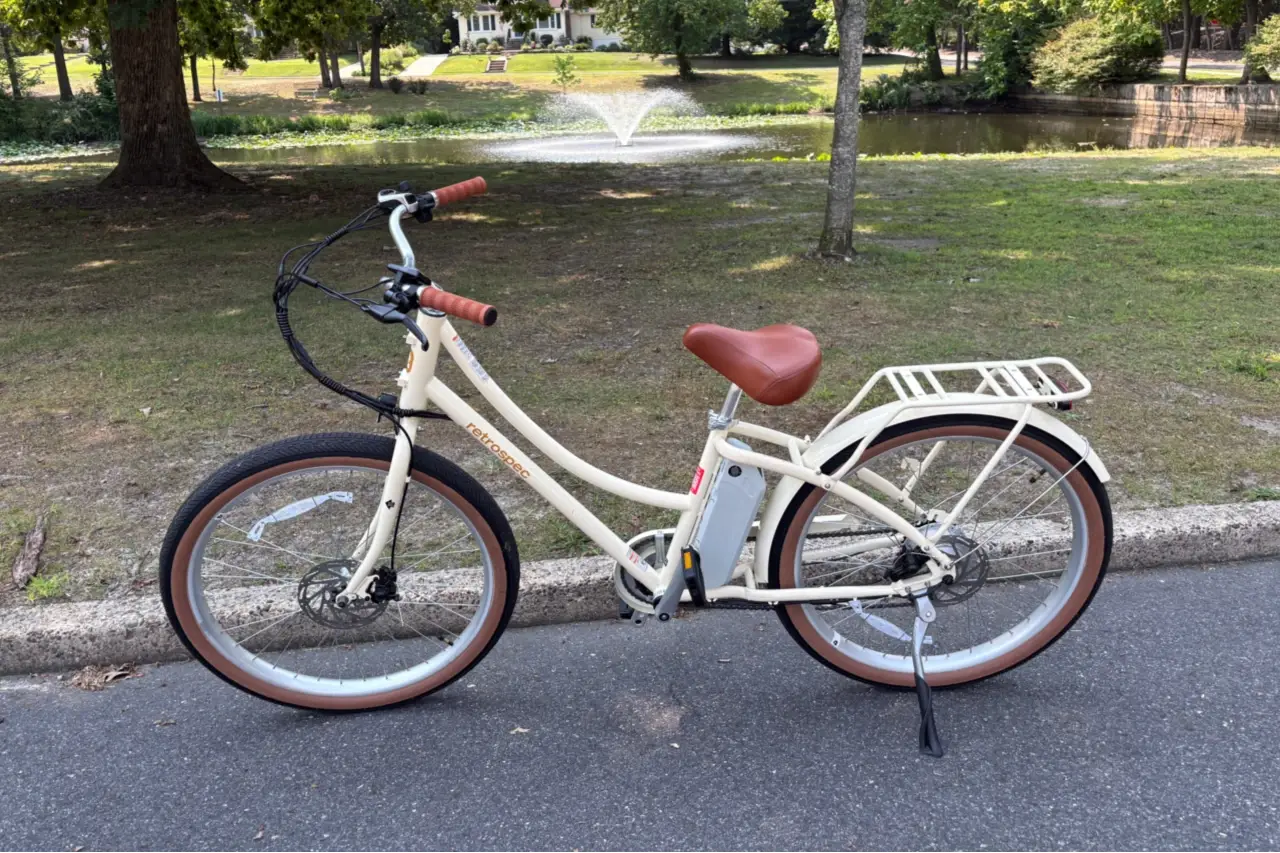
Our verdict: The Retrospec Beaumont Rev 3 is one of the more complete and approachable city e-bikes available around the $1,000 mark. Its comfortable step-through design, smooth pavement manners, throttle, integrated headlight, full fenders, and included rear rack make it especially practical for short commutes and errands. The tradeoffs are its 57.5-pound weight, basic LED display, cadence sensor, mechanical brakes, and limited one-size fit range.
Rating: 8.4/10
Best for: Everyday city rides, neighborhood errands, campus transportation, paved paths, and first-time e-bike owners who want comfort and simplicity.
Skip it if: You need a lightweight bike for stairs, a high-capacity cargo rack, advanced ride data, or a bike for aggressive hills and rough trails.
Disclosure: Retrospec provided the Beaumont Rev 3 used for this review. The company did not control our findings or final opinion. This article contains affiliate links, which means we may earn a commission if you buy through them, at no additional cost to you.
The Retrospec Beaumont Rev 3 takes a different approach from many budget e-bikes. Instead of chasing oversized motors, fat tires, or an aggressive motorcycle-inspired appearance, it focuses on the things that matter for ordinary city riding: easy mounting, an upright position, predictable assistance, useful accessories, and a friendly design.
We tested the Beaumont Rev 3 on paved roads in a campus-style setting, using multiple pedal-assist levels, the throttle, the brakes, and a local hill. Our test ride covered roughly six miles. That is enough to evaluate the bike’s handling and basic power delivery, but not enough to independently verify Retrospec’s full 42-mile range claim.
Beaumont Rev 3 at a Glance
| Specification | Details |
|---|---|
| E-bike class | Class 2 |
| Motor | 350W rear geared hub motor |
| Top assisted speed | 20 mph |
| Battery | 36V, 10.4Ah / approximately 360Wh |
| Claimed range | Up to 42 miles |
| Charging time | Approximately 5–6 hours |
| Pedal assist | 5 levels, cadence sensor |
| Throttle | Yes, up to 20 mph |
| Drivetrain | Shimano Tourney 7-speed |
| Brakes | Tektro mechanical disc brakes, 180mm rotors |
| Tires | 27.5 × 2.4-inch city tires |
| Frame and fork | Steel step-through frame, rigid steel fork |
| Included equipment | Front light, rear light, bell, full fenders, rear rack, chain guard, kickstand, and tool kit |
| Rear-rack capacity | 22 lb / 10 kg |
| Recommended total weight limit | 350 lb |
| Bike weight | 57.5 lb with battery |
| Stated rider-height range | 5’0″–5’10” |
| Safety certification | UL 2849 e-bike system and UL 2271 battery |
| Price at time of review | $999.99; no current discount code supplied |
Specifications and pricing can change. Confirm the current configuration and price before ordering.
What We Liked
- Comfortable, accessible step-through frame
- Smooth, relaxed ride on paved streets
- Throttle and five pedal-assist levels
- Reaches its 20 mph assisted limit promptly in higher assist
- Strong, predictable braking during our test
- Full fenders, rack, lights, bell, and chain guard included
- 350-pound recommended weight limit is generous for this category
- UL 2849 and UL 2271 certified
- Distinctive city-bike styling without looking overly “electric”
What Could Be Better
- Heavy at 57.5 pounds, especially if stairs are involved
- Manufacturer lists only one size for riders from 5’0″ to 5’10”
- Basic LED display does not provide the detail of a full LCD screen
- Cadence-sensor assistance is less natural than a torque-sensor system
- Mechanical disc brakes require periodic cable adjustment
- Rigid fork limits comfort on badly broken pavement
- Rear rack is useful but rated for only 22 pounds
- Rear light uses separate AA batteries rather than the main e-bike battery
- Our short ride did not verify the full 42-mile range claim
Design, Fit, and Everyday Comfort
The Beaumont Rev 3 looks more like a classic Dutch-inspired city bicycle than a typical budget e-bike. Its curved step-through frame, swept-back handlebars, brown comfort saddle, matching tire sidewalls, full chain guard, and understated battery placement give it a cohesive appearance. Riders who dislike bulky, industrial-looking e-bikes may find this design especially appealing.
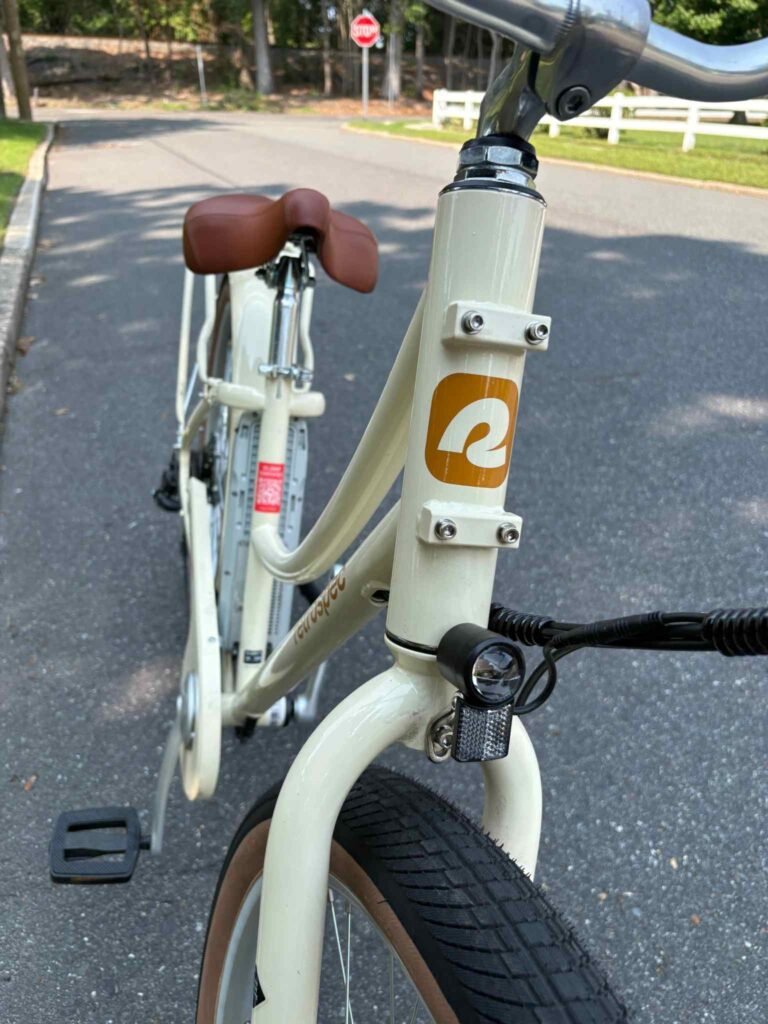
The low 19.35-inch standover height makes getting on and off easier than with a conventional high-step frame. The swept-back Dutch-style handlebar supports a relaxed, upright riding position, while the padded saddle and 2.4-inch tires help absorb smaller pavement imperfections.
Our tester’s strongest impression was how smooth the bike felt on ordinary roads. The upright riding position makes it easy to look ahead, monitor traffic, and remain comfortable during relaxed neighborhood or campus rides.
There is no suspension fork, so the Beaumont Rev 3 should still be treated as a pavement-first bike. The relatively high-volume tires soften cracks and minor bumps, but they cannot fully isolate the rider from potholes, rough gravel, or badly damaged streets.
Fit is also worth checking carefully. Retrospec lists the single 42cm size for riders from 5’0″ to 5’10”. The quick-release seatpost gives some adjustment, but riders near or above the upper end should compare their measurements with Retrospec’s sizing chart before purchasing.
Controls and Ease of Use
The Beaumont Rev 3 keeps its interface simple. A left-mounted LED panel displays battery status and the selected assist level. Its buttons control power and assistance, and holding the appropriate control activates the integrated headlight.
The bike also has a thumb-operated throttle, an integrated bell, and a seven-speed Shimano shifter.
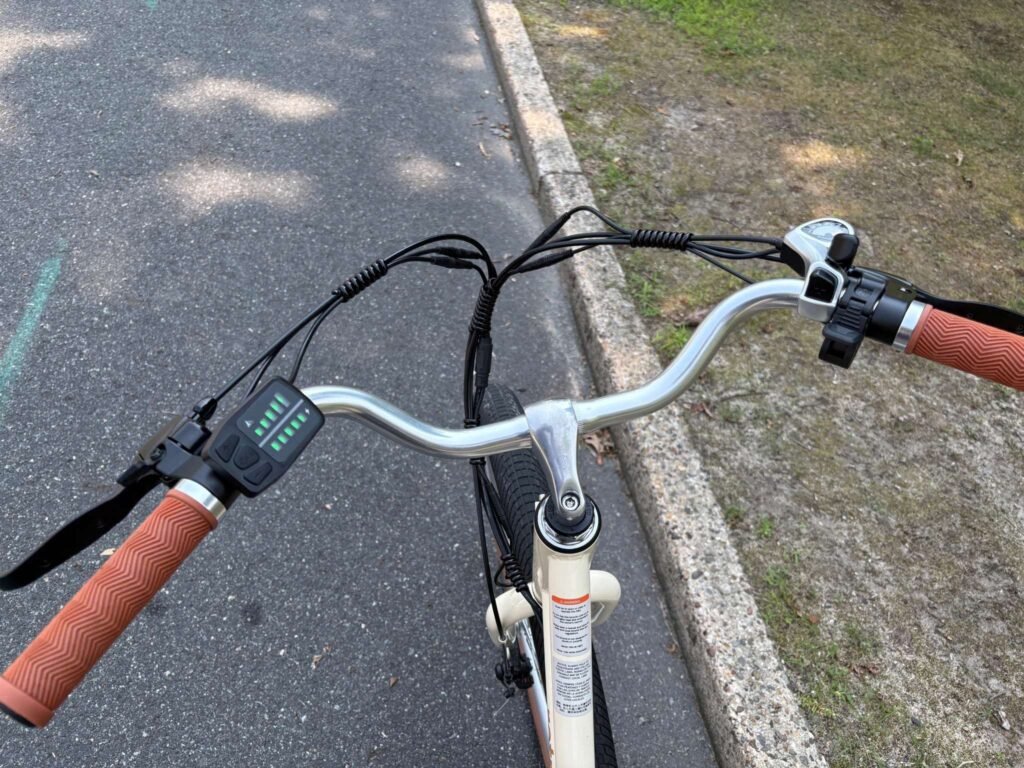
That simplicity works well for beginners. There are no deep menus or complicated settings to learn.
During testing, Pedal Assist 1 provided gentle help at roughly 6 mph, while Level 2 increased assistance to around 9 mph. Level 5 brought the bike to its assisted top speed quickly.
These speeds are observations from the test ride rather than fixed speed caps for each level. Terrain, gearing, battery charge, and rider input can all change the actual speed.
The downside is limited information. Riders who want trip distance, precise remaining range, wattage, average speed, or other detailed data may find the LED panel too basic. The battery bars are also a rough estimate, not a precise remaining-range gauge.
Motor Performance and Hill Climbing
The 350W rear hub motor is appropriately matched to this bike’s city-focused purpose. It does not have the raw acceleration of the 750W motors common on heavier fat-tire models, but it feels responsive enough for traffic lights, neighborhood roads, campus routes, and normal urban gradients.
In higher assistance, the bike accelerated to its 20 mph Class 2 limit promptly during our test.
The test route included a hill, and the Beaumont maintained useful assistance without feeling strained. That is encouraging for rolling city terrain.
However, we did not record the hill’s grade, perform repeated loaded climbs, or test the bike on very steep roads. Buyers with long, steep daily climbs should view this as a competent moderate-hill commuter—not a substitute for a higher-torque mid-drive or more powerful hub-motor bike.
The cadence sensor delivers assistance after detecting crank movement. It is straightforward and keeps the price down, but it cannot match the immediate, proportional response of a torque sensor.
New riders should begin in a low assist level in crowded areas and become familiar with how quickly the motor engages.
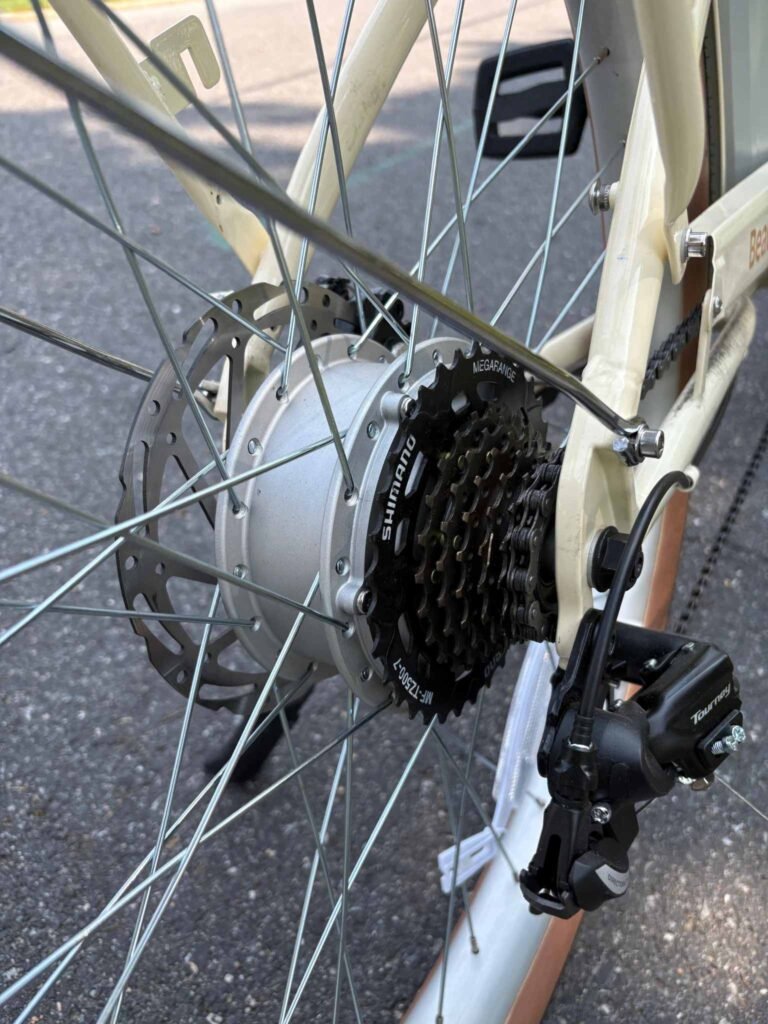
The Shimano Tourney seven-speed drivetrain provides enough gearing for city riding and lets you contribute meaningful pedal power instead of relying entirely on the motor. Starting in a lower gear is particularly helpful on inclines and reduces strain on the drivetrain.
Ride Quality and Handling
Comfort is the Beaumont Rev 3’s clearest strength. The upright cockpit reduces pressure on the hands and encourages an easy view of traffic. Its 27.5-inch wheels feel stable, while the 2.4-inch tires add more cushioning and confidence than narrow commuter tires.
The bike felt composed on paved campus roads and residential streets. It is not especially nimble or lightweight, but the mass is carried low enough that the bike remains manageable once moving.
The mid-mounted external battery also avoids putting all of the battery weight high on a rear rack.
At 57.5 pounds, however, the Beaumont is still a heavy bicycle. That matters less when rolling it out of a garage and more when lifting it onto a rack, carrying it upstairs, or maneuvering it in a tight apartment.
Confirm that your vehicle rack is rated for the bike’s weight, and remove accessories as appropriate before transport.
Braking Performance
The Tektro mechanical disc brakes use 180mm anti-vibration rotors and semi-metallic pads. They felt strong and predictable in our short test, bringing the bike down from speed with good control.
We did not perform a measured 20-to-0-mph stopping-distance test, so we are not assigning a numerical braking result.
Mechanical disc brakes are sensible at this price because they are widely serviceable and less complicated than hydraulic systems. The tradeoff is maintenance: cable stretch and pad wear can gradually increase lever travel.
Owners should inspect pad thickness, rotor condition, and cable tension regularly—especially on a 57.5-pound e-bike that may also carry cargo.
Battery and Real-World Range
The 36V, 10.4Ah battery provides approximately 360Wh of capacity and is mounted low behind the seat tube. Retrospec claims up to 42 miles per charge and lists a 5–6-hour full charging time.
As with every e-bike, actual distance depends on assist level, throttle use, hills, rider and cargo weight, tire pressure, temperature, wind, and how often the bike stops and starts.
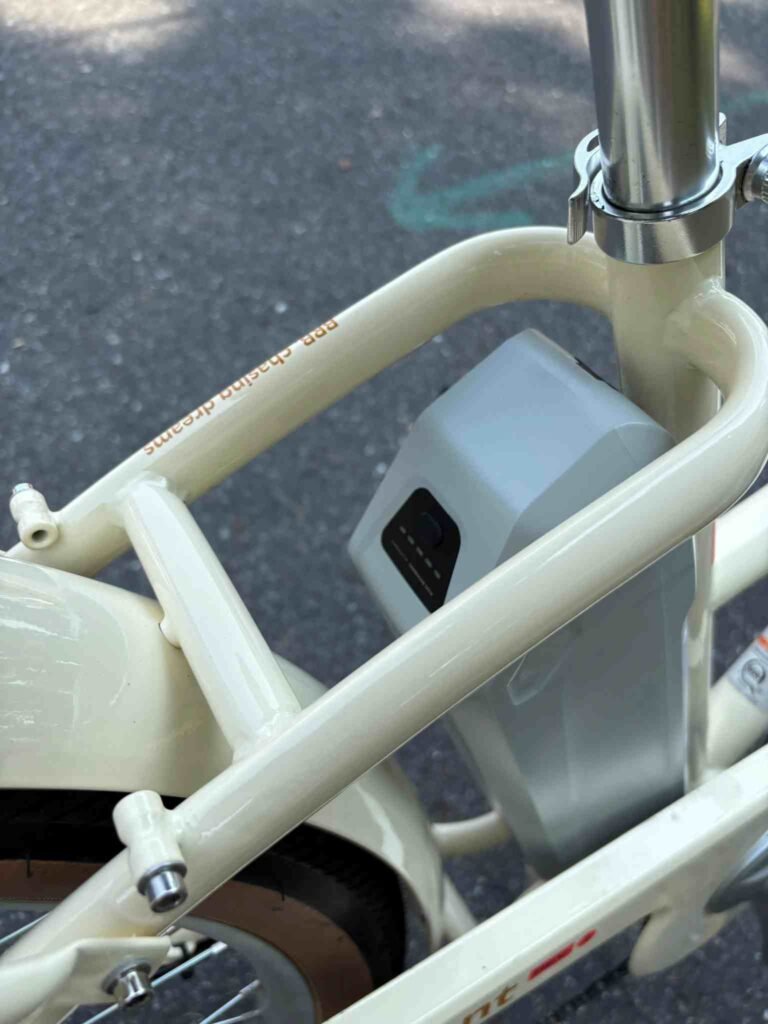
Our tester rode about six miles and reported that the LED battery indicator dropped by one bar. That is a positive early result, but it should not be used to extrapolate a precise total range.
Bar-style battery gauges are not linear enough, and a six-mile ride is too short to confirm a 42-mile maximum.
For realistic planning, treat 42 miles as an ideal-condition ceiling rather than a guaranteed commuting distance. Riders using high assistance or throttle frequently, climbing hills, or carrying more weight should expect less.
A future full battery rundown at controlled assist levels would be needed for a verified GoEBikeLife range figure.
Included Accessories and Everyday Utility
Many sub-$1,000 e-bikes appear inexpensive until essential commuter parts are added. The Beaumont Rev 3 arrives with full-coverage steel fenders, a chain guard, integrated 40-lux front light, rear light, bell, kickstand, and rear rack.
That package makes it much closer to being commute-ready from day one.
The rack is useful for a small pannier, light grocery load, or compact work bag, but its stated maximum capacity is 22 pounds. It should not be treated like a heavy-duty cargo platform, and it is not designed to carry a passenger.
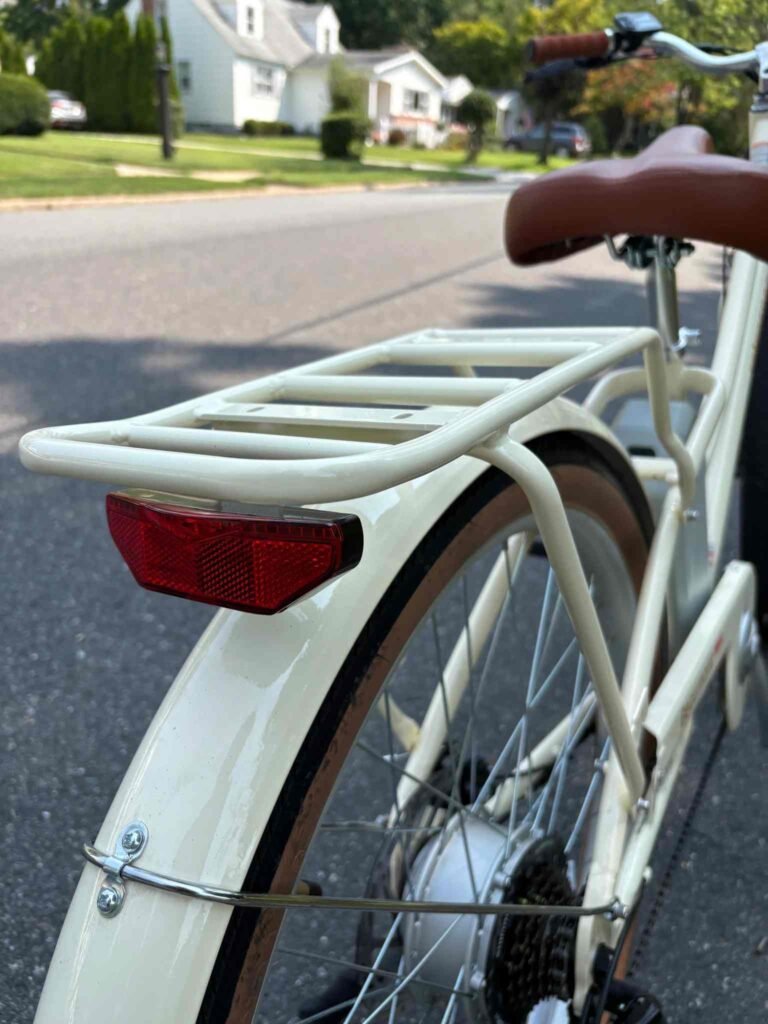
One detail to understand is the lighting setup. The front light is integrated with the e-bike system, while the rear light is powered by AA batteries.
The rear light is still valuable, but owners need to monitor and replace its batteries independently.
The full fenders and chain guard are well suited to everyday clothing and damp pavement. They will not keep a rider completely dry in heavy rain, but they reduce road spray and help prevent pants from contacting the chain.
Price and Value
At the time of this review, the Beaumont Rev 3 was listed at $999.99, with no discount code available to us.
Buyers should check the current Retrospec price and color availability because promotions and inventory can change.
The bike’s value comes from the complete package, not from any single headline specification. A 350W motor and approximately 360Wh battery are modest by current standards, but the Beaumont also includes practical parts that many budget competitors omit: full fenders, a rack, lights, a bell, a seven-speed drivetrain, high-volume tires, and certified electrical systems.
Its strongest competition will come from bikes offering a larger battery, color display, hydraulic brakes, or a torque sensor near the same price.
The Beaumont answers with better-than-average city styling, a very accessible frame, an uncomplicated interface, and a commuter-ready equipment list.
Who Should Buy the Retrospec Beaumont Rev 3?
The Beaumont Rev 3 is a good match for:
- A first-time e-bike owner who wants simple controls
- A shorter-distance commuter who rides mostly on pavement
- A campus rider who values an upright position and rear rack
- Someone replacing short car trips with errands by bike
- A rider who wants throttle assistance without exceeding Class 2 speeds
- A buyer who prefers traditional city-bike styling
- A rider who values UL-certified electrical systems
It is a less suitable choice for:
- Riders outside Retrospec’s stated 5’0″–5’10” fit range
- Apartment dwellers who regularly carry a bike upstairs
- Riders needing a high-capacity cargo rack
- Long-distance commuters who require independently verified range
- Frequent steep-hill riders seeking high torque
- Riders planning regular off-road or technical trail use
- Data-focused users who want a detailed LCD or app connection
Retrospec Beaumont Rev 3 vs. a More Powerful Budget E-Bike
Motor wattage alone does not decide which bike is better.
A 500W or 750W competitor may accelerate harder and climb steep hills more confidently, but it may also be heavier, less bicycle-like, and less refined for relaxed city riding.
The Beaumont Rev 3 is the better choice when accessibility, comfort, included commuter equipment, and restrained Class 2 performance matter more than maximum output.
On the other hand, riders with sustained steep climbs, heavier cargo needs, or a desire to travel faster than 20 mph should choose a model built for those requirements.
The Beaumont works best when judged as a comfortable city bicycle with electric assistance—not as a high-performance e-bike.
Our Final Verdict
The Retrospec Beaumont Rev 3 succeeds because its design and equipment serve a clear purpose. It is easy to approach, comfortable on pavement, quick enough for normal city trips, and already fitted with most of the accessories a commuter or errand rider needs.
Our test found smooth ride quality, responsive assistance, reassuring braking, and adequate support on a local hill.
We also appreciate the UL certifications and the unusually complete equipment package at this price.
Still, buyers should recognize the limitations: it is heavy, the display is basic, the rear rack has a modest capacity, mechanical brakes need adjustment over time, and the advertised 42-mile range remains a manufacturer claim rather than a result verified by our six-mile test.
For riders within the stated fit range who want a stylish, comfortable Class 2 city e-bike for paved everyday use, the Beaumont Rev 3 is a strong value at around $1,000.
Frequently Asked Questions
Is the Retrospec Beaumont Rev 3 a Class 2 e-bike?
Yes. It provides five levels of pedal assistance plus a throttle, with electric assistance up to 20 mph.
How far can the Beaumont Rev 3 travel on one charge?
Retrospec advertises up to 42 miles. We completed a roughly six-mile test ride and used one indicated battery bar, but that short test does not independently verify the full claim.
Real range varies with assist level, throttle use, hills, rider weight, cargo, weather, and tire pressure.
Can the Beaumont Rev 3 handle hills?
It handled the hill on our paved test route confidently. The 350W hub motor should be adequate for normal rolling city terrain, but we did not test sustained steep gradients or measure hill grade.
Riders facing demanding climbs may want more torque.
Does the Beaumont Rev 3 have a throttle?
Yes. A thumb-operated throttle can power the bike up to its 20 mph Class 2 limit, subject to riding conditions and battery charge.
What rider height fits the Beaumont Rev 3?
Retrospec lists the 42cm frame for riders from 5’0″ to 5’10”, with a 19.35-inch standover height. Compare your inseam and preferred riding position with the official sizing chart before ordering.
Is the Beaumont Rev 3 suitable for commuting?
Yes, especially for paved short-to-moderate trips. It includes full fenders, a rear rack, front and rear lights, a bell, a chain guard, and a kickstand.
The rack is rated for 22 pounds.
How long does the battery take to charge?
Retrospec lists a full charge time of approximately 5–6 hours with the supplied 36V/2A charger.
Is the Beaumont Rev 3 UL certified?
Retrospec states that the e-bike is certified to UL 2849 and that its battery is certified to UL 2271.