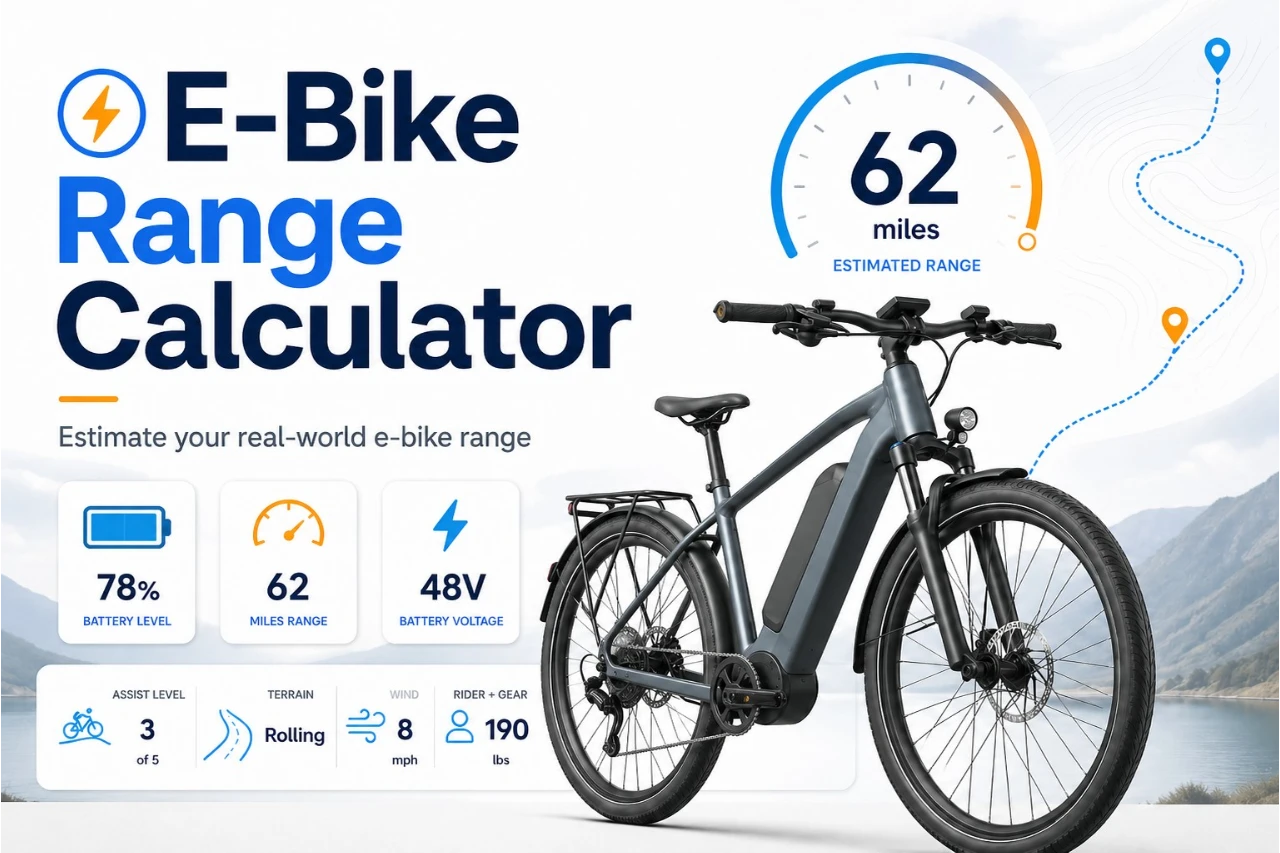
Estimate how far your electric bike can realistically go on one charge.
This e-bike range calculator helps riders estimate real-world range based on battery voltage, amp-hour capacity, rider weight, terrain, pedal assist level, average speed, weather, and cargo load.
Many e-bike brands advertise maximum range under ideal riding conditions. In daily use, range can be much lower because of hills, wind, higher assist levels, rider weight, throttle use, cargo, tire pressure, and cold weather.
Use this tool to estimate your low range, realistic range, ideal range, and the battery size you may need for your riding style.
E-Bike Range Tool
E-Bike Range Calculator
Estimate your realistic e-bike range based on battery size, rider weight, terrain, pedal assist level, average speed, weather, and cargo load.
How This E-Bike Range Estimate Works
E-bike battery capacity is usually measured in watt-hours, or Wh. A simple way to calculate battery energy is:
Battery voltage × amp-hour capacity = watt-hours
For example, a 48V 15Ah battery has about 720Wh of energy. A 52V 20Ah battery has about 1,040Wh of energy.
In general, a larger battery can provide more range. However, battery size is only one part of the estimate. Real-world range also depends on how much energy the bike uses per mile.
A light rider on flat roads using low pedal assist may use much less energy. A heavier rider climbing hills with high assist or throttle use may drain the battery much faster.
This calculator gives three estimates:
Estimated low range shows a conservative result for harder riding conditions.
Estimated realistic range is the most useful number for daily planning.
Estimated ideal range shows what may be possible in easier conditions, such as flat roads, low assist, moderate speed, and calm weather.
Why Advertised Range Can Be Different
Advertised e-bike range is often tested in favorable conditions. These conditions may include a lighter rider, flat terrain, low pedal assist, slow speed, warm weather, properly inflated tires, and little or no wind.
Real riding is usually different.
Higher pedal assist levels use more battery power. Throttle use can drain the battery faster than steady pedaling. Hills require more motor output. Headwinds increase resistance. Cold weather can reduce battery performance. Heavy cargo and heavier rider weight also lower range.
This is why two riders using the same e-bike may get very different range results.
A 150 lb rider using low assist on flat roads may get much more range than a 250 lb rider climbing hills with cargo and high assist.
For buying decisions, it is better to focus on realistic range instead of the highest advertised number.
What Battery Size Do You Need?
The right battery size depends on your riding distance, terrain, assist level, and how much range buffer you want.
For short local rides, errands, and casual bike path use, a battery around 500Wh to 700Wh may be enough for many riders.
For daily commuting, moderate hills, or regular high-assist riding, a battery around 700Wh to 900Wh is usually more practical.
For long-range rides, heavier riders, cargo use, hilly routes, or throttle-heavy riding, a battery around 900Wh or more can make the e-bike much more usable.
A larger battery does not only increase distance. It also gives you more margin. That matters if you ride in cold weather, take detours, climb hills, or do not want to charge after every ride.
As a general rule, choose a battery that gives you more range than your exact daily need. This helps avoid range anxiety and reduces the need to drain the battery fully on every ride.
Recommended E-Bikes by Range Need
Different riders need different types of e-bikes. Range is not only about battery size. Frame style, motor power, tire type, bike weight, rider weight, and riding purpose also matter.
For long-distance riding, look for e-bikes with larger batteries, efficient motors, comfortable geometry, and stable handling. Dual-battery models can also make sense for riders who need extended range.
For commuting, the best choice is usually a balanced e-bike with enough battery capacity for your route plus extra margin. A commuter e-bike does not always need the largest battery, but it should be efficient, comfortable, and easy to ride daily.
For cargo riding, battery capacity becomes more important. Carrying groceries, child seats, work gear, or delivery bags can reduce range. Cargo e-bikes should also have strong brakes, a stable frame, and a suitable payload rating.
For heavier riders, advertised range may drop more quickly. A stronger frame, wider tires, better brakes, and a larger battery can make the bike more dependable under load.
If your range estimate is lower than expected, consider choosing a long-range e-bike or a model with a higher-capacity battery.
Related Guides
Use these guides if you want to compare real e-bike options based on your range needs, commute distance, cargo use, or rider weight.
- Best Longest Range E-Bikes
- Best Commuter E-Bikes
- Best Cargo E-Bikes
- Best Electric Bike for Heavy Rider
- Best E-Bikes for 300 lb Heavy Riders
- Best E-Bike for Hills
- Best Fat Tire Electric Bikes
FAQ
How do you calculate e-bike battery watt-hours?
You calculate watt-hours by multiplying battery voltage by amp-hour capacity. For example, a 48V 15Ah battery has about 720Wh of energy. More watt-hours usually means more potential range, but real-world distance also depends on rider weight, terrain, speed, assist level, and weather.
How far can a 48V 15Ah e-bike battery go?
A 48V 15Ah battery has about 720Wh of energy. In real-world use, many riders may get around 25 to 45 miles depending on terrain, rider weight, pedal assist level, throttle use, speed, tire type, and wind.
Why is my e-bike range lower than advertised?
Your e-bike range may be lower than advertised because advertised range is usually tested in ideal conditions. Hills, high assist, throttle use, heavier rider weight, cargo, headwind, cold weather, low tire pressure, and faster riding can all reduce range.
Does rider weight affect e-bike range?
Yes. Heavier riders usually require more motor power to accelerate, climb hills, and maintain speed. This can reduce battery range, especially when combined with cargo, high pedal assist, or hilly terrain.
Does pedal assist level affect range?
Yes. Lower pedal assist uses less battery and usually gives more range. Higher pedal assist provides more motor support but drains the battery faster. Throttle-heavy riding usually uses the most energy.
What is a good battery size for commuting?
For short commutes, 500Wh to 700Wh may be enough. For longer commutes, moderate hills, cold weather, or regular high-assist use, 700Wh to 900Wh is usually more practical. Riders who want extra range margin may prefer 900Wh or more.
Are fat tire e-bikes less efficient?
Fat tire e-bikes can be less efficient on smooth pavement because wider tires create more rolling resistance. They can provide better comfort and stability, but they may use more battery than narrower commuter tires.
Should I buy the biggest e-bike battery possible?
Not always. A larger battery adds cost and weight. However, it can be worth it if you ride long distances, climb hills, carry cargo, use high assist, or want fewer charging stops. For many riders, some extra battery margin is useful.