Choosing the right electric bike is not just about picking the most powerful motor or the biggest battery. The best e-bike for you depends on how you ride, where you ride, how much weight the bike needs to carry, and what kind of comfort or performance you expect.
This simple e-bike recommendation tool helps you narrow down the right type of electric bike based on your budget, rider size, main use, terrain, storage needs, cargo needs, comfort preference, frame style, and expected range.
It is designed for everyday buyers who want a practical starting point before comparing specific models.
Quick note: This tool gives a general recommendation. Always check the latest product specifications, payload rating, frame size, warranty, local e-bike laws, and return policy before buying.
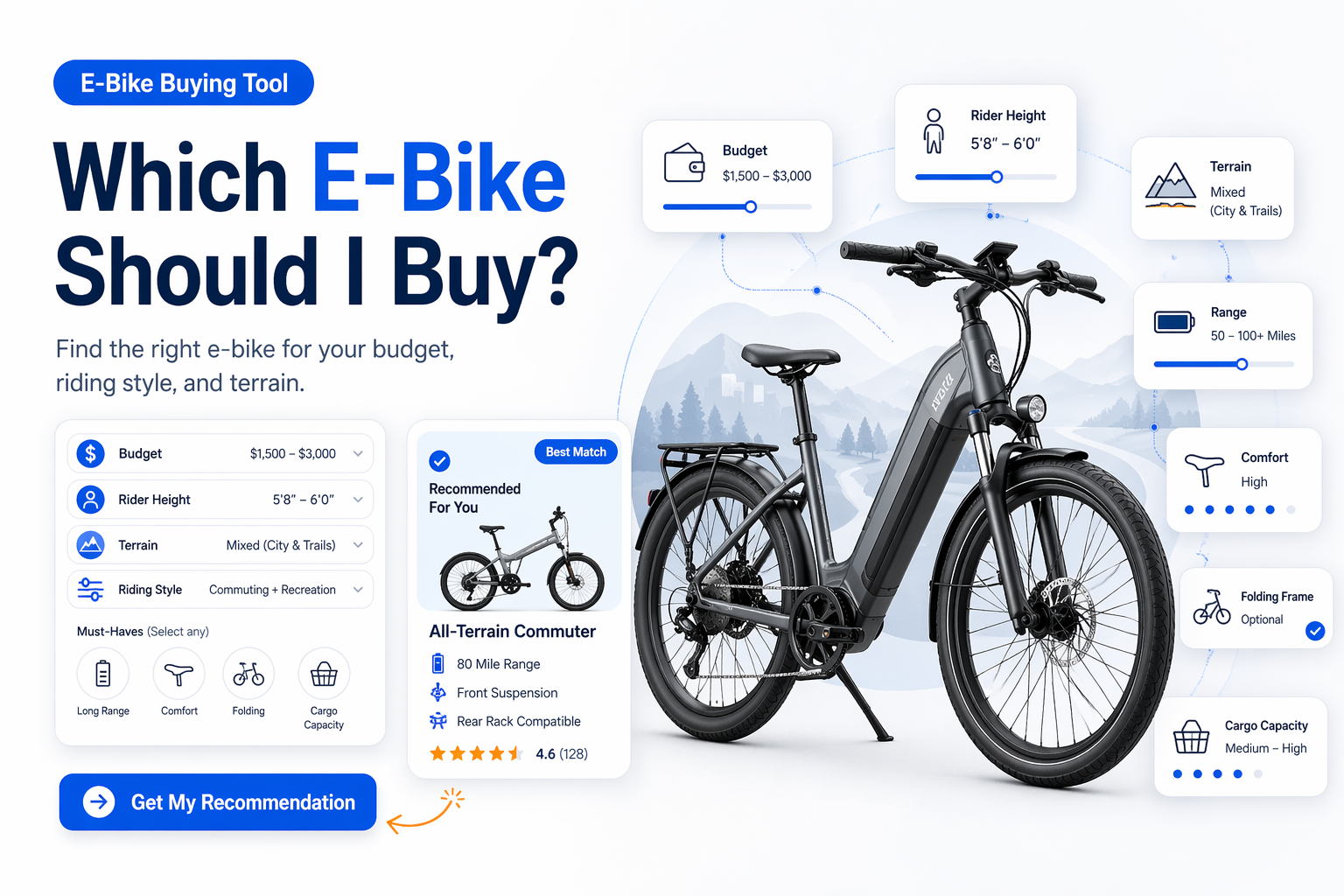
E-Bike Buying Tool
Which E-Bike Should I Buy?
Answer a few quick questions to get a practical e-bike recommendation based on your budget, rider size, riding style, terrain, comfort needs, and range expectations.
How This E-Bike Recommendation Tool Works
This tool looks at the main factors that usually affect e-bike fit and buying satisfaction.
Instead of recommending a bike only by motor wattage or price, it considers how the bike will actually be used. A rider who needs a folding e-bike for apartment storage has different needs from someone who wants a cargo e-bike for grocery runs. A heavier rider may need stronger brakes, a higher payload rating, and a more powerful motor. A commuter riding hills may need more torque and battery capacity than someone riding short flat bike paths.
The tool uses your answers to suggest:
- The most suitable e-bike type
- A practical motor power range
- A recommended tire style
- A suggested battery capacity
- Useful buying guide categories to compare next
The goal is not to choose one exact bike for everyone. The goal is to help you avoid the wrong category before you start comparing models.
For example, if you need easy storage, a folding e-bike may make more sense than a full-size fat tire bike. If you regularly carry groceries or gear, a utility or cargo e-bike is usually more practical than a lightweight city bike. If comfort matters more than speed, a step-thru commuter e-bike may be a better fit than a moped-style model.
Use the result as a starting point, then compare real models, prices, warranty support, braking systems, battery size, and user reviews before making a final decision.
What Type of E-Bike Fits Most Riders?
Most everyday riders are best served by a balanced commuter e-bike. This type of electric bike usually offers a comfortable riding position, enough motor power for city riding, practical range, and a frame that works well for errands, bike paths, and daily commuting.
A commuter e-bike is usually a good fit if you:
- Ride mostly on paved roads
- Want a practical bike for everyday use
- Need a mix of comfort, range, and value
- Do not need extreme off-road capability
- Do not carry heavy cargo every day
- Want a bike that is easier to handle than a very heavy fat tire model
However, not every rider should start with a commuter e-bike. Some riders need a more specific category.
A folding e-bike is better if you live in an apartment, need to store the bike indoors, transport it in a car, or use it for RV travel. A cargo e-bike is better if you regularly carry groceries, bags, child seats, or work gear. A fat tire e-bike is better for riders who want more stability on gravel, rough pavement, sand, snow, or mixed terrain. A step-thru e-bike is better if easy mounting and dismounting are important.
The right e-bike type should match your real riding habits, not just the most impressive spec sheet.
How to Choose the Right Motor Power
Motor power is one of the most common things buyers compare, but bigger is not always better. A stronger motor can help with acceleration, hills, heavier riders, and cargo loads, but it can also add weight, cost, and battery drain.
For many everyday riders, a 500W to 750W motor is a practical range. It usually provides enough assistance for commuting, errands, bike paths, and moderate hills.
A lower-powered motor may work well if you ride mostly flat roads, prefer a lighter bike, and do not need fast acceleration. A stronger motor may be worth considering if you are a heavier rider, live in a hilly area, carry cargo, or want a more performance-focused ride.
Here is a simple way to think about motor power:
| Rider Need | Suggested Motor Range |
|---|---|
| Short flat rides | 350W–500W |
| Everyday commuting | 500W–750W |
| Hills or heavier riders | 750W or stronger |
| Cargo use | 750W or stronger |
| Off-road or moped-style riding | 750W–1000W+ depending on model |
Motor power should not be the only deciding factor. Brakes, frame quality, controller tuning, battery capacity, gearing, tire size, and total bike weight also affect real-world performance.
If you ride in a hilly area, pay attention to torque and braking quality, not just peak wattage. If you ride in the city, predictable handling and good brakes may matter more than raw power.
How Much Battery Capacity Do You Need?
Battery capacity has a major impact on real-world range. Many e-bike listings advertise maximum range under ideal conditions, but actual range can be lower depending on rider weight, speed, terrain, wind, tire pressure, assist level, cargo load, and temperature.
A simple way to compare battery size is watt-hours, often written as Wh.
You can estimate watt-hours by multiplying voltage by amp-hours:
Battery Wh = Voltage × Amp-hours
For example, a 48V 15Ah battery is about 720Wh.
For many riders, a battery between 500Wh and 700Wh is enough for regular commuting and casual riding. Riders who want longer range, carry cargo, ride hills, or use higher pedal assist levels should consider a larger battery.
Here is a practical guide:
| Expected Use | Suggested Battery Capacity |
|---|---|
| Short errands and casual rides | 400Wh–500Wh |
| Daily commuting | 500Wh–700Wh |
| Longer rides or hills | 700Wh–900Wh |
| Heavy riders or cargo use | 700Wh+ |
| Long-range riding | 900Wh+ or dual-battery setup |
If range is very important to you, do not buy based only on the advertised maximum range. Look for the battery watt-hour rating, total bike weight, tire type, motor power, and real rider feedback.
Fat tire e-bikes, cargo e-bikes, and high-power models usually use more energy than lightweight commuter bikes. If you want both strong power and long range, you will usually need a larger battery.
Recommended E-Bikes by Rider Type
After using the tool, your result should point you toward one or more e-bike categories. Use the guide below to compare your result with common rider needs.
Best for Daily Commuters
A commuter e-bike is usually the best fit for riders who want a dependable bike for work, school, errands, and paved bike paths.
Look for:
- Comfortable upright geometry
- 500W–750W motor
- Practical battery capacity
- Fenders and rear rack
- Integrated lights
- Reliable disc brakes
- Tires that balance comfort and rolling efficiency
Recommended next guide: Best Commuter Electric Bikes
Best for Apartment Living or RV Travel
A folding e-bike is the better choice if storage space is limited or you need to transport the bike in a car, RV, or small garage.
Look for:
- Strong folding hinge design
- Manageable folded size
- Stable 20-inch tires
- Rear rack support
- Comfortable saddle and handlebar height
- Reasonable total weight
Recommended next guide: Best Folding Electric Bikes
Best for Grocery Runs and Utility Use
A cargo or utility e-bike is best for riders who need to carry groceries, bags, work supplies, or family gear.
Look for:
- High payload rating
- Strong rear rack
- Stable frame
- 750W motor or stronger
- Hydraulic disc brakes if possible
- Good kickstand
- Accessory compatibility
Recommended next guide: Best Cargo E-Bikes for Grocery Runs
Best for Heavier Riders
Heavier riders should focus on payload rating, frame strength, braking performance, wheel strength, and motor support.
Look for:
- High weight capacity
- Strong frame design
- 750W motor or stronger
- Hydraulic brakes if possible
- Wider tires for stability
- Comfortable saddle
- Battery capacity of 700Wh or more
Recommended next guide: Best E-Bikes for Heavy Riders
Best for Comfort-Focused Riders
If comfort matters more than speed, a step-thru or comfort commuter e-bike is usually the better fit.
Look for:
- Step-thru frame
- Upright riding position
- Suspension fork or suspension seatpost
- Wider comfort tires
- Easy-to-read display
- Simple controls
- Lower standover height
Recommended next guide: Best Step-Thru Electric Bikes
Best for Rough Roads and Mixed Terrain
A fat tire e-bike is useful if you ride on gravel, rough pavement, dirt paths, beach areas, snow, or uneven roads.
Look for:
- 4-inch fat tires
- Front suspension
- Strong brakes
- Stable frame
- 750W motor
- Larger battery
- Comfortable handlebar position
Recommended next guide: Best Fat Tire Electric Bikes
Best for Long Range
If you care most about distance, focus on battery size and efficiency instead of only motor power.
Look for:
- 700Wh–900Wh battery or larger
- Efficient tires
- Comfortable riding position
- Good pedal assist tuning
- Reliable brakes
- Real-world range feedback
Recommended next guide: Best Long Range Electric Bikes
Related E-Bike Buying Guides
After using the recommendation tool, compare your result with one of these buying guides:
- Best Folding Electric Bikes
- Best Fat Tire Electric Bikes
- Best Cargo E-Bikes for Grocery Runs
- Best E-Bikes for Heavy Riders
- Best Step-Thru Electric Bikes
- Best Long Range Electric Bikes
- Best Budget Electric Bikes
- Best Commuter Electric Bikes
- Best Electric Bikes for Hills
- Best Electric Bikes Under $1000
These guides can help you compare real models, price ranges, motor power, battery size, comfort features, and common trade-offs before buying.
FAQ
What is the best type of e-bike for most people?
A commuter e-bike is the best starting point for most people. It usually offers a good balance of comfort, range, price, and daily usability. However, riders who need storage flexibility, cargo capacity, off-road stability, or easier mounting may be better served by a folding, cargo, fat tire, or step-thru e-bike.
Is a 750W e-bike enough?
For many riders, a 750W e-bike is enough for commuting, moderate hills, heavier riders, and casual recreational use. However, real-world performance also depends on torque, battery size, bike weight, gearing, controller tuning, and rider weight.
Should I buy a folding e-bike or a regular e-bike?
Choose a folding e-bike if you need compact storage, apartment-friendly parking, car trunk transport, or RV travel. Choose a regular full-size e-bike if you want better frame stiffness, more stable handling, larger wheels, or higher cargo capacity.
Are fat tire e-bikes better?
Fat tire e-bikes are better for stability, rough roads, gravel, sand, snow, and mixed terrain. They are not always better for every rider because they are usually heavier and may have more rolling resistance than commuter tires.
What battery size should I look for?
For short rides, 400Wh to 500Wh may be enough. For daily commuting, 500Wh to 700Wh is a practical range. For hills, cargo, heavier riders, or longer rides, 700Wh or more is usually a better choice.
What e-bike is best for heavy riders?
Heavy riders should look for a high payload rating, strong frame, reliable brakes, wider tires, enough motor power, and a larger battery. A 750W motor or stronger is often a practical starting point, but payload capacity and brake quality are just as important.
Is a step-thru e-bike worth it?
A step-thru e-bike is worth it if easy mounting and dismounting matter to you. It is especially useful for city riders, older riders, shorter riders, casual riders, and anyone who prefers a more relaxed riding experience.
How do I know if an e-bike will fit me?
Check the manufacturer’s recommended rider height range, standover height, seat height range, handlebar adjustability, frame type, and weight capacity. If you are between sizes, comfort and riding posture matter more than the frame label alone.
Should I choose comfort or speed?
Choose comfort if you plan to ride often, commute, run errands, or use the e-bike for relaxed daily transportation. Choose speed and power if you ride hills, want stronger acceleration, or prefer a more performance-focused riding style. For most buyers, a balanced setup is the safer choice.
Can this tool choose the exact best e-bike for me?
This tool gives a practical category recommendation, not a final purchase decision. Use the result to narrow your options, then compare specific models, current prices, product reviews, warranty support, battery size, brakes, and return policy before buying.