A little joy belongs in every day.

Single vs dual battery e-bikes isn’t just about miles. Learn real range expectations, weight trade-offs, and the failure points that affect ownership.
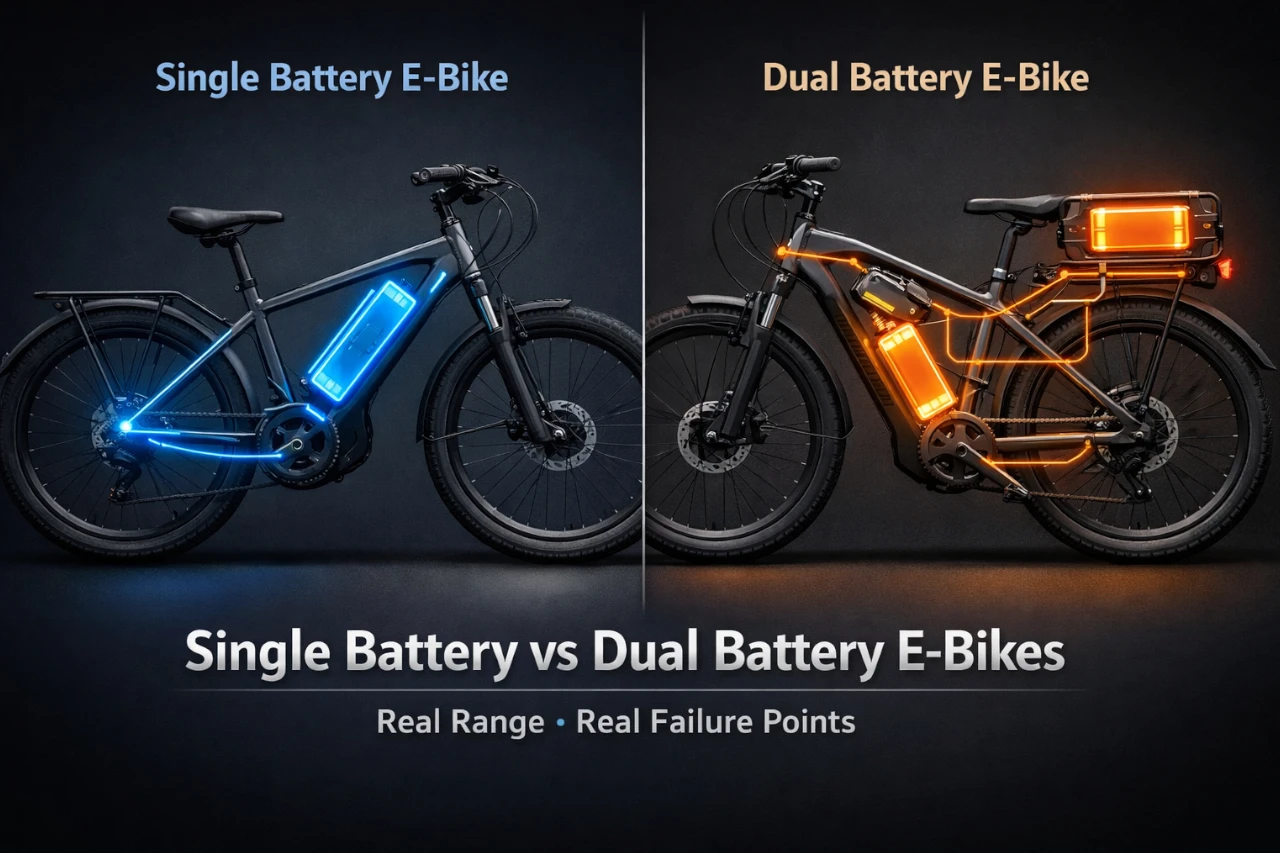
If you’re shopping for an e-bike and you keep seeing “dual battery” models advertised as the answer to range anxiety, you’re not alone. On paper, two batteries look like an easy win: double the watt-hours, double the miles.
A single-battery e-bike is the standard setup: one pack, one BMS, one main power feed. A dual-battery e-bike uses two packs—either truly integrated from the factory or added as an aftermarket/second-pack system—with some method of switching or balancing between them.
This comparison is here to make the decision simple: how much range you’ll actually gain, what you give up in weight/complexity, and the real failure points that show up over time.
Best overall choice: For most riders, a single-battery e-bike is the smarter, lower-risk buy—especially if your typical rides are under ~25–40 miles.
Choose Single Battery if:
Choose Dual Battery if:
Key deciding factor: Not “how far can it go once,” but how much extra range you’ll get per added pound and per added point of complexity—and whether you can solve your range needs with one larger battery instead.
Here’s what actually matters for buyers (and what creates headaches later):
A single battery’s real-world range is usually limited by:
In practice, a single battery can be “enough” for far more riders than they expect—especially if they’re willing to ride one assist level lower and keep tires properly inflated.
Score: 8/10
Dual battery setups genuinely help—but not always in the “double the range” way people assume.
What dual batteries do well:
What they don’t magically fix:
Score: 9/10
If your normal rides are short-to-medium, dual battery can be overkill. If you’re a high-drain rider (fast, heavy, hilly, fat tires, cargo), dual battery can feel like the difference between “fun” and “constantly managing power.”
Edge: Dual Battery (for true high-drain/long-ride riders)
A single battery keeps the bike simpler and often noticeably easier to live with:
Even if the total bike weight difference sounds small on paper, the location of that weight matters. Battery mass mounted high or rearward can change how stable the bike feels at low speed and how it behaves under hard braking.
Score: 9/10
Dual battery adds weight and can add it in the worst places:
For smaller riders—or anyone who stores the bike inside—dual battery can turn “manageable” into “annoying daily chore.”
Score: 6/10
If you routinely:
…single battery usually wins in real life.
Edge: Single Battery
Single battery reliability is mostly about:
Fewer components means fewer points of failure. Diagnosis is also simpler: if something goes wrong, the troubleshooting tree is shorter.
Common failure points:
Score: 8/10
Dual battery introduces additional failure points—some of which are easy to overlook:
1) Battery mismatch (capacity/age)
If one pack is older or lower quality, the system can behave unpredictably:
2) Extra connectors + extra corrosion opportunities
More connectors = more chances for:
3) Switcher/combiner electronics
Many dual systems rely on a:
If that component fails, you can lose:
4) Higher stress on mounts and wiring
A second battery often means:
Score: 6/10
Dual battery can be excellent when it’s factory-integrated and well engineered. But in many budget models or aftermarket add-ons, the reliability cost is real.
Edge: Single Battery (lower risk, easier diagnosis)
Single battery charging is straightforward:
Score: 8/10
Dual battery can be convenient—or annoying—depending on design:
Better designs:
Frustrating designs:
Score: 7/10
If you can charge at work or at home easily, single battery is usually fine. Dual battery becomes more valuable when you can’t reliably recharge mid-day and need long runtime.
Edge: Slight Single Battery (simplicity)
Single battery bikes often deliver the best value because:
But: one big battery can still be expensive to replace—so battery quality and support matter.
Score: 8/10
Dual battery tends to cost more upfront and later:
However, dual battery can be “worth it” if it prevents you from needing a second bike or constantly renting/charging solutions.
Score: 7/10
If your rides don’t demand it, dual battery can be money spent to solve a problem you don’t truly have.
Edge: Single Battery (most buyers)
Fewer electrical interfaces generally means:
Score: 8/10
Dual battery safety depends heavily on execution:
Also: more battery energy onboard means more stored energy to manage. That’s not automatically dangerous—but it raises the importance of good design, secure mounting, and good charging habits.
Score: 7/10
Dual battery can be safe, but the penalty for poor design is higher.
Edge: Single Battery (lower complexity)
| Factor | Single Battery | Dual Battery |
|---|---|---|
| Real-world range gain | 8/10 – enough for most | 9/10 – best for high-drain riders |
| Weight & handling | 9/10 – easier to live with | 6/10 – heavier, can feel awkward |
| Reliability / failure points | 8/10 – fewer things to break | 6/10 – switchers/connectors add risk |
| Charging convenience | 8/10 – one routine | 7/10 – varies by design |
| Cost/value | 8/10 – simpler ownership | 7/10 – higher long-term cost |
| Safety risk profile | 8/10 – fewer interfaces | 7/10 – depends on integration quality |
| Overall | Winner for most riders | Winner for long-range/high-drain use |
For most e-bike buyers, single battery is the better ownership experience: lighter, simpler, fewer failure points, and easier to maintain. The “range truth” is that many riders don’t need a second battery—they need realistic expectations, smart assist use, and sometimes just a larger single pack.
Dual battery is absolutely the right move when your riding style is genuinely high-drain or your routes demand long runtime without recharge options. Just go into it with eyes open: you’re buying range—and also buying complexity.