If your riding is mostly flat-to-rolling terrain, casual speeds, and you want low drama, a hub motor is usually the smarter, cheaper win.
If you ride real hills often, carry loads, or care about “bike-like” control, a mid-drive is usually worth the extra money—as long as you’re OK with more drivetrain wear.
The 20-second decision
Choose hub motor if you:
- Ride mostly flat or gentle rollers
- Prefer simple ownership and lower maintenance
- Want a solid e-bike for cruising/commuting without thinking about gears much
Choose mid-drive if you:
- Climb steep or long hills regularly
- Want better low-speed control (start/stop traffic, technical paths)
- Carry cargo, kids, or heavier loads and need consistent torque
The trade-off nobody says clearly:
Mid-drives usually climb better because they use your bike’s gears—but that same setup can eat chains and cassettes faster if you ride hard or shift poorly.
The Simple Difference
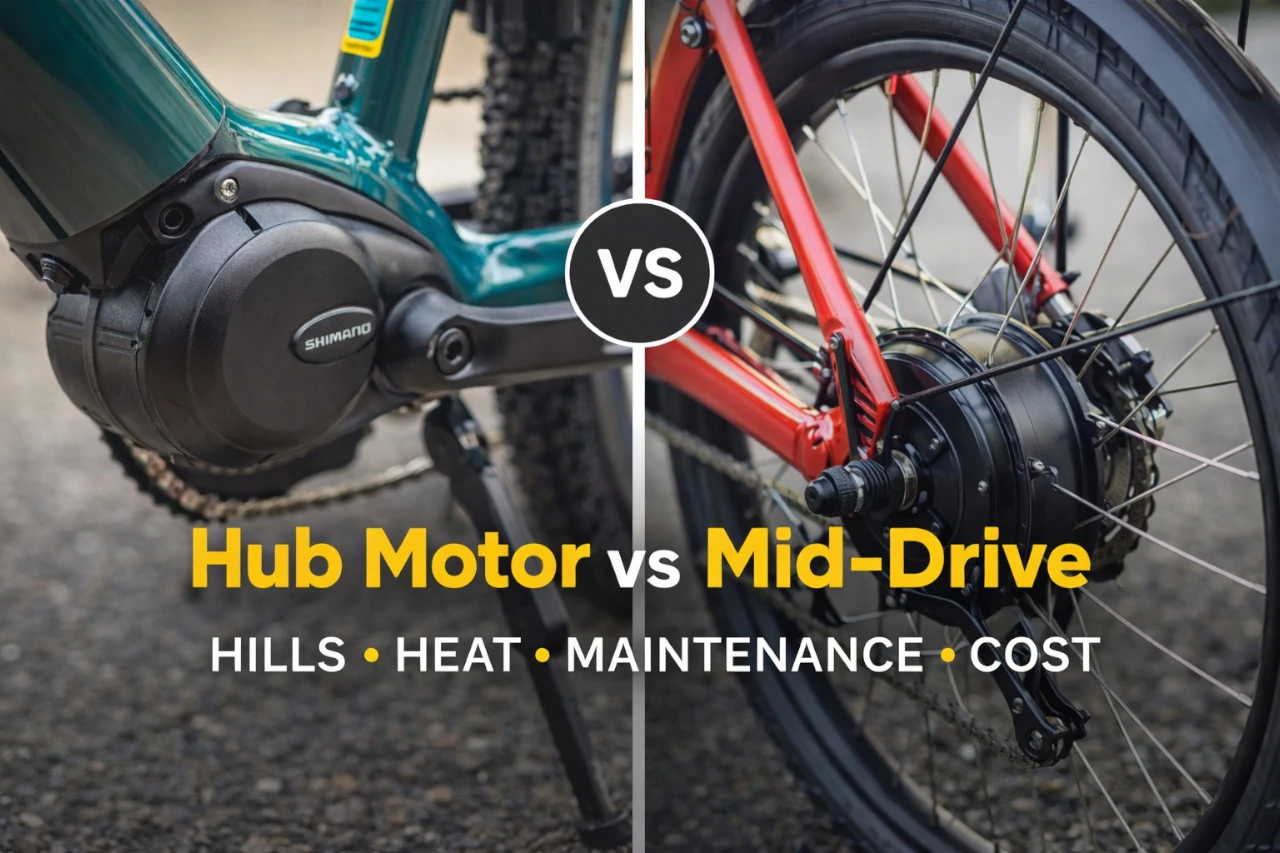
Hub motor: The motor sits in the wheel (front or rear) and pushes the bike directly.
Mid-drive: The motor sits at the crank and drives the chain, using your gears like your legs do.
That’s it. Everything else—hill performance, heat behavior, maintenance, and cost—falls out of this one difference.
Ride Feel Comparison
Starts and stop-and-go
- Hub motors often feel like a gentle shove from behind (rear hub), or a pull (front hub). On cheap tunes, the push can feel “on/off.”
- Mid-drives typically feel more connected to pedaling. In traffic, that can be easier to modulate—especially at low speed—because power is going through the drivetrain like normal pedaling.
My rule: If you hate surprises at intersections, you’ll usually prefer a well-tuned mid-drive or a hub motor with smooth assist mapping.
Low-speed control
- Mid-drive usually wins for creeping along in crowds, tight turns, or awkward slopes—because it can use low gears and keep the motor in a comfortable rpm range.
- Hub motor can be fine here too, but when it’s geared for speed, it sometimes feels less happy at “walking pace + uphill.”
“Bike-like” pedaling
- Mid-drives tend to feel more like a bicycle when the assist is off or limited—less “dead weight + drag” feeling (not always, but often).
- Hub motors vary a lot. Some coast nicely; others feel heavier or more resistant.
Hills: Torque Is Only Half the Story
Hills are where the hub motor vs mid-drive debate stops being theory and becomes “do I enjoy this ride or do I regret this purchase?”
Why mid-drives usually win on climbs
A mid-drive can use your low gears, which keeps the motor spinning faster (more efficient) while the wheel turns slowly (climbing). That’s exactly what you do with your legs: you downshift and keep cadence up.
Result:
- Better climbing at lower speed
- Less “bogging down”
- Often less heat stress for the same climb (not always, but often)
When hub motors struggle on hills
Hub motors don’t get the benefit of your bike’s gears. If the hill forces you to go slow, the motor may be forced to work in a less efficient zone (higher current, less rpm).
What you feel:
- The bike slows and the motor “push” feels strained
- You may need more throttle/assist
- Range drops fast
- Heat builds faster on long climbs
The “heat” reality
Heat is the silent limiter on hills, not top speed.
- Hub motors can overheat faster on long, slow climbs, especially with heavier riders, cargo, low tire pressure, or hot weather. The wheel is turning slowly, airflow is limited, and the motor has to draw more current.
- Mid-drives can still overheat, but they’re usually better at staying efficient because you can downshift and keep motor rpm up.
Practical takeaway:
If you regularly climb for more than a few minutes at a time, mid-drive is the safer bet.
Efficiency and Range
On paper, both systems can be efficient. In real riding:
- On flat routes at steady speed, a hub motor can be very efficient.
- On hilly routes, a mid-drive often wins because it stays in a better efficiency range using gears.
But here’s the part most buyers miss:
A mid-drive doesn’t magically save range if you ride faster
If you buy a mid-drive and start climbing faster, doing more sprints, and riding higher average speed… your battery will still drain. Efficiency helps, but physics wins.
The real range advantage of mid-drive shows up when:
- You climb often
- You’re heavier or carry loads
- You ride in stop-and-go terrain
- You keep a steady, sensible pace and shift properly
Maintenance Reality
Hub motor maintenance: simpler, but wheel work can be annoying
Pros
- Less drivetrain stress from the motor (your chain/cassette often lasts longer)
- Many hub systems are sealed and low-maintenance
Cons
- Flats can be more annoying: heavier wheel, motor cable, sometimes awkward axle hardware
- Spoke tension can matter more (hub motors add weight at the wheel)
- If the motor or controller fails, troubleshooting can be “replace the unit” rather than repair
Who cares most: commuters who ride daily and hate fiddly repairs on the roadside.
Mid-drive maintenance: better service access, but drivetrain wear is real
Pros
- Wheel removal is usually normal (no motor in the wheel)
- Weight is centered, which tends to be nicer for handling and bike racks
- On many brands, parts support is more established
Cons
- The motor drives your chain and cassette: more wear, especially if:
- you ride high assist in low cadence
- you shift under heavy load
- you mash instead of spinning
- Expect more frequent chain/cassette replacement if you ride hard.
Who cares most: riders on hills, heavier riders, cargo riders—because they’ll use more torque more often.
Cost: Upfront vs Total Ownership
Here’s the cleanest way to think about cost:
Upfront cost
- Hub motor bikes usually cost less for similar speed/range numbers.
- Mid-drives usually cost more—partly due to hardware, partly because they’re positioned as “premium.”
Long-term cost
- If you ride a lot and ride hard, a mid-drive may cost more over time due to drivetrain wear.
- If you ride mostly flat and steady, a hub motor can be cheaper and stay cheap.
My honest summary:
Mid-drive is often “worth it” for hills—but it’s rarely the cheapest path over 2–3 years if you ride daily and don’t maintain the drivetrain.
Handling, Traction, and Noise
Handling
- Mid-drive: centralized weight feels balanced; cornering and low-speed maneuvering often feel more natural.
- Hub: added wheel weight can feel “heavier steering” (front hub) or “rear-heavy” (rear hub), depending on design.
Traction
- Rear hub traction is usually good.
- Front hub can slip more on steep, loose climbs (depends heavily on tire and weight distribution).
- Mid-drive traction depends on your rear tire grip—because it’s still driving the rear wheel through the chain.
Noise
This varies by brand and tuning, but in general:
- Hub motors can be very quiet.
- Mid-drives can be quiet too, but some have more noticeable whine under load.
Reliability and Failure Modes
Hub motor common issues
- Controller or display problems (electrical)
- Cable/connector issues (especially if the rear wheel gets removed often)
- Motor itself is usually durable, but when it fails it’s often replacement rather than “simple repair”
Mid-drive common issues
- Drivetrain wear (chain/cassette/chainring)
- Sensor or firmware quirks (depends on brand)
- If you ignore shifting habits, performance and smoothness degrade faster
Good news: Both can be reliable. The bigger risk is buying a system that’s underpowered or poorly tuned for your terrain.
Who Should Buy Hub Motor
Choose hub motor if you want:
- A reliable commuter or cruiser on mostly flat terrain
- A bike that feels easy to live with
- Lower upfront cost and fewer drivetrain wear surprises
- A throttle-first riding style (common on many hub setups)
Great match for: flat-city commuting, casual weekend riding, paved paths, moderate speeds.
Who Should Buy Mid-Drive
Choose mid-drive if you want:
- Stronger, more controlled climbing for real hills
- Better low-speed modulation in stop-and-go or technical terrain
- A more “bicycle-like” feel when pedaling
- Better performance with cargo/heavier loads
Great match for: hill towns, cargo hauling, daily climbs, riders who actually use gears.
The Most Common Buying Mistakes
- Buying a hub motor for daily steep hills because the spec sheet said “1000W peak.”
- Buying a mid-drive and never shifting, then being shocked when the drivetrain wears fast.
- Ignoring heat and speed reality: any motor pushed slow + hard + long will heat up.
- Overvaluing top speed and undervaluing control at 8–12 mph, where most hills happen.
- Underestimating weight/loads: rider + gear + hills multiplies your power needs.
My No-Regrets Checklist (Use This Before You Buy)
Answer these honestly:
- Do you climb steep hills at least 3 days a week?
- Yes → mid-drive usually wins.
- Do you hate maintenance and just want to ride?
- Mostly flat → hub motor.
- Hilly → mid-drive, but budget for drivetrain wear.
- Are you carrying cargo/kids or you’re a heavier rider?
- Frequent hills → mid-drive.
- Flat routes → hub can be fine with adequate power and good brakes.
- Do you need easy wheel removal (flats, transport, racks)?
- Mid-drive is generally easier.
FAQ
Is a hub motor “bad” for hills?
Not automatically. It’s bad for long, slow, steep climbs with heavy loads—especially in heat.
Will a mid-drive always go farther on the same battery?
Not always. It often helps on hills, but speed and riding style dominate range.
Which is better for winter/snow?
Tires matter more than motor type. Rear hub and mid-drive are both fine; avoid front hub for very slick climbs.
Which is easier to repair?
Hub systems can be simple but wheel work is annoying; mid-drives are often easier for wheels but require drivetrain attention.
Which is best for commuters?
Flat commuting: hub is usually the best value. Hill commuting: mid-drive often feels less stressful.
Final Recommendation
If you want the safest “won’t regret it” pick:
- Mostly flat + budget-conscious + simple ownership: go hub motor.
- Real hills + cargo/heavy loads + control matters: go mid-drive, and treat chains/cassettes as normal wear items.
If you tell me your typical route (flat vs hills, distance, rider weight, storage), I can recommend the motor type with almost zero guesswork.