When you first start shopping for an electric bike, the spec sheet can feel like a secret code.
You’ll see things like:
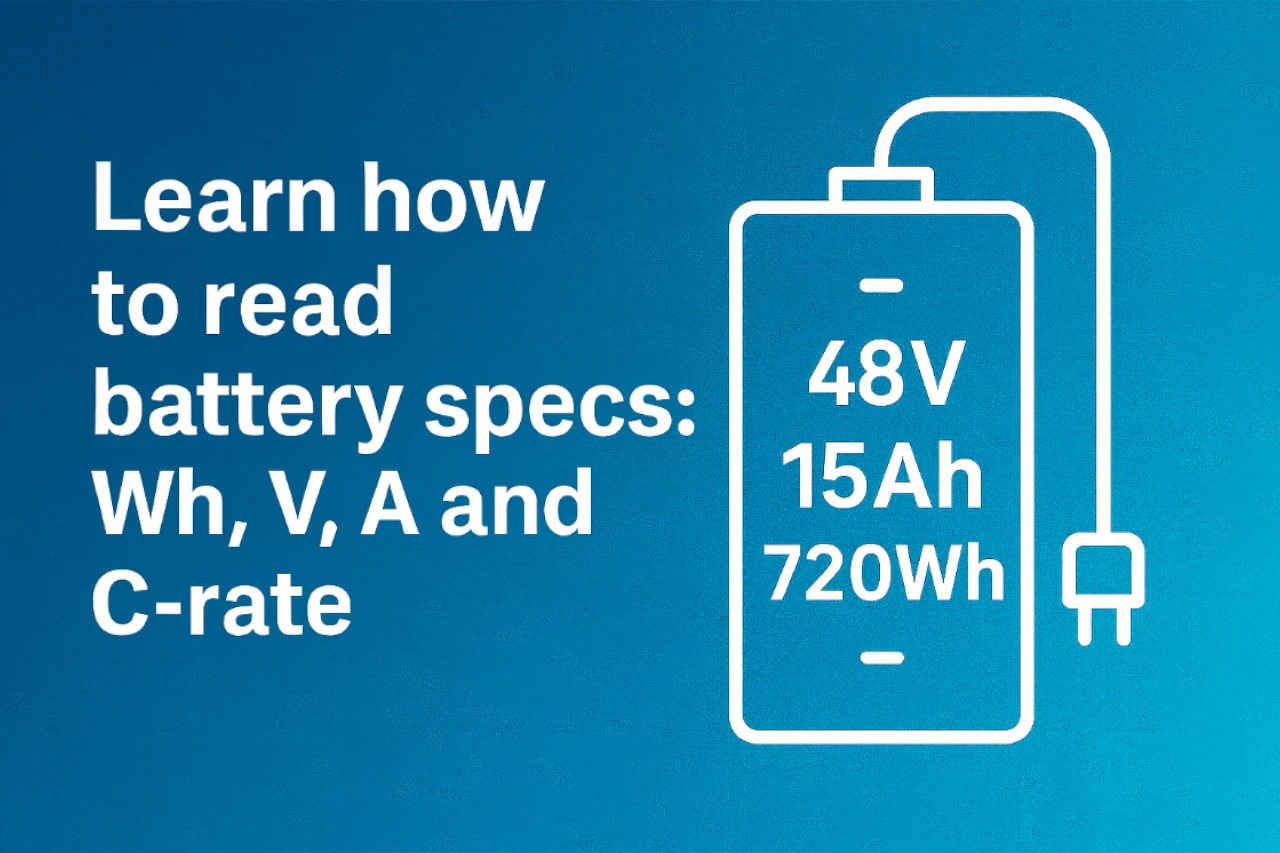
- 48V 15Ah, 720Wh battery
- 52V 20Ah, 1040Wh (Smart BMS, 3C cells)
- 2A or 4A charger
- Max discharge 30A
It sounds technical and impressive, but what does any of that actually mean for your day-to-day riding?
- Will this bike really go “up to 70 miles”?
- Is 52V really more powerful than 48V?
- Are bigger amp-hour numbers always better?
- Should you care about C-rate or is it just marketing?
This guide is meant to decode all of that in plain language, specifically for e-bike riders and buyers. By the time you reach the end, you’ll be able to look at a battery line in a product page and immediately know:
- How strong the bike will feel
- Whether the range claims are realistic
- How the battery will handle hills, heavy riders, and high PAS levels
- How to quickly compare two bikes and pick the one that actually suits your riding
1. The Four Core Specs You Must Understand
Let’s start by making a “mental map” of the key numbers you keep seeing.
For most e-bikes, the battery specs will give you four big clues:
- Voltage (V) – how “hard” the battery can push (linked to torque feel and top speed potential).
- Capacity (Ah & Wh) – how much “fuel” is in the tank (directly related to range).
- Current (A) – how much power can flow at once (tied to acceleration and hill-climbing).
- C-Rate (C) – how fast the battery can safely be charged or discharged relative to its size (affects performance and battery life).
Think of it like this:
- Voltage (V) = pressure in a water pipe
- Amps (A) = how thick the pipe is (how much water per second)
- Watt-hours (Wh) = the total water in the tank
- C-Rate = how fast you’re allowed to empty or refill the tank without damaging it
Once you see the system that way, the rest becomes much easier.
2. Wh vs Ah: The Heart of Your Real-World Range
Most e-bike buyers focus on Ah (amp-hours) because the number looks big and brands love to highlight it:
“48V 20Ah battery!” sounds more impressive than “960Wh battery” to many new riders.
But for range, the most honest, apples-to-apples number is Wh (watt-hours).
2.1. The simple formula you should memorize
There is one formula you’ll use all the time:
Wh = V × Ah
Examples:
- 36V × 10Ah = 360Wh
- 48V × 15Ah = 720Wh
- 52V × 20Ah = 1040Wh
So if brand A says “48V 15Ah” and brand B says “52V 14Ah”, you can quickly compare:
- Bike A: 48 × 15 = 720Wh
- Bike B: 52 × 14 = 728Wh
In terms of total energy (range potential), they’re almost identical, even though the Ah numbers (15 vs 14) might mislead a beginner into thinking one is clearly “bigger”.
2.2. Why Wh is better than Ah for comparing range
Imagine two bikes:
- Bike 1: 36V 15Ah
- Bike 2: 48V 12Ah
At first glance, 15Ah looks bigger than 12Ah, so Bike 1 might seem like it has more range.
Do the math:
- Bike 1: 36V × 15Ah = 540Wh
- Bike 2: 48V × 12Ah = 576Wh
Bike 2 actually has a bit more usable energy.
Takeaway:
When comparing bikes from different voltages, always convert to Wh first, then compare.
3. Voltage (V): How It Changes Torque Feel and Speed
Voltage is one of the most misunderstood numbers on an e-bike spec sheet.
You’ll see common systems like:
- 36V (city/entry level)
- 48V (most mid-range and higher power e-bikes)
- 52V (sportier or performance-oriented builds)
- Occasionally 60V+ on very high-powered machines
3.1. What voltage actually does for you
At a simple level:
- Higher voltage = more potential power and stronger “push” at a given current.
That’s because power (W) is:
P = V × I
Where:
- P = power in watts
- V = voltage
- I = current in amps
So if your controller lets, say, 20A flow:
- 48V × 20A = 960W
- 52V × 20A = 1040W
That extra 80W isn’t just a number—it can show up as:
- Stronger hill-climbing
- A bit snappier acceleration
- Slightly higher top speed (if the controller and motor are set up for it)
3.2. How voltage feels on the road
Here’s a rough “feel” comparison assuming similar battery quality and controller current limits:
- 36V systems
- Smooth and gentle
- Great for flat commuting, lighter riders, and low-to-mid PAS cruising
- Can feel underpowered on steep hills or with heavier riders
- 48V systems
- The “sweet spot” for many riders
- Good balance of punchy acceleration, hill-climbing, and decent range
- Feels noticeably stronger than 36V, especially with 20A+ controllers
- 52V systems
- A little more “snap” off the line
- Better high-speed stability for mid-drive or powerful hub motors (if tuned that way)
- Often paired with larger Wh batteries and stronger controllers
Important detail: Voltage alone doesn’t guarantee power.
A 36V battery with a high-current controller can be more powerful than a “detuned” 48V bike with strict limits. You always have to think of voltage and amps together.
4. Amps (A) vs Amp-Hours (Ah): Don’t Mix Them Up
This is where many riders get confused, because both use the letter A.
- Amps (A) – a rate of current flow (how much is flowing right now).
- Amp-hours (Ah) – a capacity measure (how much can flow over time).
4.1. Amp-hours (Ah): Size of the “fuel tank”
Ah tells you how much charge the battery can store.
If you draw 1A continuously, a 15Ah battery could theoretically run for 15 hours.
If you draw 15A, it might last for about an hour.
This is simplified (real batteries aren’t that perfect), but it’s a good mental model.
4.2. Amps (A): How “hard” you’re pulling from the battery
Now think about Amps (A) in terms of the controller:
- A controller might be rated for 20A, 22A, 25A, 30A etc.
- That’s the maximum current it will pull from the battery during heavy load (steep climbs, hard acceleration, full throttle).
This matters because:
- Higher A = more power (for the same voltage)
- More power = stronger acceleration, better hill performance
- But also more stress and heat in the battery and motor
- And faster energy use = reduced range
4.3. A quick real-world example
Let’s say you have a 48V 15Ah (720Wh) battery and a controller limited to 20A.
Max electrical power:
P = V × I = 48V × 20A = 960W
If you ride hard and stay near that power:
- You’re burning through energy at ~960W
- With a 720Wh pack, in the best case you only have:
720Wh ÷ 960W ≈ 0.75 hours ≈ 45 minutes
And that’s without factoring in real-world losses, wind, hills, or inefficiency.
This is why full-throttle, high-speed riding can drain a battery much faster than you expect.
5. Watt-Hours (Wh) and Realistic Range: Doing the Math
Now we get to the part everyone cares about: How far will this thing actually go?
5.1. The key idea: Wh per mile (or per km)
Every rider and bike combination has a typical energy consumption:
- In Wh per mile (US style)
- Or Wh per km
The basic formula:
Range (miles) ≈ Battery Wh ÷ Wh per mile
Range (km)    ≈ Battery Wh ÷ Wh per km
The tricky part is picking a realistic Wh per mile value. That depends on:
- Rider weight
- Bike weight
- Terrain (flat vs hills)
- Wind
- Tire type and pressure
- Assist level (PAS 1 vs PAS 5, or throttle)
- Average speed
5.2. Realistic Wh per mile benchmarks for e-bikes
These are rough but practical real-world numbers for many e-bikes:
- Very efficient riding: 8–10 Wh/mi
- Light rider, PAS 1–2, mostly flat, 12–15 mph
- Normal mixed riding: 12–18 Wh/mi
- Average rider, PAS 2–4, some hills, 15–20 mph
- Aggressive / high-speed: 20–25+ Wh/mi
- Heavy rider, lots of throttle, steep hills, 20+ mph
If you prefer kilometers:
- Efficient: 5–7 Wh/km
- Normal: 7–11 Wh/km
- Aggressive: 12–16+ Wh/km
5.3. Plugging in example numbers
Take a 48V 15Ah (720Wh) battery.
Scenario 1: Efficient commuter
Range ≈ 720Wh ÷ 10Wh/mi = ~72 miles
This is best-case: light rider, gentle PAS, mostly flat.
Scenario 2: Typical mixed riding
Range ≈ 720Wh ÷ 15Wh/mi = ~48 miles
Scenario 3: Heavy throttle, hills
Range ≈ 720Wh ÷ 22Wh/mi ≈ 32–33 miles
Now you can see why brands say “up to 70 miles” on a 720Wh battery.
Technically, it’s not impossible—but it assumes perfect conditions and conservative riding.
5.4. Fast shortcut for buyers
When you’re comparing e-bikes and don’t want to overthink it:
- For average riders, estimate range as:
Range (miles) ≈ Wh ÷ 15
Range (km)    ≈ Wh ÷ 9
So:
- 500Wh ≈ 33 miles / 55 km
- 720Wh ≈ 48 miles / 80 km
- 960Wh ≈ 64 miles / 105 km
That’s not marketing range; it’s a sane, middle-of-the-road expectation.
6. C-Rate: The Quiet Spec That Affects Punch and Longevity
You won’t always see C-rate on a public product page, but it comes up in more technical discussions or spec sheets (especially for performance bikes).
6.1. What is C-rate?
C-rate describes how quickly a battery can be safely charged or discharged relative to its capacity.
- 1C means the battery is charged or discharged in 1 hour.
- 0.5C means it would take 2 hours.
- 2C means 30 minutes, and so on.
To translate C-rate into amps:
Allowed current (A) = C × Ah
Example:
You have a 48V 15Ah pack.
- At 1C, max continuous current is 1 × 15Ah = 15A
- At 2C, max is 2 × 15Ah = 30A
6.2. Why this matters for e-bikes
A higher discharge C-rate (within reason) allows:
- Higher peak currents (better acceleration and hill-climbing)
- Less voltage sag under heavy load
- Less stress on the cells at a given current (if you stay below their limit)
But there’s a trade-off:
- Pushing a battery near its maximum C-rate all the time will shorten its lifespan.
- High C-rate cells are often more expensive.
Good e-bike design balances:
- Enough discharge capability to feel strong and safe
- Not so extreme that the pack ages rapidly or overheats
On the charging side:
- A 0.3C–0.5C charge rate is gentle and good for long-term health
- 1C fast charging is possible with some designs but usually reduces cycle life
6.3. Practical takeaway for buyers
You don’t have to become a battery engineer, but keep these in mind:
- If a bike claims very high power (e.g., 1500W+) from a relatively small Wh pack, it’s likely discharging at a high C-rate → more stress → potentially shorter lifespan if ridden hard all the time.
- If you see “fast charging” marketing, check the charger current vs. battery Ah.
- 4A charger on a 20Ah pack ≈ 0.2C → gentle
- 8A charger on a 10Ah pack ≈ 0.8C → relatively aggressive
7. How All the Specs Work Together: A Step-by-Step Example
Let’s decode a typical mid-range e-bike battery line you might see on a product page:
Battery: 48V 15Ah (720Wh), 3A charger, max discharge 25A
7.1. Step 1 – Range potential
Wh = 48 × 15 = 720Wh
Using our realistic shortcut:
- At 15Wh/mi ⇒ ~48 miles
- At 10Wh/mi ⇒ ~72 miles
- At 20Wh/mi ⇒ ~36 miles
So the realistic range is roughly 30–70 miles, most riders falling around 40–55 miles.
7.2. Step 2 – Power potential
Controller max current: 25A
Max power:
48V × 25A = 1200W (electrical)
The motor may be marketed as “750W” (a common nominal rating), but it will likely see peak bursts up to around 1200W under heavy load.
Rider feels:
- Strong takeoff
- Good hill performance
- Noticeably more punch than a 48V 15A or 18A setup
7.3. Step 3 – Stress on the battery
Assume the cells are designed for at least ~2C–3C discharge.
A 15Ah pack at 25A is:
25A ÷ 15Ah ≈ 1.67C
That’s not crazy, but it’s not gentle either.
If you’re always riding at full power, expect:
- More heat
- Faster degradation over the years
- Shorter range as the pack ages
If you mostly ride in lower PAS levels and only occasionally use full power, the pack will likely last much longer.
7.4. Step 4 – Charging behavior
3A charger on 15Ah pack:
Charge rate = 3A ÷ 15Ah = 0.2C
That’s nice and gentle, good for longevity. Runtime to ~100% will be in the 5–6 hour range from low, which is typical for commuter setups.
8. How to Compare Two E-Bikes Quickly Using Battery Specs
Let’s put everything into a quick comparison framework.
Imagine two bikes:
Bike A
- 48V 15Ah (720Wh)
- 22A controller
Bike B
- 52V 14Ah (728Wh)
- 18A controller
8.1. Which one has more range?
Calculate Wh:
- A: 48 × 15 = 720Wh
- B: 52 × 14 = 728Wh
They are basically the same in energy. So range potential is almost identical, assuming the bikes weigh about the same and you ride them similarly.
8.2. Which one feels more powerful?
Peak electrical power:
- A: 48V × 22A = 1056W
- B: 52V × 18A = 936W
Even though Bike B has the higher voltage, Bike A actually has more peak power because of the higher current limit.
In real life:
- Bike A will likely feel a bit stronger off the line and on steep hills.
- Bike B may feel slightly smoother and more efficient at cruising speeds, depending on how the motor is tuned.
8.3. Which one is better?
It depends on your priorities:
- Want stronger punch and better climbing? Bike A.
- Want a slightly more relaxed system with a bit lower controller stress? Bike B.
The important part:
You aren’t guessing. You’re reading the numbers like a “spec sheet adult,” not a marketing victim.
9. Factors That Change Your Real-World Range (Even with the Same Battery)
Even with the same Wh, two riders can see wildly different ranges.
Here are the big factors to keep in mind.
9.1. Rider & cargo weight
Heavier total load (rider + gear) increases energy use:
- A 60 kg rider on a light bike will always get more range than a 100 kg rider on the same bike, riding the same route and speed.
- Add cargo (rear rack bags, child seat, groceries) and range drops further.
Plan for 10–30% less range if you’re a heavier rider or carry a lot of gear.
9.2. Terrain & wind
- Hills are battery killers. Lots of climbing dramatically increases Wh per mile.
- Headwinds can mimic climbing—especially at higher speeds.
If your daily ride has long climbs, use a more conservative range estimate (e.g., 18–22 Wh/mi instead of 12–15 Wh/mi).
9.3. Assist level & riding style
- Riding mostly in PAS 1–2, pedaling actively: best range.
- Riding in PAS 4–5 or full throttle: shortest range.
- Constant stop-and-go in the city burns more energy than steady cruising on a bike path.
If you like to feel the motor do most of the work, don’t expect to hit the optimistic “up to” range numbers.
9.4. Speed
Air resistance grows very quickly with speed.
Jumping from 15 mph to 20+ mph may cut your range by 25–40% or more, even if everything else stays the same.
If you need maximum range from a single charge, riding a bit slower is one of the easiest “free upgrades” you can make.
9.5. Temperature
Cold weather (especially near or below freezing) can temporarily reduce usable capacity:
- Don’t be surprised if your winter range drops by 15–30%.
- Store the battery indoors at room temperature when possible and only expose it to the cold during the ride.
10. How to Choose the Right Battery Size for Your Riding
Instead of just grabbing the biggest number on the page, match the battery to your actual life.
10.1. Step 1 – Estimate your daily “round trip”
Ask yourself:
- How many miles/km do you realistically ride in a day?
- How often do you need to ride without charging? (Once per day? Multiple trips?)
Example:
- You commute 10 miles each way → 20 miles total
- You may add 5–10 miles of errands → call it 30 miles worst-case
10.2. Step 2 – Pick a realistic Wh/mile value
If you’re an average rider, assume 15Wh/mi (9Wh/km).
If you’re heavier, ride fast, or have hills, maybe 18–20Wh/mi.
For our example commute, say 15Wh/mi:
Daily energy need = 30 miles × 15Wh/mi = 450Wh
10.3. Step 3 – Add a buffer
You don’t want to run the battery down to 0% every day; it’s not healthy for longevity, and conditions vary.
Add a 30–50% buffer.
So for that commute, you’re realistically looking for:
- At least 600–700Wh battery capacity
In practical terms:
- 48V 14Ah = 672Wh
- 48V 15Ah = 720Wh
- 52V 13Ah = 676Wh
Any of those would be a comfortable choice.
11. Safety, Cell Quality, and What Specs Don’t Tell You
Battery specs are powerful, but they don’t tell the whole story.
11.1. Cell quality and pack design
Two packs with the same “48V 15Ah” label can behave very differently:
- High-quality cells (from reputable manufacturers)
- Better cycle life
- Lower voltage sag under load
- More consistent performance over years
- Poor-quality cells
- Faster capacity drop
- More heat at high load
- Less predictable range
You won’t always see the exact cell model listed, but if a brand is transparent about the cell manufacturer and certifications, that’s a good sign.
11.2. BMS (Battery Management System)
The BMS is the “brain” that:
- Balances individual cell groups
- Protects against overcharge and over-discharge
- Limits current if things get too hot or risky
A good BMS:
- Keeps your battery safer
- Extends usable life
- May gently limit extreme power events to preserve the pack
11.3. Certifications and basic care
Beyond the numbers, always:
- Use the original or approved charger
- Avoid storing the battery fully empty or fully full for long periods
- Don’t leave the battery in a car or garage baking in extreme heat
- Keep the pack dry and undamaged; if it’s ever crushed or seriously impacted, treat it with caution and consider a professional check
12. Quick Cheat Sheet: Reading an E-Bike Battery Line in 10 Seconds
When you see something like:
Battery: 48V 15Ah (720Wh), 25A controller, 3A charger
You can now decode:
- 48V → Good mid-range voltage, solid hill and speed potential
- 15Ah / 720Wh → Healthy capacity; for typical riders, about 40–55 miles of real-world range
- 25A controller → Peaks around 1200W; will feel strong off the line and on hills
- 3A charger → Gentle charging (~0.2C); 5–6 hours from low to full, good for battery life
If another bike shows:
Battery: 52V 20Ah (1040Wh), 30A controller
You can quickly sense:
- Big battery (over 1kWh) → 60+ miles for many riders, even with spirited riding
- Higher voltage + 30A → Potential for very strong performance (over 1500W peak), likely aimed at sporty or heavy-duty use
And you know to ask more questions about:
- Cell quality / brand
- Safety and certifications
- Realistic range at your weight and your typical assist level
13. Final Thoughts: Turn Marketing Numbers into Useful Information
Battery specs don’t have to be mysterious. Once you know how to read Wh, V, A, and C-rate, you can:
- Stop being impressed by big Ah numbers without context
- Translate marketing claims into realistic range expectations
- Pick the right battery size for your daily routes
- Understand why some bikes feel punchy and others feel gentle
- Take better care of your battery so it lasts longer
If you remember nothing else, keep these core ideas in your back pocket:
- Wh (Watt-hours) is the best single number for comparing range.
- Voltage (V) + Controller Current (A) together tell you how powerful the bike can feel.
- Your real-world range = Wh ÷ your personal Wh/mile, which depends on weight, terrain, speed, and assist level.
- C-rate and good pack design matter for how hard you can push the bike and how long the battery will last.
With that framework, you can look at any e-bike battery spec, decode it in seconds, and decide whether that bike fits your rides—or if you should keep scrolling.