A little joy belongs in every day.

E-bike sidewalk laws vary by state, city, and property. Check local rules, yield to pedestrians, ride slowly, and dismount in crowded areas.
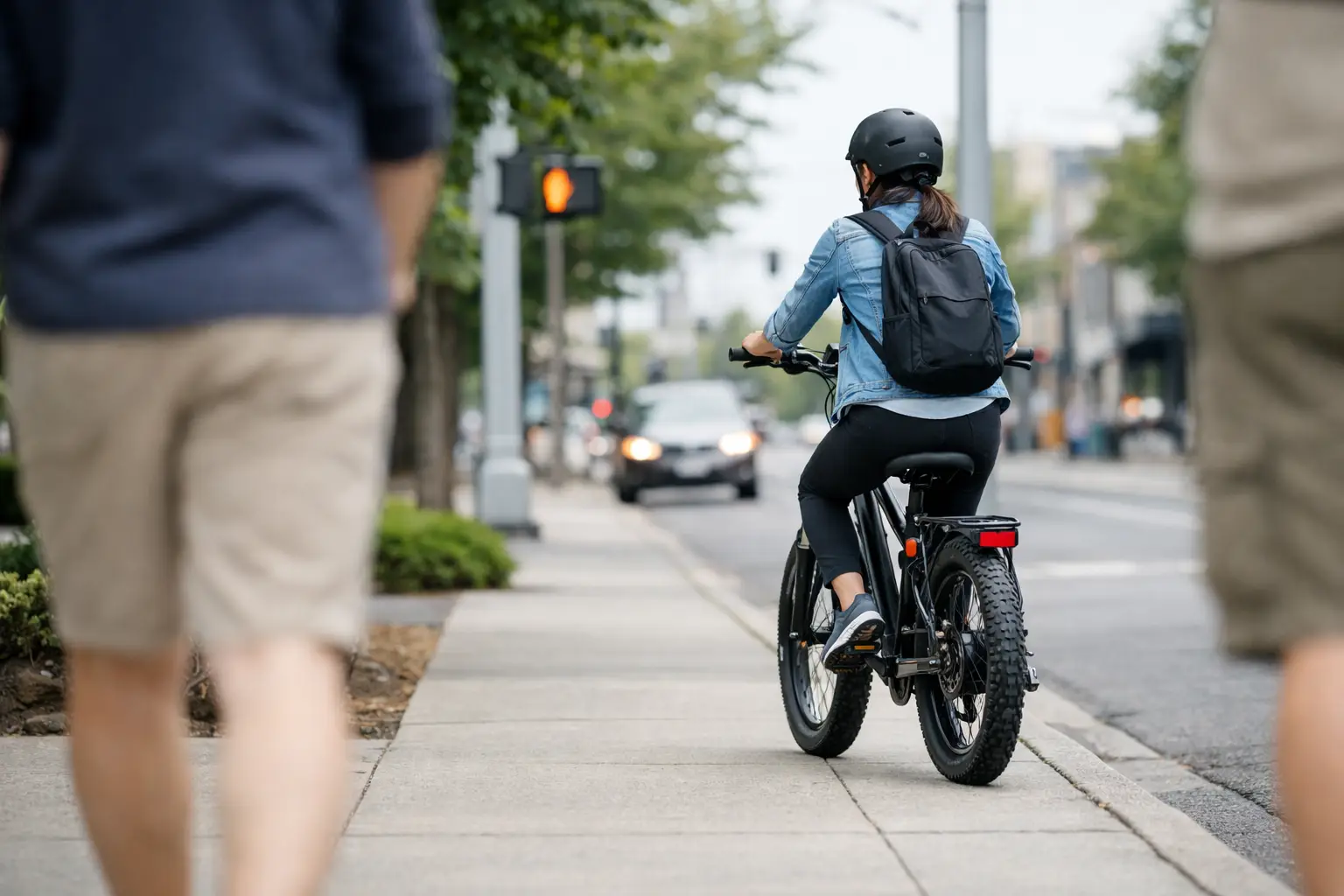
The short answer: are ebikes allowed on sidewalks? Sometimes, but often not. There is no single nationwide sidewalk rule for electric bicycles. Your state may set a baseline, while your city, county, park agency, or trail manager adds stricter rules. Even where sidewalk riding is legal, yielding to pedestrians and riding at a very low speed are essential.
For most e-bike trips, the bike lane, a low-traffic street, or a permitted shared-use path is the better choice. Sidewalks are designed first for people walking, using wheelchairs, pushing strollers, and entering driveways or businesses. An e-bike’s quiet approach and quicker acceleration can create a conflict before either person has time to react.
E-bike rules are mainly decided at the state and local level. Many states use a three-class system: Class 1 e-bikes provide pedal assist up to 20 mph, Class 2 e-bikes can use a throttle up to 20 mph, and Class 3 e-bikes provide pedal assist up to 28 mph. That classification may determine where an e-bike can operate, but it does not automatically give riders permission to use sidewalks.
A common pattern is that local law prohibits cycling on sidewalks in business districts or downtown areas but may allow it in residential areas. Other communities prohibit bicycles, including e-bikes, on all sidewalks unless a rider is a child. Some allow sidewalk riding but require cyclists to yield to pedestrians. A few locations treat e-bikes differently from conventional bicycles, particularly higher-speed Class 3 models.
Rules can also differ by the agency managing the space. A sidewalk beside a city street, a path through a county park, and a route on federal land may have separate rules. Do not assume that a sign allowing bicycles on a nearby trail also allows e-bikes on the sidewalk leading to it.
Nearly every rider needs to cross a sidewalk when entering a driveway, leaving a parking area, or reaching a bike rack. That is different from traveling along the sidewalk for several blocks. Local ordinances often address these situations differently.
When crossing, slow down enough to check for people walking, children, pets, and riders approaching from either direction. At a driveway or crosswalk, drivers may be looking for pedestrians moving at walking speed, not an e-bike moving at 15 mph or 20 mph. Slowing before the crossing gives drivers more time to see you and gives you more time to stop.
The main issue is not whether an e-bike has a motor. It is the difference in speed, visibility, and available space. On a narrow sidewalk, a person walking may step aside to avoid a crack, turn suddenly into a storefront, or move around a parked car door. An e-bike rider has limited room to safely avoid them.
Driveways are another concern. Drivers pulling out often focus on traffic in the roadway and may creep across the sidewalk. A rider moving quickly along the sidewalk can appear from outside the driver’s expected line of sight. This risk rises near parking lots, gas stations, and residential driveways.
E-bikes are also heavier than many standard bicycles. A heavier bike generally needs more distance to stop, especially on wet leaves, gravel, rain-slick concrete, or uneven pavement. Brake condition, tire pressure, tire tread, rider weight, cargo, and speed all affect stopping distance.
A sidewalk may feel safer than riding next to traffic, especially for a new rider or parent carrying cargo. That feeling is understandable. But a route with less vehicle traffic, lower posted speeds, a bike lane, or a protected path may be safer than a busy sidewalk lined with driveways and pedestrians.
Before using a sidewalk as part of your regular route, verify the rule for the exact location. Use this practical order:
Keep in mind that laws change. Check again after moving, changing your commute, or hearing that a local e-bike ordinance has been updated. General online summaries can be helpful starting points, but they may be outdated or miss a local exception.
Legal does not always mean appropriate for every block. If a local rule permits e-bikes on sidewalks, ride in a way that matches the space and conditions.
| Situation | Safer rider response |
|---|---|
| Pedestrians are nearby | Slow to walking pace, yield early, and be ready to stop. |
| The sidewalk is narrow or crowded | Dismount and walk the e-bike. |
| A driveway, alley, or parking-lot entrance is ahead | Reduce speed before reaching it and look for vehicles crossing the sidewalk. |
| You are passing someone | Give a clear, friendly verbal warning only when it will not startle them, then pass slowly with space. |
| Visibility is poor | Use a front light and rear light, wear visible clothing, and choose another route if practical. |
Do not expect people walking to move aside for you. Pedestrians may have hearing loss, be using headphones, be managing a child or dog, or simply not hear your bike. A bell can help alert someone, but it does not give you the right of way.
If you need to ride near pedestrians, reduce or turn off assist if your e-bike allows it. Lower assist can make it easier to control acceleration. Follow your owner’s manual for the correct use of assist modes and walk-assist features. Never modify the bike to defeat speed limits or safety controls.
Walking your e-bike is often the simplest, safest answer. Dismount in crowded downtown blocks, outside schools, near transit stops, through farmers markets or event areas, and anywhere signage says no riding. It is also a smart choice when you are unfamiliar with the route or cannot clearly see around corners.
Hold the handlebars firmly and keep the bike on the side away from passing pedestrians when space permits. Be mindful of pedals, panniers, baskets, and trailers, which can extend farther than you expect. If your e-bike has a walk-assist mode, use it only as the manufacturer directs and stay in control of the bike at all times.
The fastest route is not always the best route. A calm residential street with lower traffic, a designated bike lane, or a permitted multiuse path can offer more predictable movement than a sidewalk. For a new rider, practicing on a quiet, legal route can also build braking, turning, and scanning skills without pressure from traffic or pedestrians.
If your commute requires a difficult corridor, consider combining routes: ride on a permitted street or path for most of the trip, then dismount for the short sidewalk section near your destination. That small adjustment can reduce conflicts and keep your ride within local rules.
A sidewalk can look like a refuge from traffic, but it is still shared pedestrian space. Check the rule, read the environment, and choose the option that gives everyone the most room to move safely.
Are e-bikes allowed on sidewalks everywhere in the United States?
No. There is no single nationwide rule that permits e-bikes on every sidewalk. State laws may establish general rules, while cities, counties, parks, and property managers can impose additional restrictions.
Can Class 1 and Class 2 e-bikes be ridden on sidewalks?
Their classification does not automatically make sidewalk riding legal. Some locations permit Class 1 or Class 2 e-bikes on certain sidewalks, while others prohibit all bicycles or motor-assisted bicycles.
Are Class 3 e-bikes allowed on sidewalks?
Class 3 e-bikes are more likely to face restrictions because they can provide pedal assistance at higher speeds. Check the applicable state law, local municipal code, and posted signs before riding one on a sidewalk.
Do e-bike riders have to yield to pedestrians?
Yes, riders should yield to pedestrians whenever sidewalk riding is permitted. Slow to walking speed, leave adequate passing space, and give a polite verbal warning or bell signal before passing when appropriate. The NHTSA also advises cyclists to check local laws and pass pedestrians carefully.
Can children ride e-bikes on sidewalks?
Some local laws provide sidewalk-riding exceptions for children, but these exceptions are not universal and may not apply to every e-bike class. Parents should verify local age, helmet, licensing, and operating-location requirements.
Is crossing a sidewalk different from riding along it?
It may be treated differently under local law. When entering or leaving a driveway, parking area, or bike rack, slow down and watch carefully for pedestrians and vehicles crossing the sidewalk.
What should I do if e-bikes are prohibited on the sidewalk?
Dismount and walk the e-bike until you reach a legal riding area. When available, use a bike lane, low-traffic street, or permitted shared-use path instead.