A good ride can change your day.

This e-bike charging cost calculator estimates cost per full charge, monthly cost, yearly cost, and car fuel comparison by battery size and electricity rate.
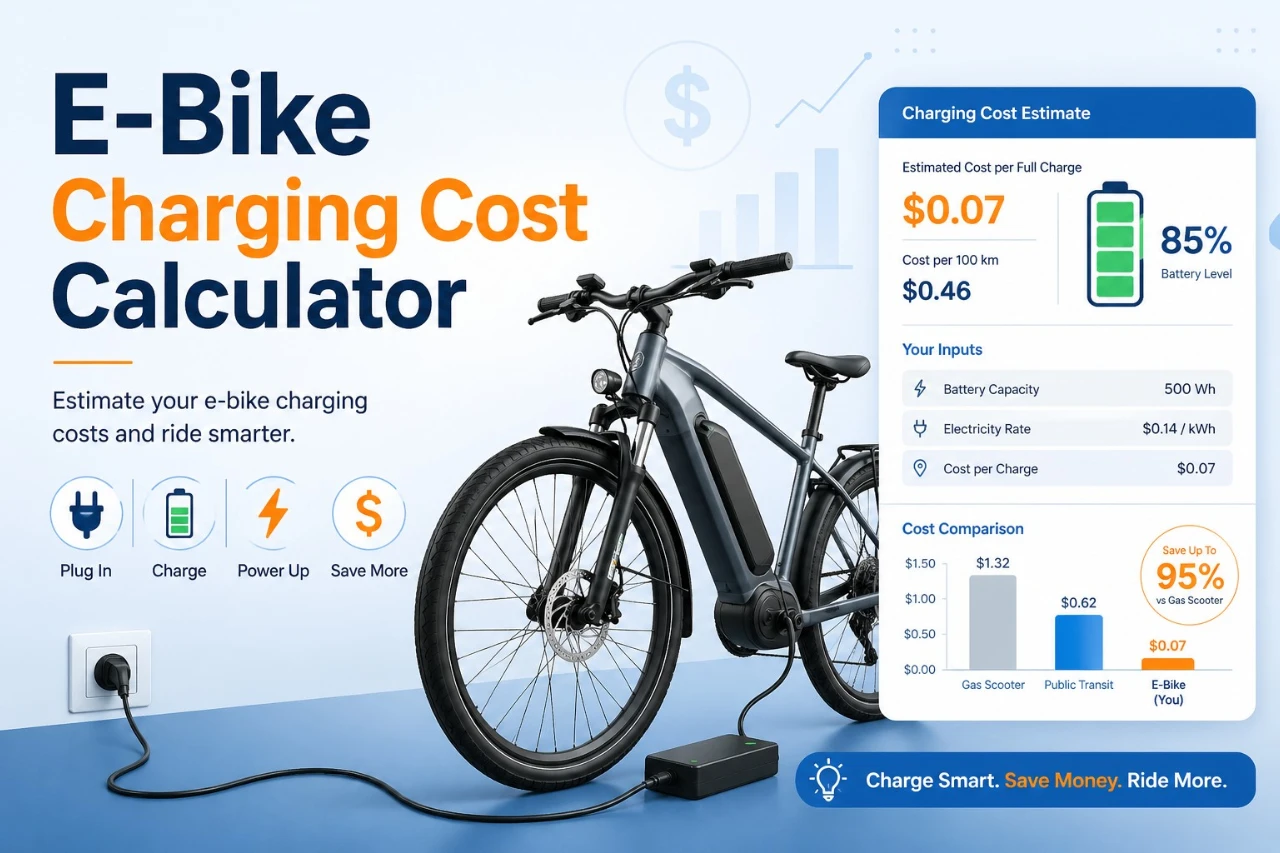
Estimate how much it costs to charge your electric bike battery.
This e-bike charging cost calculator helps riders estimate the cost per full charge, monthly charging cost, and yearly charging cost based on battery voltage, amp-hour capacity, local electricity rate, and charging frequency.
E-bikes are usually very inexpensive to charge compared with using a gas-powered car for short trips. However, the exact cost depends on your battery size, electricity rate, charger efficiency, and how often you charge the battery.
Use the calculator below to estimate your charging cost and compare it with a simple car fuel cost estimate.
E-Bike Cost Tool
Estimate how much it costs to fully charge your e-bike battery and compare your weekly, monthly, and yearly charging cost with typical car fuel costs.
E-bike battery energy is measured in watt-hours, or Wh. A simple way to estimate battery size is:
Battery voltage × amp-hour capacity = watt-hours
For example, a 48V 15Ah battery has about 720Wh of energy. A 52V 20Ah battery has about 1,040Wh of energy.
Electricity is usually billed in kilowatt-hours, or kWh. Since 1,000Wh equals 1kWh, a 720Wh battery stores about 0.72kWh of energy.
The calculator estimates charging cost by converting your battery size into kilowatt-hours, adjusting for charging efficiency, and multiplying that by your local electricity cost.
A simplified formula is:
Battery kWh ÷ charging efficiency × electricity rate = cost per full charge
The monthly and yearly estimates are based on how many times you charge the battery each week.
E-bikes use small batteries compared with electric cars. Most e-bike batteries are between about 400Wh and 1,000Wh, while electric car batteries are much larger.
That means a full e-bike charge often uses less than 1kWh of electricity for many standard batteries. Even if your local electricity rate is higher than average, the cost per full charge is usually still low.
For many riders, the yearly charging cost of an e-bike can be much lower than the fuel cost of short car trips. This is one reason e-bikes can be useful for commuting, errands, grocery runs, and local transportation.
The main cost of an e-bike is usually the bike itself, maintenance, accessories, and battery replacement over time—not daily electricity use.
The biggest factor is battery size. A larger battery stores more energy, so it costs more to fully charge than a smaller battery. However, a larger battery can also provide more range, so the cost per mile may still be low.
Your local electricity rate also matters. Riders in areas with higher electricity prices will pay more per charge than riders in lower-cost areas.
Charging frequency is another important factor. A rider who charges once per week will spend much less per month than a daily commuter who charges five or six times per week.
Charger efficiency also affects the estimate. Some energy is lost as heat during charging, so the electricity drawn from the wall can be slightly higher than the energy stored in the battery.
Battery condition, partial charging, temperature, and charger quality can also change the real cost slightly.
For short local trips, an e-bike can be much cheaper to power than a gas-powered car.
A car may cost several cents to more than 20 cents per mile in fuel, depending on fuel price and fuel economy. An e-bike often costs only a small fraction of that in electricity, especially when used for commuting or errands.
This calculator uses a simple car fuel cost estimate to show the difference. It does not include car insurance, parking, maintenance, depreciation, or repairs. Those costs can make car ownership much more expensive.
For a fair comparison, think of the e-bike as a replacement for some short car trips, not every trip. Even replacing a few weekly errands or commutes can reduce fuel use and lower transportation costs over time.
Use these guides if you want to compare e-bikes for commuting, lower ownership cost, longer range, or daily transportation.
How do you calculate the cost to charge an e-bike?
To estimate e-bike charging cost, multiply battery voltage by amp-hour capacity to get watt-hours. Convert watt-hours to kilowatt-hours, adjust for charger efficiency, and multiply by your local electricity rate.
How much does it cost to fully charge an e-bike?
The cost depends on battery size and electricity rate. Many standard e-bike batteries cost only a few cents to fully charge. Larger batteries and higher electricity rates increase the cost, but e-bike charging is usually inexpensive compared with car fuel.
What does Wh mean on an e-bike battery?
Wh means watt-hours. It measures how much energy a battery can store. A 48V 15Ah battery has about 720Wh. A higher Wh number usually means more stored energy and more potential range.
Does a bigger e-bike battery cost more to charge?
Yes. A bigger battery stores more energy, so it costs more to fully charge. However, it may also provide more range, so the cost per mile can still remain low.
How much does it cost to charge an e-bike per month?
Monthly charging cost depends on battery size, electricity rate, and how often you charge. A rider charging a standard e-bike battery a few times per week will usually spend only a small amount per month on electricity.
Is charging an e-bike cheaper than buying gas?
Yes, for most short local trips, charging an e-bike is much cheaper than buying gas for a car. The exact savings depend on local electricity prices, gas prices, car fuel economy, trip distance, and how often the e-bike replaces car use.
Does charger efficiency affect charging cost?
Yes. Some energy is lost during charging, usually as heat. A less efficient charger may draw slightly more electricity from the wall than the battery stores. This calculator includes a charging efficiency setting to make the estimate more realistic.
Should I fully charge my e-bike battery every time?
You can fully charge the battery when you need maximum range. For everyday use, many riders avoid leaving the battery fully charged for long periods. Follow the battery manufacturer’s charging and storage guidance for best long-term battery health.