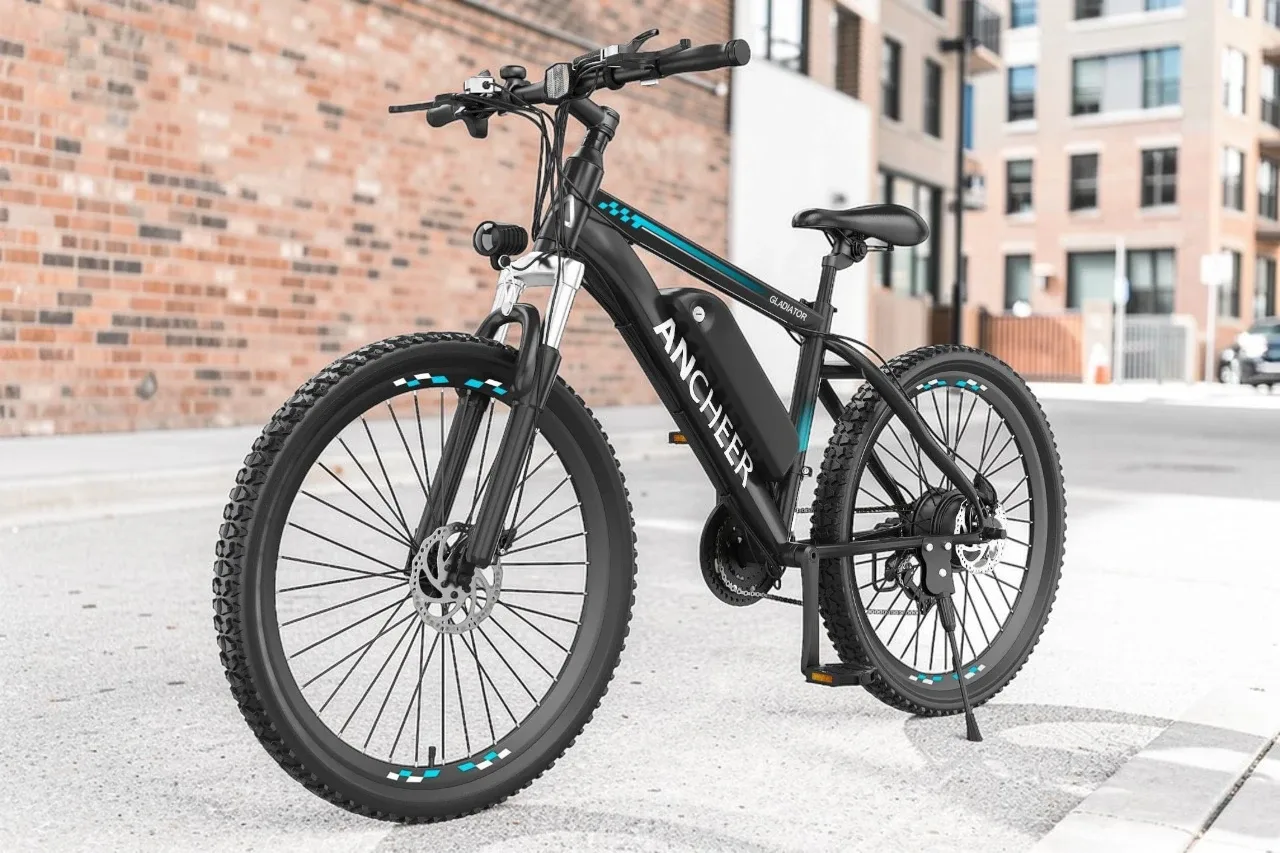
The ANCHEER Gladiator is a great choice for budget-minded riders who want a real starter e-bike for commuting, neighborhood rides, and light trails, but it is not ideal for riders who expect premium braking, long real-world range, or polished out-of-the-box setup.
Best for
- First-time e-bike buyers on a tight budget
- Casual riders mixing pavement, bike paths, and light gravel
- Commuters who want a removable battery and simple controls
Not ideal for
- Riders tackling steep hills every day
- Anyone expecting strong long-range throttle performance
- Buyers who want premium components with minimal tuning
Biggest strength: It gives you a surprisingly complete package for the money: removable battery, 21-speed drivetrain, front suspension, and usable everyday power.
Biggest trade-off: You can feel where the price was saved, especially in the saddle, brake feel, and final setup refinement.
At a Glance
Category: Entry-level electric mountain/commuter hybrid
Motor: 500W rear hub motor, 750W peak
Battery: 48V 10.4Ah / 499Wh, removable
Claimed range: Up to 50 miles
Realistic range: About 20 to 35 miles for most riders
Top speed: Up to 22 mph claimed
Drivetrain: 21-speed Shimano-style setup
Suspension: Front suspension fork
Brakes: Mechanical disc brakes
Bike weight: About 48 lb
Payload: 265 lb claimed
Best for: Budget commuters, casual riders, beginners
Test Conditions
Rider weight: About 180 lb
Rider height: 5’10”
Terrain: Pavement, neighborhood streets, bike paths, gravel sections, and light off-road trails
Typical speed: I spent most of my time around 12 to 17 mph, with short pushes closer to the bike’s limit
PAS levels used: Mostly PAS 1 and PAS 2, with PAS 3 or throttle when I wanted more help
Weather: Best judged in normal daily riding conditions with light wind
Test duration: My setup and ride impressions reflect early riding; long-term durability expectations are best treated as owner-report territory rather than something I would overclaim from a short test
Real-World Takeaways
Assembly time: About 20 to 30 minutes
First-ride setup issues: I had to spend extra time dialing in the brakes and gears
Power feel: Stronger than I expected for the price, but not explosive
Hill performance: Respectable on moderate hills if I pedaled and used the gears well
Range reality: More like 20 to 35 miles in normal use than the full 50-mile claim
Handling: Stable, beginner-friendly, and easy to control
Noise/rattles: Mostly quiet, though brake noise and budget-bike sounds can show up if tuning is off
Biggest surprise: It feels like a real, usable e-bike rather than a cheap toy
Biggest disappointment: The finishing touches feel basic, especially the saddle and brake feel
What Is the ANCHEER Gladiator?
The ANCHEER Gladiator is a low-cost, 26-inch e-bike aimed at riders who want an affordable way into commuting, casual fitness rides, and light trail use. It is not a serious mountain bike, and I would not treat it like one. What it tries to do is simpler: give budget shoppers a familiar bicycle layout with electric help, a removable battery, front suspension, disc brakes, and gears that make it more versatile than many stripped-down entry bikes.
That matters, because a lot of e-bikes in this price tier feel overly compromised. Some are too heavy, some are too under-geared, and some rely so heavily on throttle use that they stop feeling like bicycles. The Gladiator sits in a more useful middle ground. It still feels like a bike first, just with enough motor help to make commuting and casual riding easier.
Key Specs
| Spec | ANCHEER Gladiator |
|---|---|
| Motor | 500W rear hub, 750W peak |
| Torque | 55 Nm claimed |
| Battery | 48V 10.4Ah, 499Wh removable |
| Charge time | About 3.5 hours claimed |
| Range | Up to 50 miles claimed |
| Realistic range | About 20-35 miles depending on assist, terrain, rider, and throttle use |
| Top speed | Up to 22 mph claimed |
| Drivetrain | 21-speed |
| Tires | 26″ x 2.1″ |
| Suspension | Front suspension fork, lockable/adjustable |
| Brakes | Mechanical front and rear disc brakes |
| Display | LCD with speed, mileage, battery, and assist info |
| Riding modes | Throttle, pedal assist, normal bike, walk/booster mode |
| Weight | About 48 lb |
| Payload | 265 lb claimed |
| Rider height | About 5’2″ to 6’2″ claimed |
| Certifications | Brand materials show UL 2849 compliance for the e-bike and UL 2271 for the battery |
One thing worth flagging: the listing materials are not perfectly consistent on the assist-level count. Some brand content shows 5 assist levels, while the written listing mentions 3. I would confirm that at the point of purchase, because it affects how fine-tuned the assist feels.
Who This Bike Is For
I think the Gladiator makes the most sense for someone who wants a first e-bike without spending serious money. If your riding is mostly pavement, bike paths, neighborhood roads, and occasional gravel or light dirt, it gives you enough power and enough gearing to feel practical instead of limiting.
It also suits riders who still want a conventional bike feel. The 26-inch wheels and 21-speed drivetrain help it feel more familiar than many compact or fat-tire budget options. For commuting, casual weekend rides, or getting a little exercise with some electric help, I can see the appeal clearly.
Who Should Skip This Bike
You should skip it if you ride steep hills regularly, need dependable long-range throttle riding, or want high-end braking and finishing details. I would also pass if comfort is your top priority and you do not want to budget for a better saddle.
Heavier riders near the payload limit should think carefully too. The bike may still work, but the modest motor, basic mechanical brakes, and entry-level parts make more sense for average-weight casual riders than for bigger riders pushing the bike hard.
If your priorities are stronger hill performance, better brakes, or fewer setup compromises, I would look toward a heavier-duty commuter e-bike or a mid-range hardtail-style e-bike rather than the cheapest category.
Real Drawbacks
Drawback #1: The saddle is a weak point
Who it affects: Riders doing frequent rides, longer commutes, or anyone sensitive to saddle comfort
When it shows up: After the novelty wears off and rides get longer than quick neighborhood loops
Why it matters: Comfort is not a small issue on a daily-use e-bike. A bad saddle can make an otherwise solid budget bike feel worse than it is
Workaround: Replace the saddle early. This is one of the easiest and smartest upgrades to make
Drawback #2: The brakes feel basic
Who it affects: Heavier riders, faster riders, and people riding in traffic or on longer descents
When it shows up: Harder stops, emergency braking, downhill riding, or after the brakes drift out of adjustment
Why it matters: Mechanical disc brakes can be fine at this price, but these do not feel premium. Brake confidence matters more than spec-sheet bragging
Workaround: Bed them in properly, re-check alignment early, and keep expectations realistic. Better pads or a full brake upgrade would help if you keep the bike long term
Drawback #3: Real-world range is meaningfully below the headline claim
Who it affects: Commuters with longer round trips and riders who depend heavily on throttle
When it shows up: Faster riding, hilly routes, heavier rider loads, cold weather, or higher-assist use
Why it matters: A 50-mile claim sounds generous, but many buyers will not ride in ideal lab-style conditions
Workaround: Plan around a realistic 20 to 35 miles, not the maximum claim
Drawback #4: Final setup may need patience
Who it affects: Beginners expecting a perfect ride straight out of the box
When it shows up: During assembly and the first few rides, especially with gears and brake rub
Why it matters: A cheap bike that needs adjustment is not automatically bad, but it can frustrate buyers who are not comfortable with basic tuning
Workaround: Set aside extra time for derailleur and brake adjustment, and re-check bolts, spoke tension, and rotor rub after the first 10 to 20 miles
Real-World Performance
Motor and Power Feel
On the road, I found the Gladiator stronger than I expected for the price. It does not have that hard launch or deep torque you get from stronger hub motors or pricier bikes, but it gives a solid, useful push from a stop. For ordinary commuting, neighborhood riding, and casual bike-path use, it feels lively enough.
Where I liked it most was in moderate-effort riding. If I pedaled with it instead of treating it like a mini motorcycle, the motor felt appropriately matched to the bike. It helped flatten everyday effort without making the bike feel jerky or awkward.
On hills, I would call it respectable rather than impressive. With my weight around 180 lb, it handled moderate hills better than I expected, especially when I stayed in the right gear and added steady pedaling. I would not buy it for steep, repeated climbs, but I also would not dismiss it as underpowered for normal city terrain.
Speed and Control
The Gladiator feels most natural in the low-to-mid teens, where the bike tracks well and stays easy to manage. I was comfortable cruising around 12 to 17 mph. Pushing toward the top end is possible, but that is also where the budget nature of the bike becomes more obvious.
The control layout looks simple, which I like on a beginner e-bike. You are not dealing with a complex app ecosystem or too many ride-mode distractions. The throttle and assist system are there to make riding easier, not more complicated. That simplicity is part of the appeal.
The 21-speed drivetrain is one of the better choices on this bike. It helps the Gladiator feel more adaptable than a lot of cheap single-chainring, low-flexibility e-bikes. That matters on rolling terrain and when the battery is low.
Range: What to Expect
This is one of the biggest reality-check areas. I would not plan around the full 50-mile claim unless conditions are unusually favorable and I am using light pedal assist the whole time. In normal use, I think most riders should expect roughly 20 to 35 miles.
That range will drop if I use more throttle, ride faster, climb more, carry gear, or face cold temperatures and wind. For short commutes or casual rides, that is still very usable. But for a longer daily round trip, I would want to do the math carefully before buying.
A helpful way to think about it is this: for a short urban commute, the Gladiator can absolutely be enough. For extended recreational riding, you just need to go in with honest range expectations.
Comfort, Handling, and Practicality
Comfort
The riding position felt reasonable for casual riding. I did not feel overly stretched out, and at 5’10” I fit the bike in a pretty normal way. The front suspension helps take the edge off rough pavement and light trail chatter, but it is not a miracle worker.
The saddle is the real comfort weak point. On short rides I could live with it. On regular rides, I would replace it. That is the difference between a bike feeling acceptable and a bike feeling worth keeping.
Handling and Stability
I found the Gladiator stable and beginner-friendly. It is not especially refined, but it is easy to point, easy to control, and easy to understand. That matters more than flashy design in this price class.
It feels happiest on pavement, bike paths, gravel sections, and mild trails. I would not take it into aggressive mountain-bike terrain. The tires, fork, and overall build suggest light mixed-surface use, not hard trail punishment.
Brakes and Safety
The mechanical disc brakes are serviceable, but they do not feel premium. In ordinary riding, I think they are adequate. In harder stops or more demanding conditions, I would want them perfectly adjusted and bedded in. Some noise would not surprise me either.
The UL compliance claims are a genuine positive here. At this price, having a bike marketed with whole-bike UL 2849 compliance is meaningful. It does not guarantee perfection, but it is a stronger sign of baseline electrical safety than a vague no-name listing.
Controls, Display, and Riding Modes
The LCD gives you the basics: speed, battery info, mileage, and assist data. That is enough for this type of bike. I prefer simple displays on budget bikes, because there is less to go wrong and less that feels unfinished.
Cruise control and walk/booster mode are useful extras at this price, though they are not features I would buy the bike for by themselves. They are more like nice bonuses. The only caution is that buyers should confirm the exact PAS structure, because the brand materials are not fully consistent.
Fit, Sizing, and Adjustability
At 5’10”, I fit the Gladiator comfortably enough for casual and commuting use. The claimed rider range of about 5’2″ to 6’2″ sounds plausible, but fit within that range will not feel equally good for everyone.
For shorter riders, the key questions are stand-over comfort, handlebar reach, and whether the saddle can drop low enough for confident stops. This is not a step-through, so shorter beginners should pay extra attention there.
For taller riders, the bike may still work, but the cockpit and overall scale will likely feel more entry-level than roomy. Heavy riders near the 265 lb payload should also remember that fit, braking, and climbing performance tend to feel more strained as load goes up.
What to Expect as an Owner
Assembly is fairly straightforward, and I would budget about 20 to 30 minutes to get it ride-ready. Most of the work is typical: front wheel, handlebar, pedals, and final checks. The part that takes longer is the tuning.
After the first 10 to 20 miles, I would re-check brake alignment, cable tension, rotor rub, derailleur adjustment, pedal tightness, axle security, and general bolt tightness. That is especially important on a budget e-bike, because small setup issues can grow into bigger annoyances if ignored.
The practical upside is that the bike uses common, familiar categories of parts. Tires, brake consumables, and general service items should be more manageable than on more unusual or proprietary e-bikes. The flip side is that support and long-term service realities on a value-focused bike are usually not as strong as on premium brands, so self-sufficiency helps.
Pros & Cons

Pros:
- Strong value for the price
- Motor feels better than expected for a starter e-bike
- Removable battery adds convenience
- 21-speed drivetrain improves versatility
- Stable, beginner-friendly handling
- Front suspension helps on rough pavement and light gravel
- UL compliance claims add peace of mind
Cons:
- Saddle comfort is poor for frequent riding
- Mechanical brakes feel basic
- Real-world range is well below the headline maximum
- Likely needs more out-of-box tuning than pricier bikes
- Not a strong choice for steep hills or aggressive trail riding
- Listing details appear inconsistent on assist-level count
Comparison
Compared with many cheap fat-tire e-bikes, the Gladiator feels more practical and easier to live with if most of your riding is on pavement, paths, and light mixed terrain. It is lighter, simpler, and closer to a normal bicycle experience.
Compared with a better mid-range commuter or hardtail e-bike, it loses in refinement, braking confidence, comfort, and long-term polish. That is not a surprise at this price, but it is the line buyers need to understand clearly. The Gladiator wins on entry cost, not on overall sophistication.
FAQ
Is the ANCHEER Gladiator good for hills?
It is decent on moderate hills if I pedal and use the gears properly. I would not buy it for steep, repeated climbs.
Is it comfortable for long rides?
It is acceptable for shorter casual rides, but I would upgrade the saddle if I planned to ride it often or for longer distances.
Is the battery removable?
Yes. The battery is removable and lockable, which is useful for indoor charging.
What range should I realistically expect?
I would plan around roughly 20 to 35 miles in mixed real-world riding, not the full 50-mile headline claim.
Is it beginner-friendly?
Yes. The bike feels stable, easy to control, and straightforward to understand, which makes it a good entry-level option.
Are the brakes good enough?
They are acceptable for normal use, but they feel basic. Proper setup matters, and heavier or faster riders may want better brake performance.
Can shorter riders fit it?
Possibly, but they should look closely at stand-over height and seat adjustment. This is not the easiest frame style for every shorter rider.
Does it need much assembly?
Not a lot, but it may need more brake and gear tuning than a higher-end bike.
Final Verdict
Buy it if: you want a genuinely usable first e-bike under a tight budget, mainly ride pavement and light mixed surfaces, and can accept a few rough edges.
Skip it if: you want premium comfort, stronger brakes, better hill power, or range that consistently matches the headline number.
The ANCHEER Gladiator gets the important part right: it feels like a real entry-level e-bike, not a throwaway gadget. I can see why it would appeal to beginners. The motor is useful, the removable battery is convenient, the 21-speed setup helps it ride like a normal bike, and the overall package makes sense for casual commuting and light recreational riding.
The compromise is that you have to be realistic. The range claim is optimistic, the brake feel is basic, and the finishing touches remind you that this is a budget bike. I would not recommend it to demanding riders, but I would recommend it to the right budget buyer.
Would I spend my own money on it?
Yes, but only in a specific scenario: if I wanted a low-cost starter e-bike for commuting, neighborhood riding, and light trails, and I was comfortable doing a little setup tuning and probably replacing the saddle. For that use, it offers honest value. For anything more demanding, I would save for a better-sorted bike.
| Preview | Product | Price | |
|---|---|---|---|

| ANCHEER 26″ Electric Mountain Bike for Adults, 48V 499Wh Commuter Ebike | 19.8MPH Electric… | $459.99 $413.99 | View on Amazon |
GoEBikeLife publishes independent e-bike reviews, comparisons, and practical buying guides. Some links on this page are affiliate links. If you make a purchase through an eligible link, we may earn a commission at no additional cost to you.