A little joy belongs in every day.

48V and 52V e-bike systems feel closer than most people expect. Here’s what changes on hills and speed, what doesn’t, and how to choose safely.
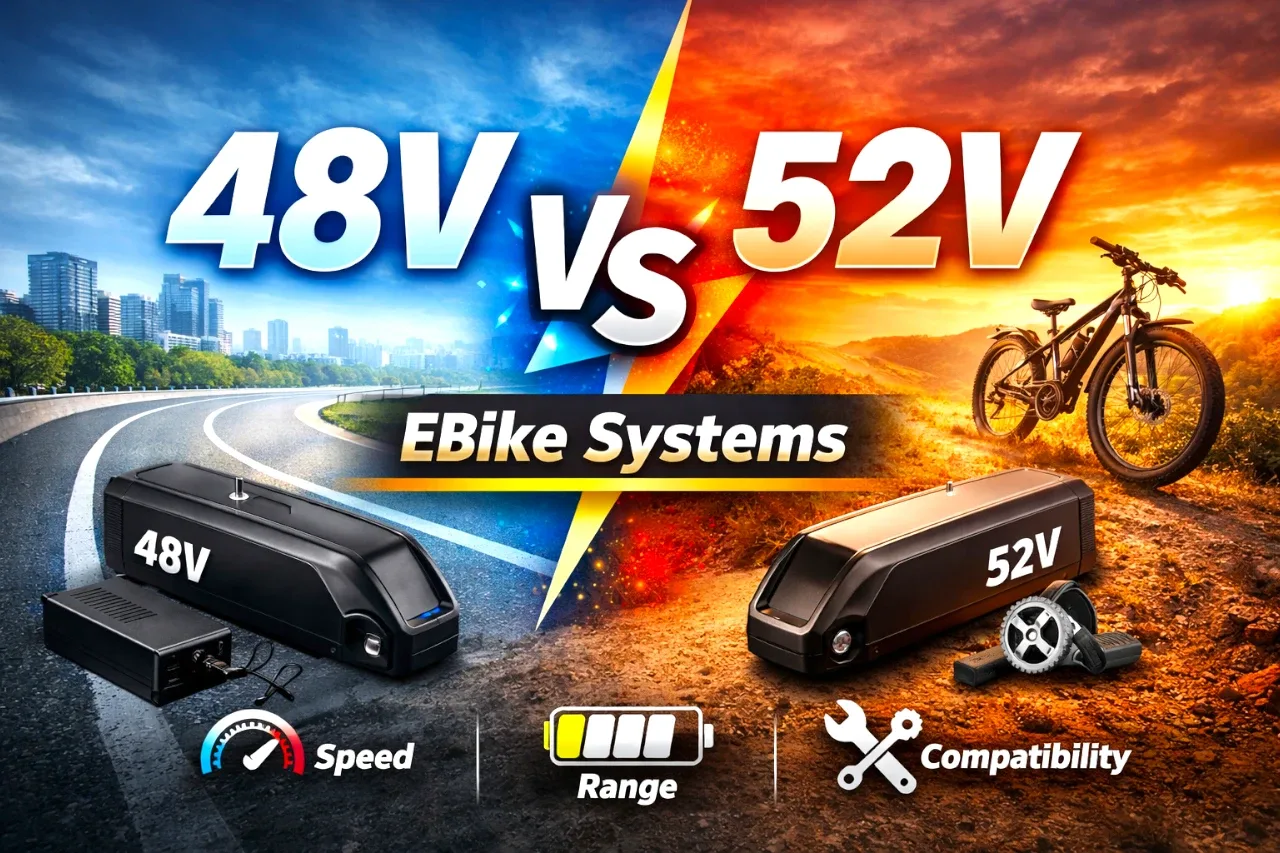
If you’re debating a 48V vs 52V ebike system, you’re probably trying to answer one practical question: “Will I actually feel the difference on real rides?”
In simple terms, 52V is a slightly higher-voltage system that can deliver a bit more “snap” and hold speed under load a little better, assuming the controller and motor are designed to use it. 48V is the more common, widely compatible, easier-to-service standard that already performs extremely well when paired with a good controller tune and battery.
This comparison will help you decide which voltage makes sense for your riding—without getting tricked into thinking voltage alone guarantees speed, torque, or range.
Best overall choice: 48V (for most riders, it’s the simplest, most compatible, lowest-hassle option with almost no real-world downside).
Choose 48V if:


Choose 52V if:
Key deciding factor: System compatibility and tuning (controller limits + motor capability) matter more than the number on the battery label.
A good 48V system can feel punchy and responsive—especially with a controller that delivers strong current at low speed and a motor that’s properly matched to your wheel size and gearing.
Score: 8/10
At the same controller current limit, 52V can deliver slightly more power (because power is voltage × current). In practice, that can translate to a modest improvement in initial pull and mid-speed “push,” if the controller actually allows it.
Score: 8.5/10
You might notice the difference most when accelerating from ~15 mph up to cruising speed, or when merging into traffic. But it’s usually not a night-and-day jump—more like “a bit sharper” than “a different bike.”
With common e-bike speed limits (Class settings) and typical controller programming, 48V often tops out where the bike is configured to stop assisting—not where the voltage “runs out.”
Score: 8/10
A 52V system can enable a slightly higher top speed if the controller is not speed-limited (or if limits are adjustable) and the motor is wound/tuned for it. Otherwise, top speed may be identical to 48V.
Score: 8.5/10
What you’ll notice: slightly better ability to hold speed on mild grades or into headwinds.
What you won’t notice: a guaranteed top-speed increase just because the battery is 52V.
Range is mostly about watt-hours (Wh), tire choice, speed, wind, hills, rider weight, and how much throttle you use. A 48V battery can be huge (high Wh) and out-range a smaller 52V pack easily.
Score: 8.5/10
A similarly sized 52V pack often has slightly higher Wh if the amp-hours are similar, so there can be a modest range advantage—typically single-digit to low double-digit percentage—depending on the exact battery sizes.
Score: 8.5/10
If you’re expecting 52V to magically add “10–20 extra miles,” that’s usually disappointment territory. Battery Wh is the real range number, not just voltage.
As the battery drains, you may feel the bike get a little less eager—especially on hills or higher speeds—because voltage naturally drops under load. Well-built packs sag less; cheaper packs sag more.
Score: 7.5/10
Because it starts higher, 52V tends to feel a bit stronger later into the discharge, particularly for riders who push higher speeds or ride steep grades.
Score: 8.5/10
This is one of the most legitimate “you’ll feel it” differences: 52V often feels less “tired” near the end—but it still depends heavily on battery quality and controller behavior.
If you demand high power (heavy rider, hills, lots of throttle), the system may draw higher current to hit the same performance target. Higher current can mean more heat in wiring, connectors, and the controller.
Score: 7.5/10
A well-designed 52V system can achieve similar power with slightly less current, which can help reduce heat in some scenarios. However, it can also push the motor/controller harder if the tune encourages higher peak power.
Score: 8/10
Voltage isn’t automatically “safer” or “harder” on components—it depends on how the controller is tuned and whether the system is actually rated for that voltage.
This is where 48V shines. Batteries, chargers, controllers, displays, and accessories are more widely available and generally more plug-and-play within a brand ecosystem.
Score: 9.5/10
You need to ensure the controller and display are truly 52V-compatible, and the system’s electrical components (especially controller capacitors and low-voltage accessories) are designed for the higher voltage. Some “48V” systems tolerate 52V—some do not.
Score: 7/10
If you want low drama ownership, 48V is the safer bet.
If you’re upgrading, 52V can be great—but only when everything is confirmed compatible.
48V chargers are ubiquitous. Finding a replacement is easy, and service shops are more used to seeing 48V systems.
Score: 9/10
52V chargers are still common, but you must match the correct charger to the battery. Mixing chargers is a real mistake people make (and it can damage the battery or leave you undercharged).
Score: 8/10
Both are easy to live with when you keep your system matched. The risk is higher with 52V mainly because people “assume it’s close enough.”
For most riders, spending extra purely to chase 52V is not the best use of budget. You’ll often get more real-world benefit from better brakes, better tires, a higher quality battery, or a better controller tune.
Score: 9/10
Worth it when you’re buying a bike that’s genuinely designed around it (not retrofitted), or when you know you ride in conditions that expose voltage sag (speed + hills + load).
Score: 8/10
Buy quality first (battery + controller + brakes). Voltage is secondary unless you already know why you need it.
| Factor | 48V | 52V |
|---|---|---|
| Acceleration feel | 8/10 – strong when tuned well | 8.5/10 – slightly snappier if supported |
| Top speed potential | 8/10 – often limit-based | 8.5/10 – slight edge if not capped |
| Range | 8.5/10 – depends on Wh | 8.5/10 – depends on Wh (often slightly higher) |
| “Near empty” performance | 7.5/10 – can soften | 8.5/10 – usually holds better |
| Heat/stress (practical) | 7.5/10 – current can rise | 8/10 – can reduce current for same power |
| Compatibility | 9.5/10 – easiest | 7/10 – verify everything |
| Ownership value | 9/10 – best for most | 8/10 – best for specific needs |
| Overall | Winner for most riders | Winner for performance-focused setups |
For most e-bike riders, 48V is the smarter default because it’s common, compatible, and already delivers excellent real-world performance when the battery and controller are decent.
52V is a valid upgrade—but it’s not a magic switch. You’ll feel it most in speed-holding and late-battery performance, and you’ll benefit most when the entire system is built (or confirmed) to support it. If you’re not 100% sure your platform is compatible, 48V is the safer, cleaner decision.