A good ride can change your day.

Full suspension isn’t always better. Compare full suspension vs hardtail e-bikes for comfort, traction, range, weight, and maintenance—then choose confidently.

“Full suspension” sounds like an automatic upgrade—until you live with it day to day: extra weight, extra moving parts, and a different feel when you pedal. On the other side, “hardtail” can sound basic, but for a lot of riders it’s actually the smarter tool for the job.
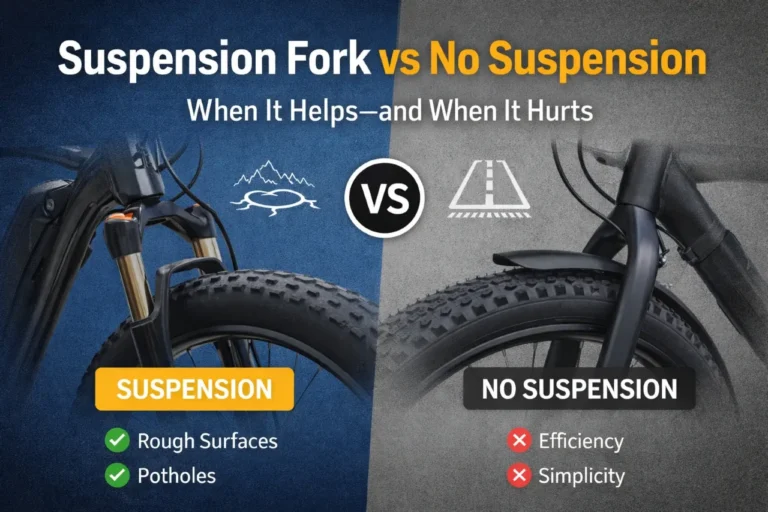
A full-suspension e-bike has suspension in the front and rear. A hardtail e-bike has a suspension fork up front, but the rear end is rigid.
In this comparison, I’ll keep it buyer-focused: how each setup feels on real terrain, what it costs you (money and maintenance), and which type of rider truly benefits.
Best overall choice for most riders: Hardtail e-bikes—simpler, lighter, more efficient, and usually better value unless you regularly ride rough terrain fast.
Choose full suspension if:
Choose hardtail if:
Key deciding factor: how often you ride rough terrain (and how fast) versus how much you value simplicity, efficiency, and low ownership friction.
Now let’s break it down.
I’m comparing them on the factors that actually change the buying decision:
If your routes include pothole-riddled streets, washboard gravel, or trail chatter, full suspension can feel like switching from “tolerable” to “I can ride another hour.” The rear shock takes the sharp edge off impacts that would otherwise travel through the saddle into your lower back.
The biggest “real life” benefit: you finish rides less beat up. That matters for heavier riders, longer distances, and anyone with back or joint sensitivity.
Score: 9/10
Hardtails can still be comfortable—especially with the right tire pressure and a decent fork—but the rear end will always transmit more vibration and hits. On rough ground, you’ll feel it most through the saddle: repeated bumps add up.
On smoother terrain, hardtails are perfectly comfortable and often feel more direct and predictable.
Score: 7/10
Rear suspension helps the rear wheel stay in contact with the ground instead of skipping. That means better traction while climbing loose surfaces and more control in corners. It’s not just about comfort—it can be a safety and confidence upgrade if you ride trails at real speed.
Score: 9/10
Hardtails can still be capable off-road, but the rear wheel will bounce and lose traction sooner on choppy terrain. You compensate by slowing down, choosing cleaner lines, and sometimes standing more.
For casual off-road, that’s fine. For aggressive riding, you hit the limit earlier.
Score: 7/10
Full suspension helps you stay in control when the surface is unpredictable. Hardtails work best when you’re okay riding a little slower and smoother.
Full suspension tends to cost you energy. Even with modern suspension designs, some power gets absorbed through movement—especially when you’re pedaling hard, climbing, or accelerating repeatedly. E-bikes hide some of this with motor assist, but you can still feel it in “snap” and range consistency.
Also, heavier bikes tend to drain batteries faster on stop-and-go and hills. Full-suspension models often weigh more, and that matters.
Score: 7/10
Hardtails feel more direct: when you pedal, the bike moves forward without the slight “settle and go” sensation some full-suspension bikes have. That usually translates into better efficiency and a more consistent range feel for the same battery size.
If you commute, ride longer distances, or want the most miles per charge, hardtail has the edge.
Score: 9/10
At higher speeds over rough ground, full suspension can feel calmer and more planted. The bike tracks better, and you get fewer sudden “kicks” that can unsettle steering. If you ride fast on uneven surfaces, this is a meaningful safety and confidence benefit.
Score: 9/10
On smooth surfaces, hardtails feel stable and crisp. But when the surface gets rough at speed, the rear end can hop—especially if you’re seated and the trail is chattery. That’s the point where many riders start thinking, “Okay, I get why full suspension exists.”
Score: 8/10
Full suspension wins for speed on rough ground. Hardtail is excellent for speed on smoother ground, and many riders never need more than that.
Rear suspension adds a shock, linkage hardware, pivots, and reinforcement. In real ownership terms: more weight to lift onto a rack, more effort maneuvering in tight spaces, and less fun carrying it up stairs.
Score: 6/10
Hardtails are usually lighter and simpler. That’s not just a spec-sheet win—it’s a “daily friction” win: easier storage, easier transport, easier handling at low speeds.
Score: 8/10
If you deal with stairs, car racks, or tight storage, hardtail is usually the practical choice.
Full suspension means:
None of this is “bad,” but it’s real. If you want low-maintenance ownership, full suspension is rarely the best match.
Score: 6/10
Hardtails are mechanically simpler. You still maintain the fork, drivetrain, brakes, and tires—but you remove a whole set of rear suspension parts from the equation. That usually means fewer weird noises, fewer things to inspect, and lower long-term cost.
Score: 9/10
Hardtail wins if you want straightforward ownership and predictable upkeep.
To get truly good rear suspension, you typically pay more. Budget full-suspension bikes can exist, but the risk is that the rear shock and linkage quality won’t match the promise—leading to poor tuning, faster wear, or a ride that feels “mushy” rather than controlled.
When it’s done right, it’s worth it—for the right rider.
Score: 7/10
For the same money, hardtails often deliver better overall value: better components, simpler frame design, and fewer compromises. If you’re shopping on a budget, hardtail tends to be the safer bet.
Score: 9/10
Hardtail usually gives more performance per dollar unless your riding demands full suspension.
Full-suspension frames can limit accessory mounting options (depending on design). Also, the extra weight and bulk can make daily commuting tasks—like rolling into an office, lifting to storage hooks, or parking in tight spots—more annoying.
Score: 7/10
Hardtails are typically easier to live with every day: more predictable frame space, fewer moving parts, and often more straightforward accessory compatibility.
Score: 9/10
If your e-bike is primarily transportation (not trail riding), hardtail usually fits the lifestyle better.
| Factor | Full Suspension | Hardtail |
|---|---|---|
| Comfort on rough terrain | 9/10 – absorbs rear hits | 7/10 – more vibration through saddle |
| Traction & control | 9/10 – rear wheel stays planted | 7/10 – can skip on chatter |
| Efficiency & range feel | 7/10 – more weight/movement | 9/10 – direct and consistent |
| Handling at speed | 9/10 – calmer on rough surfaces | 8/10 – great on smoother ground |
| Weight & portability | 6/10 – heavier, bulkier | 8/10 – easier daily handling |
| Maintenance & cost | 6/10 – pivots/shock add upkeep | 9/10 – simpler ownership |
| Price-to-value | 7/10 – worth it for real trail use | 9/10 – better value for most |
| Daily practicality | 7/10 – can be cumbersome | 9/10 – commuter-friendly |
Overall: For most riders, hardtail is the smarter default. Full suspension becomes the better choice when terrain and speed justify the extra complexity.
In plain terms: full suspension is not a “must-have upgrade.” It’s a specialized tool that shines when you ride rough terrain often enough that comfort, traction, and control truly matter.
If your riding is mostly everyday transportation with occasional light off-road, a hardtail e-bike is usually the better decision—lighter, simpler, and more efficient without giving up the front suspension that matters most for curb hits and potholes.
If you want, tell me your typical route (pavement % vs trail %, and how rough it gets), and I’ll give you a straight recommendation in one sentence.