A good ride can change your day.

An e-bike throttle may stop working because of low battery voltage, brake sensor lockout, loose connectors, damaged wiring, or display settings.
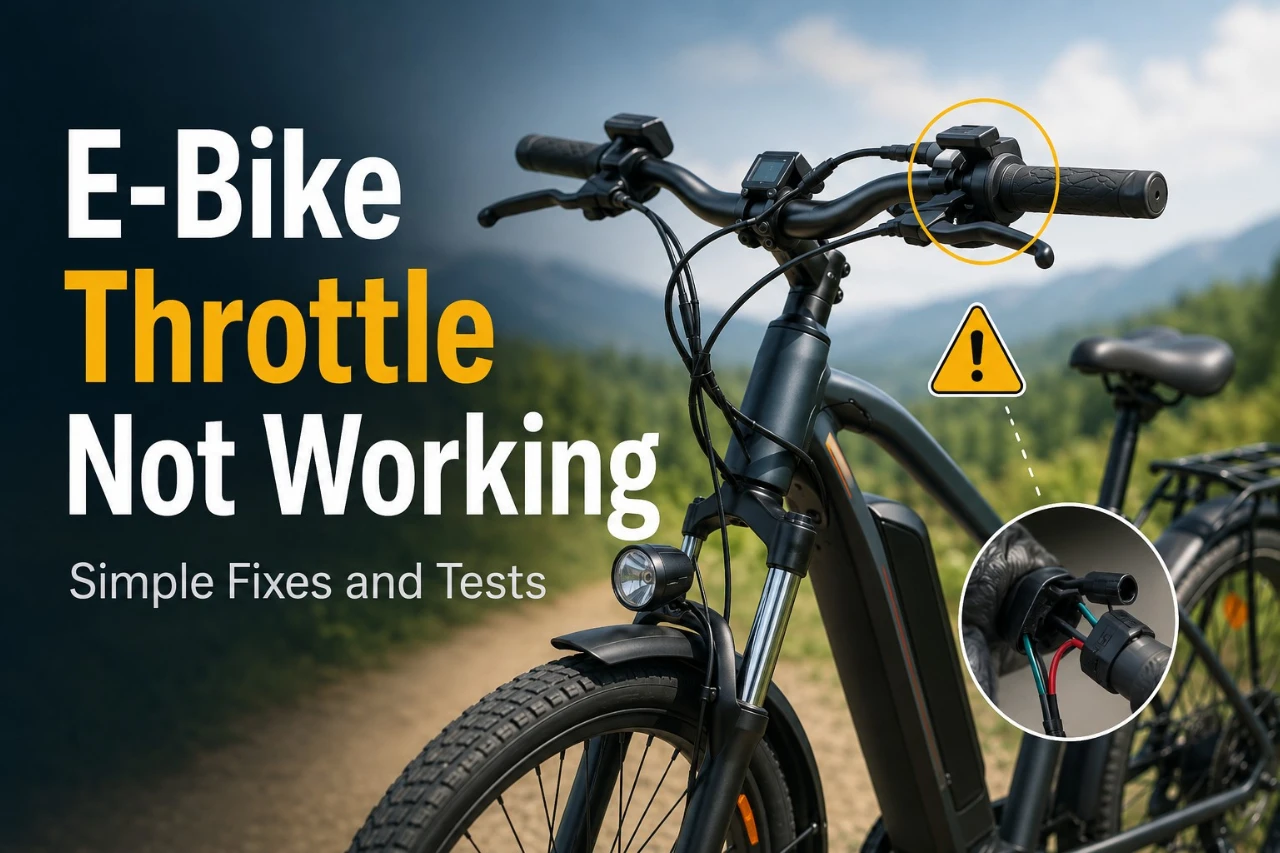
Your electric bike throttle stops responding and suddenly your commute, trail ride, or errand run grinds to a halt. It’s a frustrating problem, but in most cases the fix is simpler than it looks. The cause usually comes down to one of a handful of issues: a low battery, a stuck brake sensor, a loose connector, or a setting that got changed somewhere in the display menu.
Most e-bike throttle problems can be diagnosed at home with basic tools before you spend a dollar on parts. This guide walks you through each likely cause in order, starting with the safest and simplest checks first.
You will work through battery and power checks, brake cutoff sensors, wiring and connector inspection, basic electrical testing, and controller or display settings. Each section ties directly to a real symptom so you can skip ahead if you already know what yours looks like.
Before you touch any wiring or connectors, there are a few things worth knowing about how your e-bike’s electrical system is designed and where the real risks sit. The brake cut-off sensor, the speed limiter, and the battery system each have safety functions built in for good reason.
Do not bypass or disable brake cut-off sensors. They exist to prevent accidental motor engagement while braking, and removing them creates a genuine safety hazard.
Do not open your battery pack. Internal cells operate at voltages that can cause serious injury if shorted or mishandled. Battery inspection is limited to the outside: terminals, connections, and the charge port.
Do not short wires together to test outputs, and do not attempt to modify speed limiter settings in the controller firmware. These actions can damage your controller, void your warranty, and in some cases create fire or shock risks.
Stop troubleshooting and contact your manufacturer, a local e-bike shop, or a qualified technician if any of the following apply:
A good local shop can usually diagnose throttle and controller problems faster than extended home troubleshooting.
You do not need specialized equipment for most of these checks. The list below covers everything used in this guide.
| Tool | Purpose |
|---|---|
| Digital multimeter | Voltage testing at throttle and battery |
| Small Phillips and flathead screwdrivers | Accessing throttle housing and connectors |
| Electrical contact cleaner spray | Cleaning corroded or dirty connector pins |
| Dielectric grease | Protecting connectors after cleaning |
| Zip ties | Securing cables after inspection |
| Pen and paper or phone camera | Documenting connector positions before removal |
A multimeter is the one tool worth buying if you do not already own one. Affordable options work fine for the basic voltage checks in this guide.
Not every throttle failure looks the same. Matching your symptom to a likely cause saves time and keeps you from chasing the wrong problem. The most common patterns break down into three situations: throttle failure with pedal assist still working, intermittent throttle response tied to vibration, and throttle that stopped working after a specific event.
This is one of the clearest symptom patterns for diagnosing an electric bike throttle problem. When pedal assist runs normally but the throttle does not respond at all, the motor and controller are both functional.
Likely causes in this pattern:
Start with display settings and brake sensors before assuming the throttle itself has failed.
An intermittent throttle that drops out on rough roads or vibration almost always points to a connection problem rather than a fully failed component.
A connection that looks seated can still have a bent pin or corroded contact inside. Wiggling the connector while the bike is powered on (display only, motor not running) can reveal whether the fault is positional.
Each of these events points to a different area:
| Event | Most Likely Cause |
|---|---|
| After rain or washing | Water in throttle body or connector |
| After charging | Battery reseated incorrectly, display reset |
| After transport or storage | Connector partially unplugged, pinched cable |
| After a fall or crash | Bent connector pins, damaged throttle housing, shifted wiring |
A fall or crash deserves a careful visual inspection of every connector and cable run before powering the bike back on.
Low battery voltage and loose battery connections are the most common cause of throttle problems across all e-bike types. Many controllers automatically cut throttle output when voltage drops below a safe threshold, even if the display still appears to be on. Start here before moving to any wiring or sensor checks.
A battery that reads 80 percent on the display can still cause throttle cutouts if voltage sags under load. This happens most often with older batteries or after hard use in cold weather.
Charge the battery fully before any other testing. If the throttle works after a full charge but cuts out again after partial use, the battery may have a weak cell and is worth testing or replacing separately.
Low battery voltage under load is also why the throttle sometimes cuts out on hills but works fine on flat ground. The motor draws more current climbing, which pulls voltage down faster.
A battery that is not fully seated can interrupt power to the controller intermittently, which the rider often misreads as a throttle problem.
Steps to check:
Also check the main power cable from the battery to the controller. A loose or corroded main connection can cause the same symptom as a dead throttle.
Some displays store settings that can disable the throttle without any obvious sign. After a firmware update, a hard reset, or a dead battery, throttle-enable settings sometimes revert to off.
If your display shows an error code, search that exact code along with your bike model before proceeding. Error codes often point directly to the faulty system.
Brake sensors are designed to cut motor power the moment you squeeze a brake lever. This is a core safety feature on nearly every modern e-bike. The problem is that a stuck lever, a misaligned sensor, or a faulty brake cutoff sensor can make the controller think you are always braking, which completely blocks throttle output.
The brake cut-off sensor sends a signal to the controller that says the brake is engaged. When that signal is active, the controller will not allow the motor to run regardless of what the throttle is doing.
If the signal is stuck in the “brake engaged” position due to a sensor fault, a stuck lever, or a wiring issue, your throttle response will be zero even though nothing appears wrong with the throttle itself.
Look and feel for these signs before doing any electrical testing:
On mechanical disc setups, the sensor is usually a small magnetic switch near the lever. On hydraulic setups, it may be integrated into the lever body. Both can stick or fail.
To test whether a brake cutoff sensor is blocking your throttle:
Do not ride with brake sensors disconnected. This test is for diagnosis only. Reconnect or replace the sensor before riding.
After ruling out battery and brake sensor issues, a physical inspection of the throttle and its wiring is the next logical step. Both thumb throttles and twist throttles share the same signal path, but they fail in slightly different ways based on their construction and where they sit on the handlebars.
A thumb throttle uses a lever you press with your thumb. The most common failure points are the pivot pin inside the housing and the point where the cable exits the throttle body. Dirt and moisture can jam the lever or corrode the internal contacts.
A twist throttle rotates around the handlebar grip. It tends to fail at the grip-end seal where water enters, or at the connector if the housing cracks. Twist throttles on folding bikes also see more stress because the handlebar folds repeatedly over the cable exit point.
Both types use a hall effect sensor inside, which you can test with a multimeter if physical inspection does not reveal the fault.
The throttle connector is usually a 3-pin or 4-pin JST-style plug located near the handlebar or running into the cable bundle at the stem. This is one of the first things to inspect.
Steps:
If pins are visibly bent, use a fine tool to realign them gently. A connector with bent pins often appears fully plugged while making no electrical contact at all.
On folding e-bikes, cables that pass through or near the fold joint are exposed to repeated stress every time you fold or unfold the bike. Over time, the insulation cracks and eventually the wire inside breaks.
Run your fingers slowly along the full length of the throttle cable and look for:
After a crash, also inspect the throttle housing itself for cracks. A cracked housing can shift the internal sensor out of alignment even if the cable looks fine.
If the physical inspection did not reveal the problem, a basic voltage test with a multimeter can confirm whether the throttle is generating a signal or not. This test does not require electrical experience, just a multimeter set to DC voltage and careful attention to where the probes are placed.
Most e-bike throttles use a hall effect sensor inside the housing. The sensor receives 5 volts of power from the controller, uses a ground connection, and outputs a variable signal voltage that changes as you press or twist the throttle.
The three wires in a typical throttle connector carry:
When the throttle is at rest, the signal wire reads roughly 0.8 to 1.0 volts. At full throttle, it should read approximately 3.6 to 4.2 volts.
To test the throttle signal:
If you are unsure which wire is which, check your bike’s wiring diagram or take a photo of the connector color arrangement before probing.
| Reading | What It Indicates |
|---|---|
| Voltage rises smoothly from ~1V to ~4V | Throttle is functioning normally |
| Voltage stays fixed at one level throughout | Internal sensor stuck or failed |
| No voltage change at all | Throttle sensor dead or no power reaching it |
| No voltage on power wire | Controller not supplying power; check controller |
| Signal voltage present but motor still unresponsive | Fault is likely in the controller, not the throttle |
If the throttle produces a clean rising signal but the motor does not respond, the problem is downstream of the throttle, pointing toward the controller or display settings.
Once you have confirmed the throttle is producing a good signal, attention shifts to the controller and display. These two components manage whether throttle input is accepted and how it gets translated into motor output. A setting change, a controller fault, or a mismatched replacement part can all block throttle response without any visible damage.
Controller failure is less common than throttle or wiring problems, but it does happen. Signs that the controller may be the source of the problem include:
If you suspect controller failure, contact your manufacturer or a shop before replacing it. Controllers must match your motor’s voltage, current rating, and connector type exactly.
Many e-bikes sold in the United States ship with specific Class 2 settings that allow throttle use up to 20 mph. Some bikes allow the owner to switch between Class 2 and Class 3 modes through the display menu, and switching modes can disable the throttle entirely.
Check your display settings for:
If a setting was changed recently, restoring it to the default profile is worth trying before further testing.
If you have already replaced the throttle and it still does not work, compatibility is the most likely issue. Throttles are not universal.
A replacement throttle must match:
Before ordering a replacement, note your controller’s brand and model and confirm the replacement is listed as compatible. Check current price on compatible throttle options and verify connector pin diagrams before you buy.
Working through a checklist in the right order prevents replacing a part that is still functioning and helps you walk into any shop visit or manufacturer support call with useful information already in hand. Most faulty throttle situations can be narrowed down before spending anything.
Go through these steps before ordering any components:
If you complete all nine steps and the throttle still does not respond, replacement or professional service is the next reasonable step.
Replacement is a reasonable next step when:
If pedal assist is still working and the throttle test showed zero output, a replacement throttle is very likely to fix the problem. If the test showed a clean signal but the motor did not respond, the controller is the more likely cause.
When buying a replacement throttle, a brake sensor, or a controller kit, focus on compatibility over price. A low-cost part that does not match your controller’s voltage or connector spec will not fix the problem.
Useful replacement categories to look for:
Check current prices on compatible throttle and brake sensor options before buying. Confirm connector pin count and wire color diagrams match your existing setup. View on Amazon for a range of compatible e-bike throttles and sensors that cover most common connector types.
Why does the bike power on but not move when I use the throttle?
The most common causes are a discharged or poorly seated battery, a brake cut-off sensor holding the motor in a locked-out state, or a throttle disabled in the display settings.
Work through battery and sensor checks first before suspecting the throttle itself or the controller.
Why does pedal assist work but the throttle does nothing?
When pedal assist runs normally, the motor and controller are both functional.
The throttle is most likely disabled in the display menu, the throttle connector is loose or corroded, or the throttle unit has failed while the rest of the system remains intact.
Check settings first, then inspect the connector.
What are the most common wiring or connector issues that stop a throttle from working?
Bent or corroded pins inside the throttle connector are the most frequent wiring fault. On folding e-bikes, cable insulation cracked at the fold joint is a close second.
A connector that looks seated can still have a pin that makes no contact, so unplugging, inspecting, and reseating is always worth doing before electrical testing.
How can I test a throttle with a multimeter to confirm it has failed?
Set your multimeter to DC voltage on the 20V range. Back-probe the signal wire at the throttle connector with your black probe on ground and red probe on the signal wire.
At rest, you should read roughly 0.8 to 1.0 volts. At full throttle, the reading should climb smoothly to around 3.6 to 4.2 volts. A reading that does not change confirms a faulty throttle sensor.
When should I replace the throttle versus repairing the wiring or controller?
Replace the throttle when the multimeter test shows no voltage change, when the housing is visibly broken, or when cleaned and reseated connectors do not restore function.
Repair wiring when damage is visible and localized to a single section. Consider the controller only after the throttle voltage test shows a clean signal but the motor still does not respond.
How do I safely disassemble and inspect a thumb throttle for damage or corrosion?
Power off the bike and disconnect the throttle connector before opening anything.
Most thumb throttle housings are held by two small Phillips screws on the underside.
Open the housing slowly and photograph the interior before touching anything.
Look for corroded contacts, a stuck pivot, or debris around the hall sensor.
Clean with contact cleaner, dry fully, and reassemble before reconnecting and testing.