Real rides. Real notes. No hype.

Decision-first ANDSKY Apex 50 review: AWD traction helps loose climbs and stability, but 98-lb weight and punchy assist reduce daily convenience.
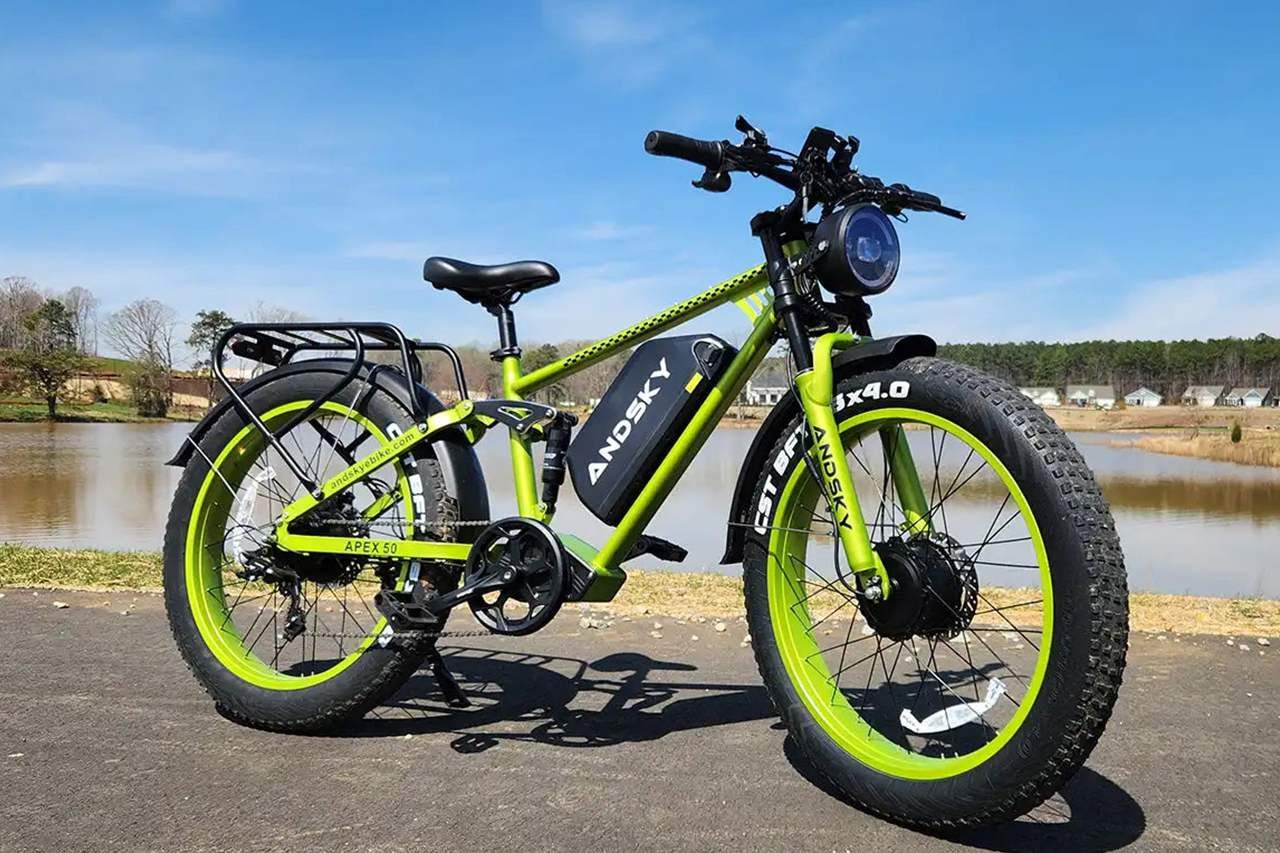
The ANDSKY Apex 50 is a dual-motor, fat-tire, full-suspension e-bike built around one idea: make loose terrain and steep climbs feel easy. It’s marketed like an “e-MTB,” but in real use it rides more like a high-powered off-road cruiser / hunting-capable utility rig—stable, grippy, and confidence-boosting, with a couple of big ownership trade-offs you should be honest with yourself about (mainly weight and how “non-bicycle-like” the assist can feel if you don’t tune your habits around it).
List price is shown as $1,399 (pricing can vary). My perspective below is from riding it like an actual owner would: mixed pavement, broken pavement, gravel/service roads, and at least one steep/loose climb to see what the AWD traction actually changes.
One-sentence verdict: A great choice for riders who want AWD traction and high-speed stability on rough terrain, but not ideal for anyone who needs a light, nimble bike for stairs, tight storage, or relaxed “natural-feeling” pedaling.
Best for
Not ideal for
Biggest strength: AWD traction + planted stability makes steep/loose terrain noticeably less stressful.
Biggest trade-off: The weight and power delivery make it feel more like a small off-road machine than a simple bicycle.
In plain terms, the Apex 50 is trying to do what many single-motor fat bikes struggle with: keep traction and forward drive when the surface gets sketchy. With a motor in both wheels, the front tire isn’t just along for the ride—it contributes to climbing and stability, especially when the rear starts to unload or spin.
The design choices that shape ownership:
(Specs vary by configuration; I’m listing what’s presented for this model and what matters for buying decisions.)
| Item | What you’re buying |
|---|---|
| Motors | Dual-motor AWD hub drive; marketed up to ~3000W peak total |
| Torque | Marketed as ~95 Nm x2 (total ~190 Nm) |
| Battery | Options shown: 52V 25Ah (~1300Wh) or 48V 25Ah |
| Claimed range | 60–100 miles (best-case conditions) |
| Top speed | Marketed up to 35+ mph (depends on settings/conditions) |
| Tires | 26 x 4.0 fat tires |
| Brakes | Hydraulic disc brakes (rotors shown as 180mm) |
| Drivetrain | 7-speed derailleur |
| Sensor | Cadence sensor (pedal assist feel depends on tuning) |
| Weight / payload | ~98 lb bike weight; payload listed up to 350 lb |
| Notable features | Big headlight (listed 1000 lumen), display, accessories bundle |
If your riding reality includes loose climbs, uneven service roads, beachy patches, snowy sections, or hunting-style terrain, the Apex 50’s AWD setup is the headline feature that actually changes outcomes. I found it most satisfying when I rode it like a stability-first machine: seated, steady throttle or higher PAS, and letting the bike’s mass and traction do the work.
It also makes sense for riders who:
Skip (or think very carefully) if:
If you’re in that “skip” group, a lighter single-motor commuter or a mid-drive trail-oriented eMTB will usually feel more precise and less tiring to manage—even if it’s less “wow” on loose climbs.
In dual-motor mode, it doesn’t feel like a gentle assist—it feels like a steady shove from underneath me. The sensation is more “traction + momentum” than “light and zippy.” When I rolled on throttle or bumped PAS higher, the bike responded immediately, and the front end stayed more composed than I expected because it’s helping pull instead of just following.
On pavement, that power can be overkill unless I’m deliberately riding fast. On broken pavement and gravel, it makes more sense—less time bogging down, more time cruising.
This is the section that matters most, because it’s the main reason to buy an AWD e-bike.
On steep or loose climbs, a rear-hub fat bike often does one of two things:
On the Apex 50, the front wheel helping to pull made it easier to keep momentum. I still had to ride smart—line choice and throttle control matter—but the “rear tire spin then stall” problem showed up less. It felt especially helpful on climbs where the surface alternated between hardpack and loose patches.
My comfortable cruise zone was 18–24 mph (PAS 2–3). It felt calm and planted there. When I pushed harder, PAS 4 felt like ~25 mph was the practical ceiling for me in normal riding. The bike is marketed up to 35+ mph, and I believe it can be configured and ridden faster, but that’s also where my “this is no longer casual bicycle behavior” alarm starts ringing.
The stability is good, but the trade-off is agility: tight turns need planning. It’s not twitchy—it’s the opposite. That’s great off-road and on broken pavement, but it’s not a bike I’d choose for weaving through tight urban obstacles.
I treat the claimed 60–100 miles as best-case: low PAS, lower speeds, minimal stops, friendly terrain, and conservative use of dual-motor/throttle.
In my style of mixed riding—cruising PAS 2–3 with occasional higher-power bursts—I’d expect a solid half-day of riding before range anxiety starts. The biggest range killers on a bike like this are:
A practical way to think about it: if I rode it like a stable 20–24 mph cruiser, I’d expect multiple rides per charge. If I rode it like a 28–35 mph machine, I’d expect the battery to disappear much faster.
Comfort is one of the Apex 50’s strongest everyday wins. Fat tires plus full suspension noticeably reduced hand and upper-body fatigue on rough surfaces. That matters more than it sounds—if you’re riding broken pavement, gravel, or service roads regularly, reduced vibration is the difference between “fun ride” and “my wrists hate me.”
The stock saddle is wide and soft, which I liked for casual cruising. On longer rides, I personally prefer a firmer saddle because very soft saddles can create pressure points over time.
At speed, it feels composed. At low speed, the weight shows up. In tight U-turns or slow technical maneuvering, I had to be deliberate—no lazy steering inputs. Once rolling, the bike settles down and feels more cooperative.
The hydraulic brakes were a highlight for me. Two-finger braking with predictable modulation is exactly what I want on a bike that can move this fast and weighs this much. The value of strong brakes increases nonlinearly with speed and mass—so this is not a “nice to have,” it’s a core safety feature.
One practical note: because this bike encourages higher speeds, I’d take brake setup seriously—caliper alignment, rotor trueness, pad bed-in—and I’d re-check it after the first few rides.
I liked that the bike can be ridden in a “calm” mode or a “let’s move” mode depending on PAS and throttle use—but I also think some riders will need a learning curve. If you jump straight into higher PAS expecting gentle assistance, it may feel more aggressive than you want.
Also, because some riders report speed readouts can be optimistic depending on settings, I’d treat the display as a helpful gauge, not a lab instrument—especially if you’re trying to stay within legal limits.
The listed height range is roughly 5’7″ to 6’5″ with a 350 lb max load. At 5’10”, I felt like I was in the “sweet spot” for cockpit fit—no extreme seatpost extension and no cramped reach.
Notes for shorter riders (around 5’7″ and below):
Notes for taller/heavier riders:
My build was straightforward: it arrived mostly assembled, and I mainly did the front wheel, handlebar, pedals, and accessories. I’d call it 30–60 minutes depending on your comfort level.
With heavier, higher-speed e-bikes, early bolt checks aren’t optional. After the first few rides, I re-checked:
This is where I want to be candid: with many newer direct-to-consumer e-bikes, support experience can vary, and parts sometimes take patience. The good news is that several wear items are common:
Where you may need more patience is anything specific to the electronics (display/controller/motor wiring). My advice: keep photos of connectors and cable routing, and don’t be shy about doing preventative checks.
(I’m not making warranty promises here because I’m only stating what I can verify from the product info provided.)
The bundle is generous for a first-time owner: bike, charger, tool kit, manual, and accessories such as a lock, frame bag, rear rack bag, bottle holder, pump, and mirrors (exact contents can vary by listing/config).
It’s nice because it gets you riding with fewer extra purchases—but I still consider pedals and a good helmet non-negotiable upgrades for a bike that can run fast.
Where the Apex 50 wins:
Where it loses:
If your biggest problem is traction and climbing confidence, the Apex 50’s AWD can be worth the complexity. If your biggest problem is daily convenience, a single-motor bike usually wins.
Is it actually good for steep hills?
In my riding, yes—the AWD traction is the point, and it helped on steep/loose climbs by maintaining momentum where rear-hub bikes often spin.
How fast does it feel in real riding?
I rode it mostly 18–24 mph in PAS 2–3. Around 25 mph felt like the practical cruising ceiling for me in PAS 4. The bike is marketed faster, but that’s also where safety and legality questions get serious.
Is it comfortable for longer rides?
Yes, for rough terrain. Fat tires + full suspension reduce fatigue. For longer seated rides, I’d personally consider a firmer saddle.
Can shorter riders fit it?
The listed range starts around 5’7″, but fit isn’t the only issue—managing the weight at stops matters. Shorter riders should practice low-speed control and be realistic about storage/handling.
Is it okay for commuting?
It can commute, but it’s not the most convenient commuter due to weight and size. It makes more sense if your commute includes rough roads, hills, or you want comfort and stability over efficiency.
What maintenance should I expect early on?
Plan for: bolt checks after a few rides, brake alignment/pad bed-in, and basic drivetrain tuning. On high-power e-bikes, early preventative checks are part of safe ownership.
Are the range claims realistic?
Think of the 60–100 miles as best-case. If you ride fast, climb a lot, or use throttle often, expect less. Moderate-speed cruising stretches range the most.
What’s the first upgrade you’d do?
I’d start with better pedals (for grip and to reduce pedal-strike drama), then consider saddle preference and possibly tires/tire setup based on your terrain.
The ANDSKY Apex 50 makes the strongest case for itself when you judge it on the one thing most e-bikes can’t fake: traction under load on bad surfaces. If you regularly ride loose climbs, rough service roads, sand/snow patches, or off-road terrain where you want the bike to stay composed and keep moving, the AWD setup is a real advantage—not just marketing.
But you pay for that advantage every time you move it around your home. The bike’s ~98 lb weight and powerful assist behavior mean it’s best for riders who are comfortable treating it like a serious machine: planned storage, bolt checks, and disciplined speed choices.
Buy if…
Skip if…
If my riding included regular loose climbs or rough terrain—and I had ground-level storage—yes, I’d consider spending my own money on it, because the traction + comfort combo solves real problems and makes hard surfaces feel easy.
If I lived with stairs, had limited storage, or wanted a nimble “ride-it-like-a-bike” feel, I’d keep my money for a lighter, simpler single-motor setup and accept that I’ll need better technique on loose climbs.
| Preview | Product | Price | |
|---|---|---|---|

|
ANDSKY Apex50 Electric Bike for Adults Men, 52V 25AH/48V 25AH Removable Battery,3000W AWD Dual… | $1,399 $1,139 | View on Amazon |